How to Generate a Profit and Loss Report for Your Retail Shop in Nigeria (2026 Complete Guide)
SwiftPOS Team
Published May 17, 2026
Every week, thousands of retail shop owners across Nigeria stay open for long hours, move hundreds of products, and keep their staff busy — only to look at their bank account at the end of the month and wonder: where did all the money go?
If that sounds familiar, the real problem is not your sales volume. It is that you do not have a clear, accurate profit and loss report showing exactly what came in, what went out, and what you actually kept. Learning how to generate a profit and loss report for your retail shop in Nigeria is one of the most important financial habits any business owner can build — and in 2026, it no longer requires an accountant or a spreadsheet.
In this guide, we will walk you through everything: what a P&L report is, why it matters specifically for Nigerian retailers, how to build one step by step, and how tools like SwiftPOS make the whole process automatic so you spend less time calculating and more time growing.
What Is a Profit and Loss Report — and Why Should Every Nigerian Shop Owner Care?
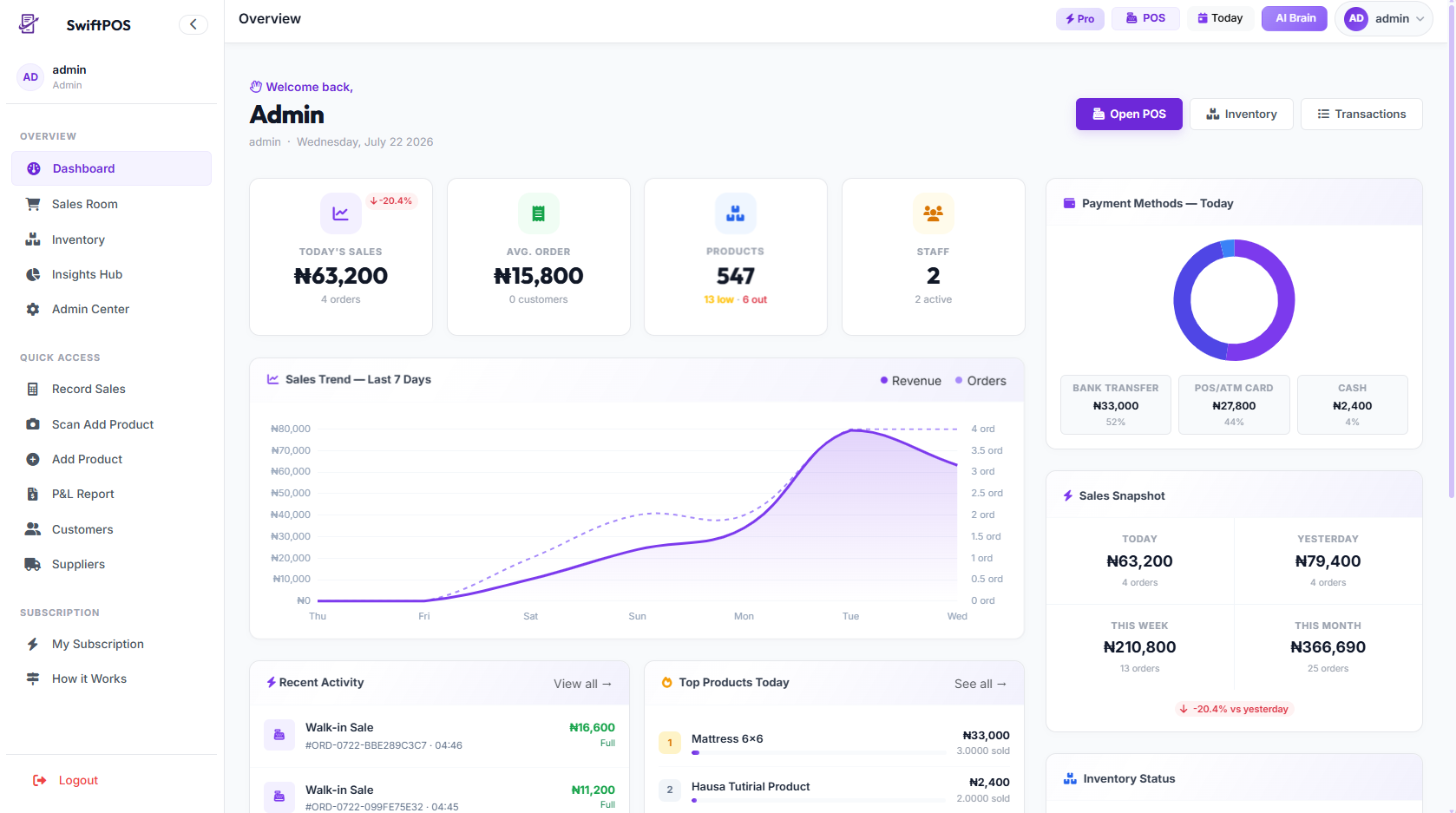
A profit and loss report — also called a P&L report or income statement — is a financial document that summarises your total revenue, total costs, and net profit or loss over a specific period. It answers three core questions:
- How much did I earn? (Total sales revenue)
- How much did I spend? (Cost of goods sold + operating expenses)
- How much did I actually keep? (Net profit or loss)
Most shop owners in Nigeria track sales loosely — writing in a notebook, saving WhatsApp receipts, or remembering transactions in their head. But none of that gives you a P&L. Without a proper report, you have no way of knowing whether your business is genuinely profitable, growing, or slowly bleeding money.
The stakes are high. According to the Small and Medium Enterprises Development Agency of Nigeria (SMEDAN), a significant percentage of Nigerian small businesses fail within the first three years — and poor financial tracking is consistently cited among the leading causes. A P&L report is your financial mirror. Without it, you are running blind.
The Difference Between Cash Flow and Profit
Many shop owners confuse cash flow with profit. You can have cash coming in daily and still be running at a loss — especially when you factor in the cost of restocking, staff salaries, generator fuel, rent, and customer credit that has not been repaid. Your P&L report separates these clearly so you can see the truth about your business finances.
Why Generating a P&L Report Is So Hard for Nigerian Retailers (And Why It Should Not Be)
Before we get into the how, it is worth naming the real obstacles that Nigerian shop owners face when trying to produce a profit and loss report. Understanding these barriers is the first step to overcoming them.
1. Manual Record-Keeping Creates Gaps and Errors
When sales are recorded in a notebook and expenses paid in cash with no receipts, it becomes nearly impossible to reconstruct an accurate P&L at month end. Numbers get forgotten, returns go unrecorded, and staff discounts disappear from memory. The data simply is not there.
2. No Separation Between Business and Personal Money
This is one of the most common problems in Nigerian retail. When a business owner uses the shop's cash to buy fuel, settle personal bills, or lend money to family, those transactions do not appear in any financial report — but they absolutely affect profitability.
3. Untracked Cost of Goods Sold (COGS)
Many retailers know what they sell, but few accurately track the true purchase cost of every product they stock. Without accurate COGS data, your gross profit calculation will always be wrong.
4. Multiple Revenue Streams With No Consolidation
If you operate a supermarket with a counter section, a drinks section, and a cosmetics section — each managed by different staff — consolidating all of that into a single P&L can feel overwhelming without the right system in place.
The good news is that all of these challenges are solvable — not with more effort, but with better tools. More on that below.
How to Generate a Profit and Loss Report for Your Retail Shop: Step-by-Step
Whether you are doing this manually for the first time or setting up a system that runs automatically, here is the correct structure for building a P&L report for a Nigerian retail shop.
Step 1: Define Your Reporting Period
Decide whether your P&L will cover a day, a week, a month, or a quarter. For most retail shops in Nigeria, a monthly P&L is the standard. It gives you enough data to spot trends without being too long-term to act on.
Step 2: Calculate Your Total Revenue
Add up all money received from sales during the period. If you sold 3,000 items across the month and your total receipts came to ₦4,800,000 — that is your gross revenue. Include all payment types: cash, POS transfers, and credit sales that have been paid.
Important: Do not include unpaid customer credit in your revenue yet. It has not been received and should not inflate your profit figures.
Step 3: Calculate Your Cost of Goods Sold (COGS)
COGS is the total cost of all the products you sold during the period. If you bought a carton of drinks for ₦9,000 and sold it for ₦12,500, your COGS is ₦9,000 and your gross profit on that carton is ₦3,500.
To calculate this at scale, you need to know the purchase cost of every product — which is why proper inventory management is essential. If your system tracks buying prices and selling prices, this step becomes automatic.
Step 4: Calculate Gross Profit
Gross Profit = Total Revenue − Cost of Goods Sold
Using our earlier example: ₦4,800,000 (revenue) − ₦3,200,000 (COGS) = ₦1,600,000 gross profit. This is how much you made before operating expenses.
Step 5: List All Operating Expenses
This is where many shop owners underestimate their real costs. Operating expenses include:
- Staff salaries
- Shop rent
- Generator fuel and electricity bills
- Internet subscription
- Bank charges and POS terminal fees
- Packaging materials
- Cleaning supplies
- Transport and logistics
- Repairs and maintenance
- Any business loan repayments
Total these up honestly. If your operating expenses for the month come to ₦850,000, record that figure.
Step 6: Calculate Net Profit or Loss
Net Profit = Gross Profit − Total Operating Expenses
In our example: ₦1,600,000 − ₦850,000 = ₦750,000 net profit. That is what you actually kept after covering all costs. If this number is negative, your business made a loss — which is important information that tells you where to intervene.
Step 7: Review and Act on the Report
A P&L report is only useful if you read it and respond to what it tells you. Is your gross profit margin healthy? Industry benchmarks for Nigerian supermarkets typically sit between 15% and 35%. Are operating expenses eating up too much of your revenue? Is there a category of products consistently underperforming? These are the questions your P&L helps you answer.
How SwiftPOS Generates Your P&L Report Automatically
Doing all of the above manually every month is time-consuming and error-prone. This is where SwiftPOS changes everything for Nigerian retail business owners.
SwiftPOS is a cloud-based POS and retail management system that tracks every sale, records every product's cost price, monitors stock movements, and automatically builds your profit and loss report in real time — without you lifting a calculator.
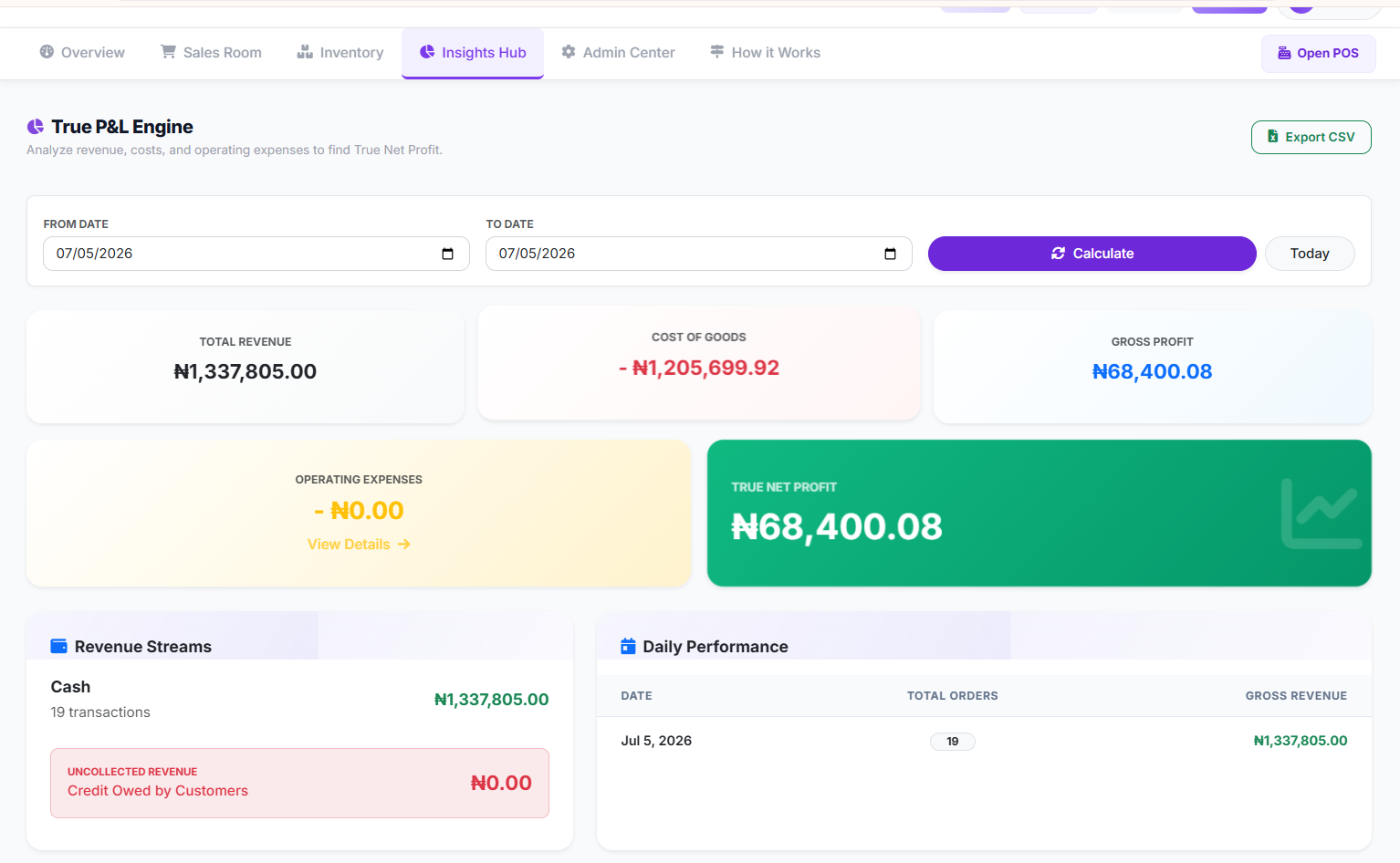
Here is what the SwiftPOS P&L report gives you at a glance:
- Total revenue across any time period you choose
- Cost of goods sold calculated automatically from product purchase prices
- Gross profit and gross margin percentage
- Operating expenses tracked per category
- Net profit or net loss with clear visual breakdown
- Period-over-period comparison so you can track growth month by month
Every time a sale is made on SwiftPOS, the system captures both the selling price and the cost price of the item. By the end of the day — or the month — your P&L is already built. You do not need to gather receipts, open Excel, or wait for an accountant.
Real-Time Dashboard for Daily Monitoring
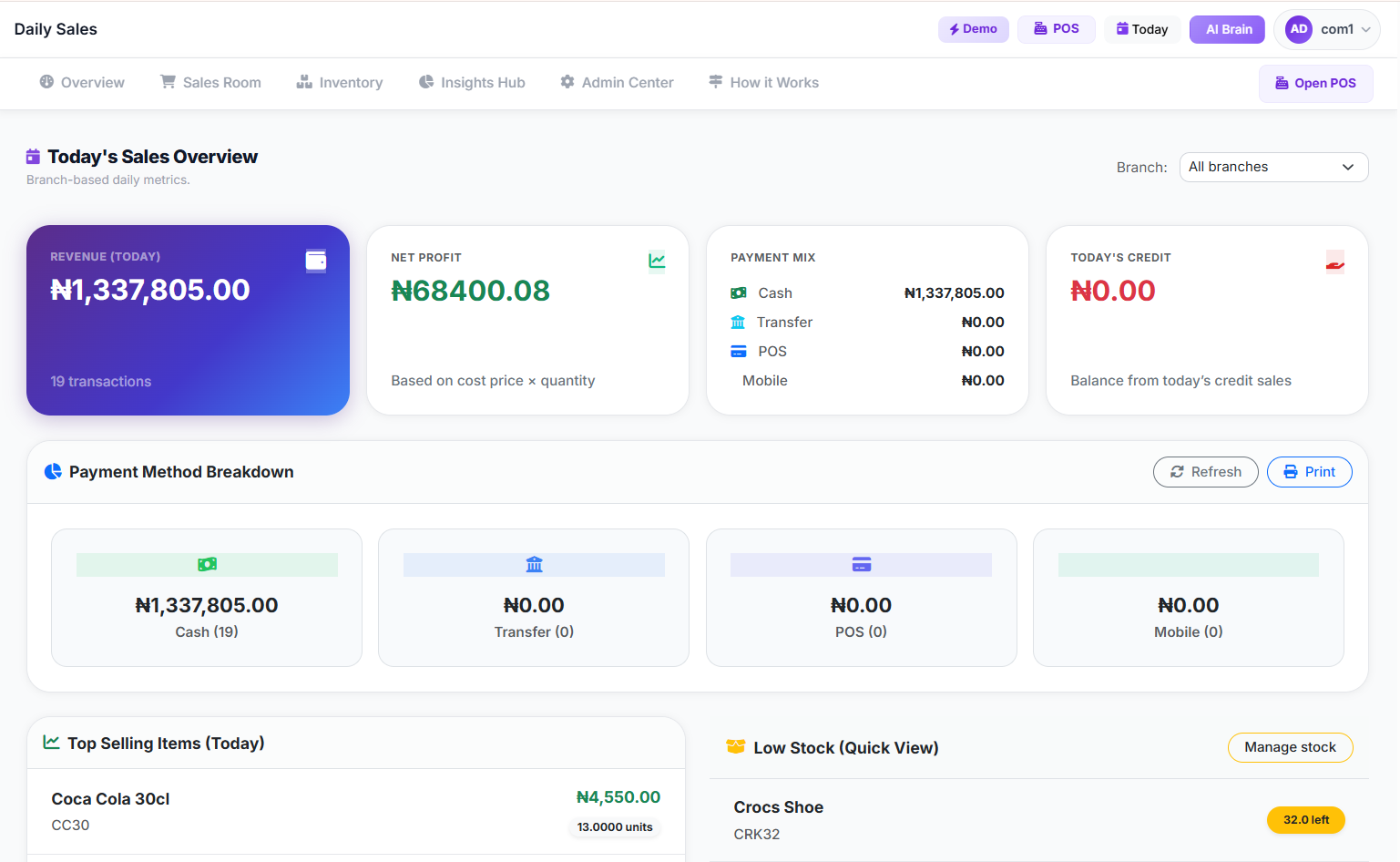
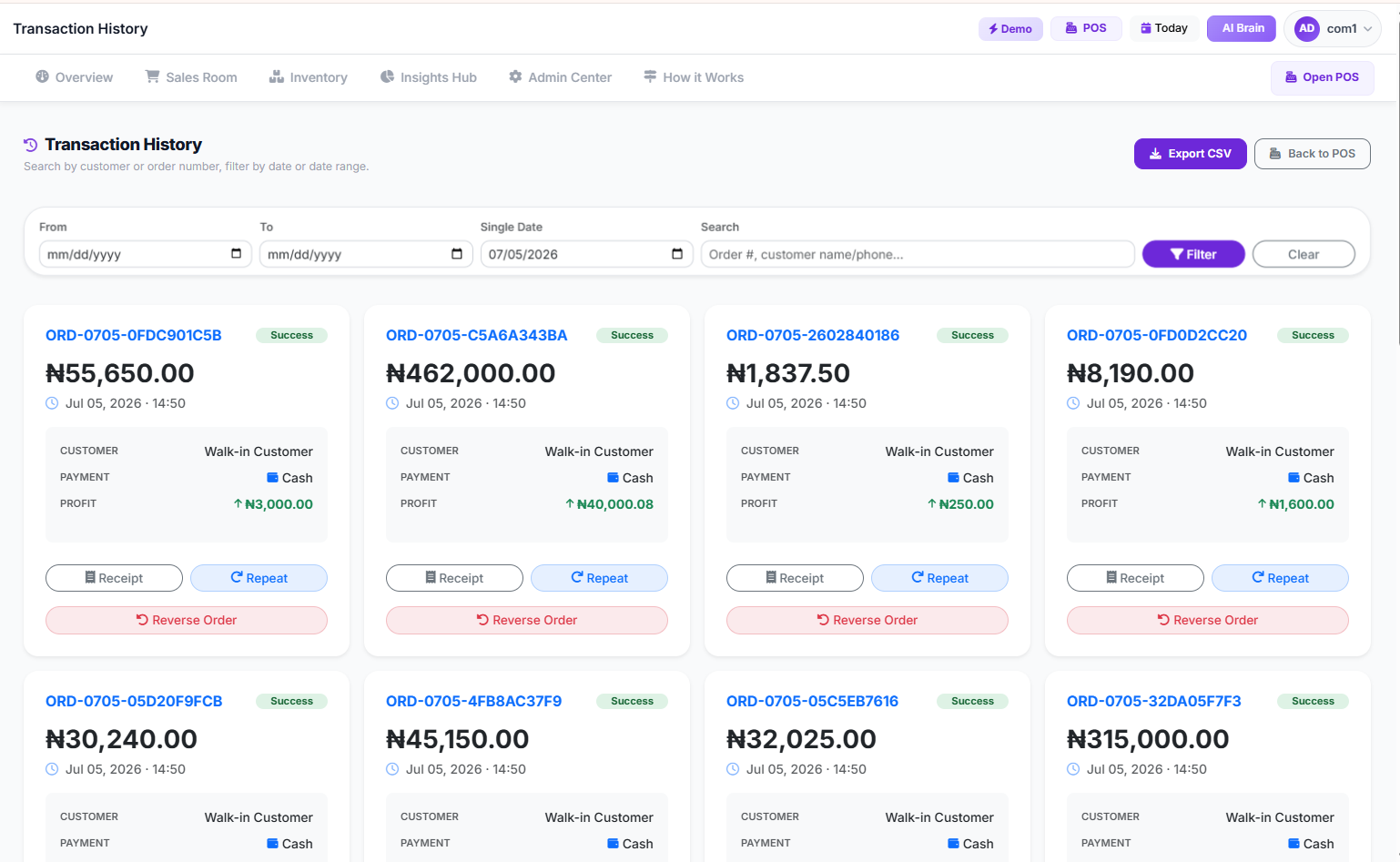
SwiftPOS also gives you a live Today Dashboard so you can see your daily sales performance, revenue targets, and profitability at any moment — not just at month end. This means problems get caught early, not after 30 days of damage have already been done.
Export and Share Reports Instantly
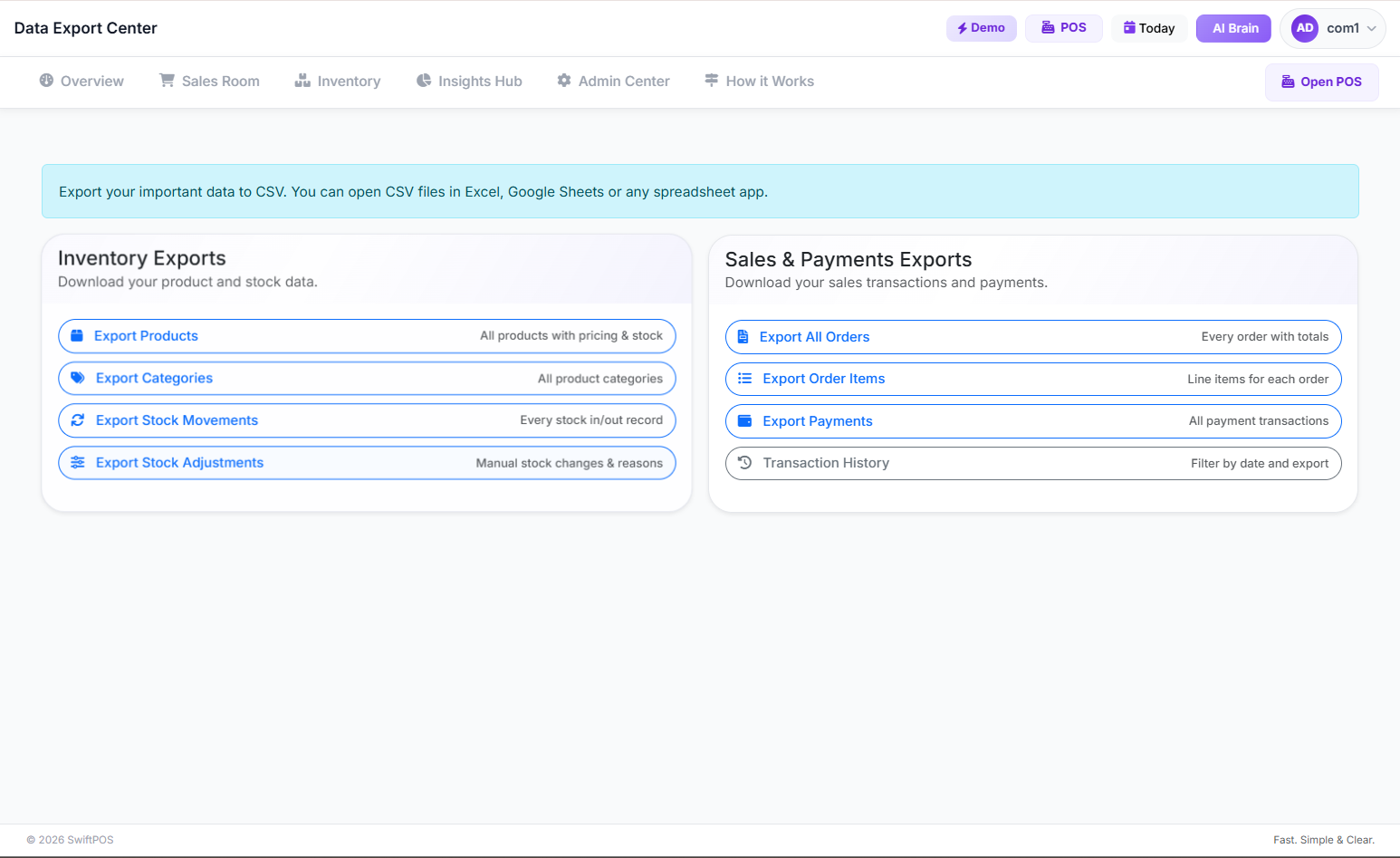
Whether you need to share your P&L with a business partner, a bank for loan purposes, or an accountant, SwiftPOS lets you export your reports instantly in clean, professional formats. No manual formatting required.
If you run multiple shop branches, the Pro Plan on SwiftPOS supports multi-branch reporting — so you can view your P&L per location or as a consolidated report across all branches. For business owners managing more than one shop, this alone is worth the subscription.
Advanced Insights: What Your P&L Report Can Reveal Beyond Profit
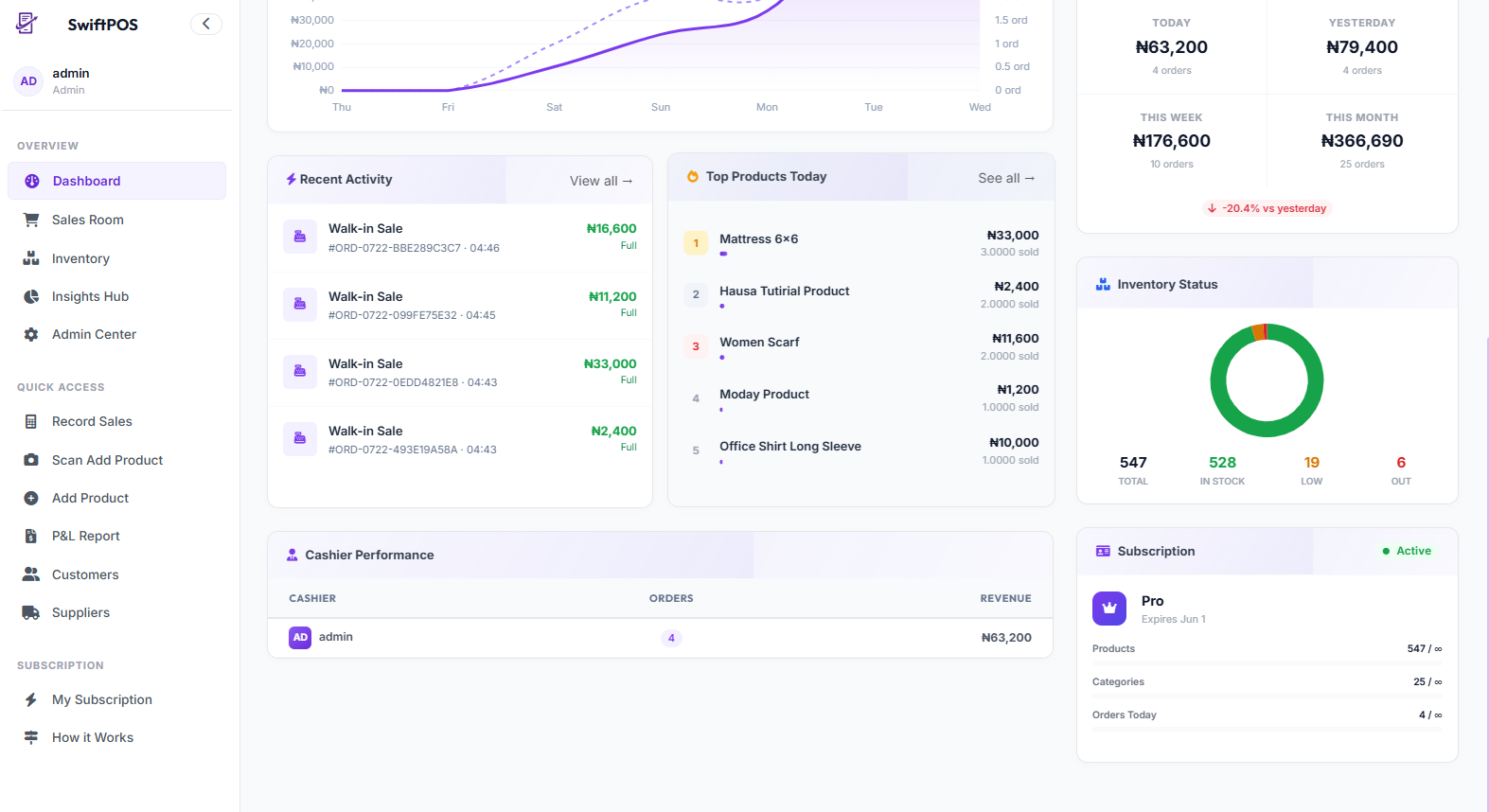
Once you start generating consistent P&L reports — whether manually or through SwiftPOS — you gain access to business intelligence that most Nigerian shop owners never have. Here is what you can begin to uncover:
Which Product Categories Are Actually Profitable
Your overall profit figure may be positive, but some categories might be dragging you down. A detailed P&L breakdown by product category shows you whether your beverages section makes more money than your household products, for example — and which areas deserve more investment or less shelf space.
Seasonal Patterns in Your Revenue
Comparing P&L reports across months reveals your seasonal peaks and slow periods. If your revenue dips every August and spikes in December, you can plan your stock purchases and staffing accordingly — instead of being caught off guard.
Whether Staff Costs Are Proportionate
If your payroll takes up more than 20–25% of your gross profit, that is worth examining. Your P&L makes this visible. You can then look at staff performance data to determine whether your team size and compensation are aligned with revenue output.
The True Impact of Customer Credit
Many Nigerian retailers offer goods on credit to regular customers — and some of it never gets repaid. When you track customer credit in SwiftPOS alongside your P&L, you can see how much outstanding credit you are carrying and factor it into your real financial position. You can learn more about this in our guide on why your shop is always busy but your account is always empty.
Pro Tips for Getting the Most From Your P&L Report in Nigeria
Whether you use software or build your report manually, these practices will make your P&L more accurate and more useful:
- Set a consistent reporting date. Generate your P&L on the same day each month — for example, the 1st of every month covering the previous month. Consistency makes comparisons meaningful.
- Record every expense, no matter how small. ₦500 spent on packaging bags, ₦1,200 on a delivery — these add up. A P&L that ignores small expenses will always overstate your profit.
- Separate personal and business finances. Open a dedicated business account and never use shop cash for personal expenses. This one habit alone dramatically improves the accuracy of every financial report you produce.
- Review your P&L with a target in mind. Before you look at your monthly report, set a profit target for the month. Then compare actual results to your target and investigate gaps.
- Do not wait for year-end. Monthly P&L reports allow you to course-correct throughout the year. Annual reports are too late to act on.
SwiftPOS Pricing: Making Professional Financial Reporting Affordable
One of the reasons many Nigerian retail businesses still rely on manual bookkeeping is the assumption that proper business management software is expensive. SwiftPOS was designed specifically to challenge that assumption.
| Plan | Price | Best For |
|---|---|---|
| Starter | ₦3,000/month | Small provision stores and kiosks |
| Standard | ₦6,000/month | Growing retail shops — includes full P&L reports, audit logs, and data export |
| Pro | ₦12,000/month | Supermarkets and multi-branch businesses — includes advanced analytics and suspicious activity detection |
Full P&L reporting is available from the Standard Plan at just ₦6,000 per month — less than ₦200 a day. And if you subscribe annually, you get one month completely free. View the full plan details at swiftpos.ng/pricing.
Frequently Asked Questions
What is a profit and loss report and why do I need one for my shop in Nigeria?
A profit and loss (P&L) report shows your total revenue, cost of goods sold, operating expenses, and net profit or loss over a specific period. It is the most important financial report for any retail business because it tells you whether your shop is actually making money — not just moving products.
How often should I generate a P&L report for my retail shop?
Monthly P&L reports are the standard recommendation for Nigerian retailers. They give you enough time to spot trends while still allowing you to make corrections quickly. Daily dashboards — like the one SwiftPOS provides — are also useful for monitoring performance in real time.
Can I generate a P&L report without an accountant?
Yes. With a system like SwiftPOS, your P&L report is generated automatically from your sales and inventory data. You do not need an accountant to produce it — though having an accountant review it periodically for tax and compliance purposes is still a good practice.
What is a healthy profit margin for a retail shop in Nigeria?
This varies by product category, but most Nigerian supermarkets and provision stores target a net profit margin of between 10% and 25%. Fast-moving consumer goods (FMCG) typically carry thinner margins, while specialty products or electronics can command higher ones. Your P&L report helps you calculate your actual margin and compare it to these benchmarks.
Does SwiftPOS help with profit and loss reports for multiple branches?
Yes. The SwiftPOS Pro Plan includes full multi-branch support, allowing you to view P&L reports per branch or as a consolidated report across all your locations. This is especially useful for supermarket chains or any retailer managing more than one shop.
Is SwiftPOS affordable for small shops in Nigeria?
Absolutely. SwiftPOS starts at ₦3,000 per month on the Starter Plan. The Standard Plan — which includes full P&L reports, audit logs, and data export — is ₦6,000 per month. Annual subscribers get one month free on any plan. See all pricing details at swiftpos.ng/pricing.
Conclusion: Stop Guessing — Start Knowing
The gap between a retail business that survives and one that thrives often comes down to financial clarity. When you know how to generate a profit and loss report for your retail shop in Nigeria — and you do it consistently — you stop making decisions based on gut feel and start making them based on facts.
You will know which products are worth stocking, when your costs are getting out of control, whether your staff size is sustainable, and whether your business is actually growing. That knowledge is the foundation of every smart decision a retail business owner can make.
You do not have to do this with a notebook and a prayer. SwiftPOS handles the numbers so you can focus on the business. Read more about how the platform works in our complete guide: How SwiftPOS Works: A Complete Guide to Managing Your Retail Business Smarter.
Ready to Know Your Real Numbers?
SwiftPOS automatically generates your profit and loss report, tracks every sale, and gives you the financial clarity your business deserves — all for less than ₦200 per day.
Or message us directly on WhatsApp:
Chat on WhatsApp: +234 916 460 1810
🎁 Get 1 month FREE when you subscribe annually on any plan.

How to Know If Your Business Is Actually Profitable: A…
Oct 08, 2026
How to Stop Cash Leakage in Your Business: A Comprehen…
Oct 04, 2026
How to Start a Food Business with Low Capital: A Step-…
Oct 01, 2026