How to Track and Collect Credit Sales in a Provision Store in Nigeria (2026 Complete Guide)
SwiftPOS Team
Published June 01, 2026
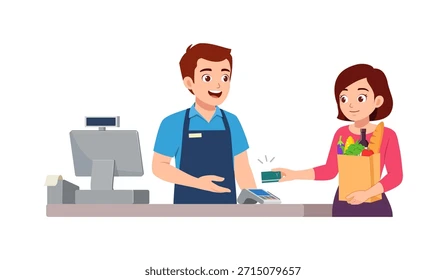
If you run a provision store, mini-mart, or small retail shop in Nigeria, you already know this situation: a regular customer walks in, picks up items worth ₦4,500, and says "write am for me, I go pay on Friday." You smile, pull out your notebook, scribble their name and the amount — and that notebook slowly becomes a graveyard of unpaid debts.
Learning how to track and collect credit sales in a provision store in Nigeria is one of the most critical skills any retail business owner can develop. Done poorly, credit sales quietly drain your cash flow, create staff disputes, and slowly choke your business. Done well, credit can actually build loyalty and increase your revenue.
This guide will walk you through why credit tracking fails, how to fix it step by step, and how a tool like SwiftPOS can automate the entire process so you stop losing money you've already earned.
Why Credit Sales Tracking Is Costing Nigerian Shops Money
Credit sales are a normal part of retail life in Nigeria. Many shop owners extend credit to trusted customers, neighbours, and regular buyers. But without a reliable system, those trusted transactions become invisible losses.
Here is what typically happens when credit sales go untracked:
- You forget who owes what. With 20 or 30 customers owing different amounts, it becomes almost impossible to remember who paid, who didn't, and who owes from two months ago.
- Staff manipulate records. When credit is tracked in a handwritten notebook, dishonest staff can erase entries, add fake payments, or give credit to friends without your knowledge.
- Customers dispute amounts. A customer who owes ₦12,000 might claim they already paid ₦7,000. Without a clear record, you have no proof — and you lose the argument or the relationship.
- Your cash flow collapses. Let's say your average credit per customer is ₦3,000. If you have 50 customers owing at any point, that's ₦150,000 locked up in credit — money you can't use to restock your shelves.
- You restock at a loss. Because you don't know your true cash position, you either over-borrow to restock or under-buy and miss sales.
According to a 2023 report by the Small and Medium Enterprises Development Agency of Nigeria (SMEDAN), poor record-keeping is among the top three reasons Nigerian small businesses fail within the first five years. Credit sales that go unmonitored are a major part of that record-keeping problem.
The solution is not to stop giving credit entirely — that can hurt customer relationships. The solution is to track it properly.
How to Track and Collect Credit Sales Effectively in Your Provision Store
Here is a practical, step-by-step system for managing credit sales in a Nigerian retail shop — whether you are operating manually right now or ready to move to a digital system.
Step 1: Create a Dedicated Credit Register for Every Customer
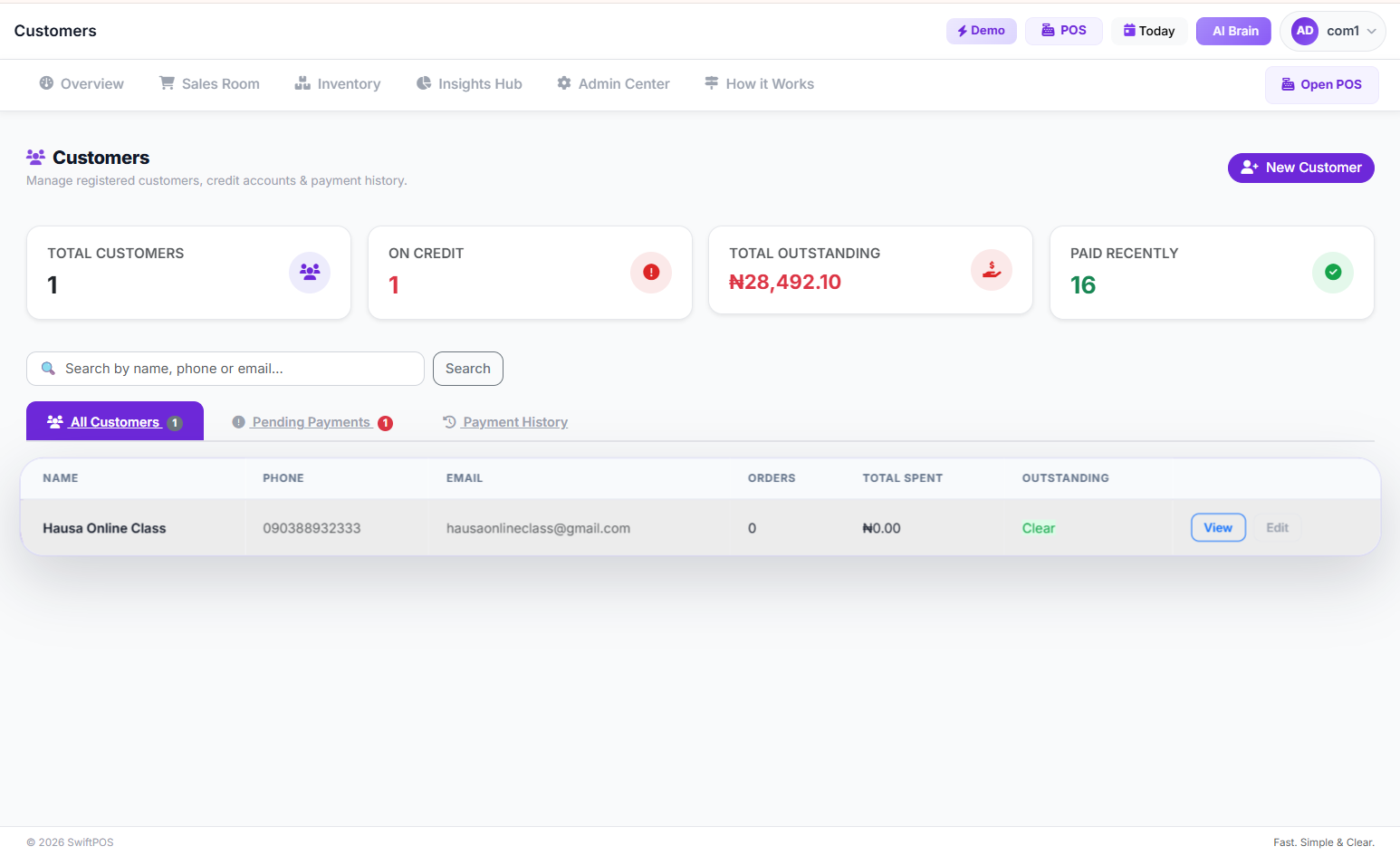
Every customer who receives goods on credit should have their own record. This record should include:
- Full name and phone number
- Date of each credit transaction
- Items purchased and total value
- Amount paid so far (partial or full)
- Outstanding balance
- Agreed repayment date
If you are doing this manually, use a dedicated hardcover ledger — not a loose notepad. Assign one page per customer. Never mix customers on the same page.
Better still, use a digital system that creates customer profiles automatically.
Step 2: Set Clear Credit Limits and Payment Deadlines Upfront
Many shop owners give credit without setting a limit or a repayment deadline. This is how debts snowball. Before handing over goods on credit, always state clearly:
- Maximum credit allowed (e.g., ₦5,000 at any time)
- Payment deadline (e.g., end of the month)
- No new credit until existing balance is cleared
Make this a shop policy — and enforce it consistently. Customers who know there is a hard limit tend to repay faster.
Step 3: Issue a Receipt for Every Credit Transaction
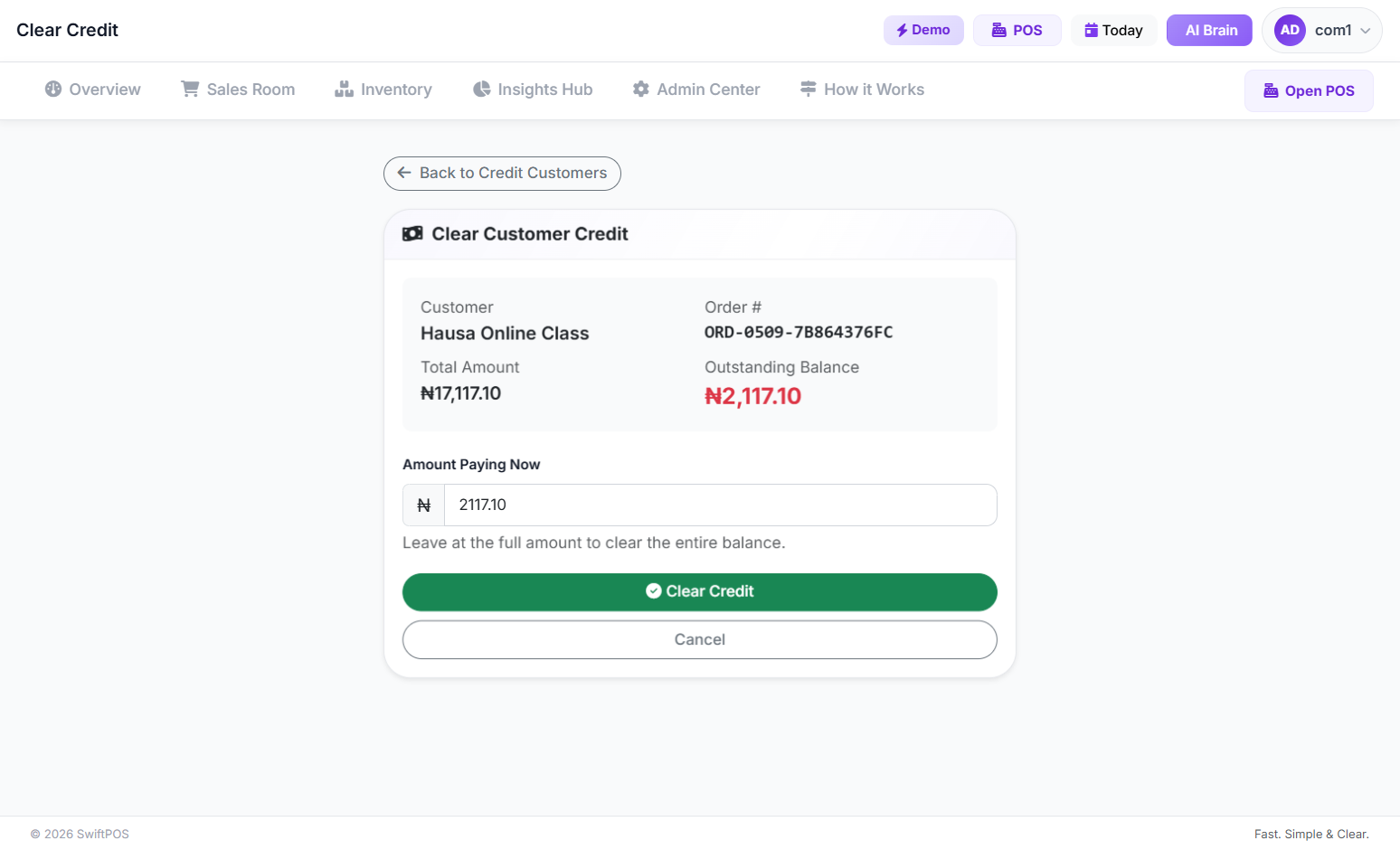
Whether you sell for cash or credit, always issue a receipt or a written acknowledgement. This does two things: it creates a paper trail, and it sets a professional tone that discourages disputes later.
A good receipt should show the date, items, quantity, price per unit, total, amount paid, and balance remaining. If you are using a POS system, these are generated automatically.
Step 4: Follow Up Before the Debt Goes Cold
The longer a debt goes unpaid, the harder it is to collect. Set a reminder system for yourself or your staff to follow up on unpaid credit before the deadline. You can do this by:
- Sending a WhatsApp message a few days before the due date
- Making a brief phone call on the due date
- Blocking further credit if the customer does not pay by a set date
Some shop owners keep a simple "this week's collections" list to stay on top of who needs to be reminded.
Step 5: Reconcile Your Credit Records Weekly
Every week, sit down with your credit records and check: Who paid? Who didn't? Who owes the most? How much in total credit is outstanding? This weekly reconciliation keeps you in control and stops debts from accumulating silently.
If you are using digital records, this summary can be generated automatically in seconds.
How SwiftPOS Makes Credit Sales Tracking Effortless for Nigerian Shops
All the steps above work — but they require discipline, time, and trust in your staff to execute correctly. The moment a dishonest cashier handles your credit notebook, or you're too busy to reconcile weekly, the system breaks down.
That's exactly what SwiftPOS was built to solve. It replaces the notebook, the loose receipts, and the guesswork with a clean, automated, cloud-based system you can access from anywhere.
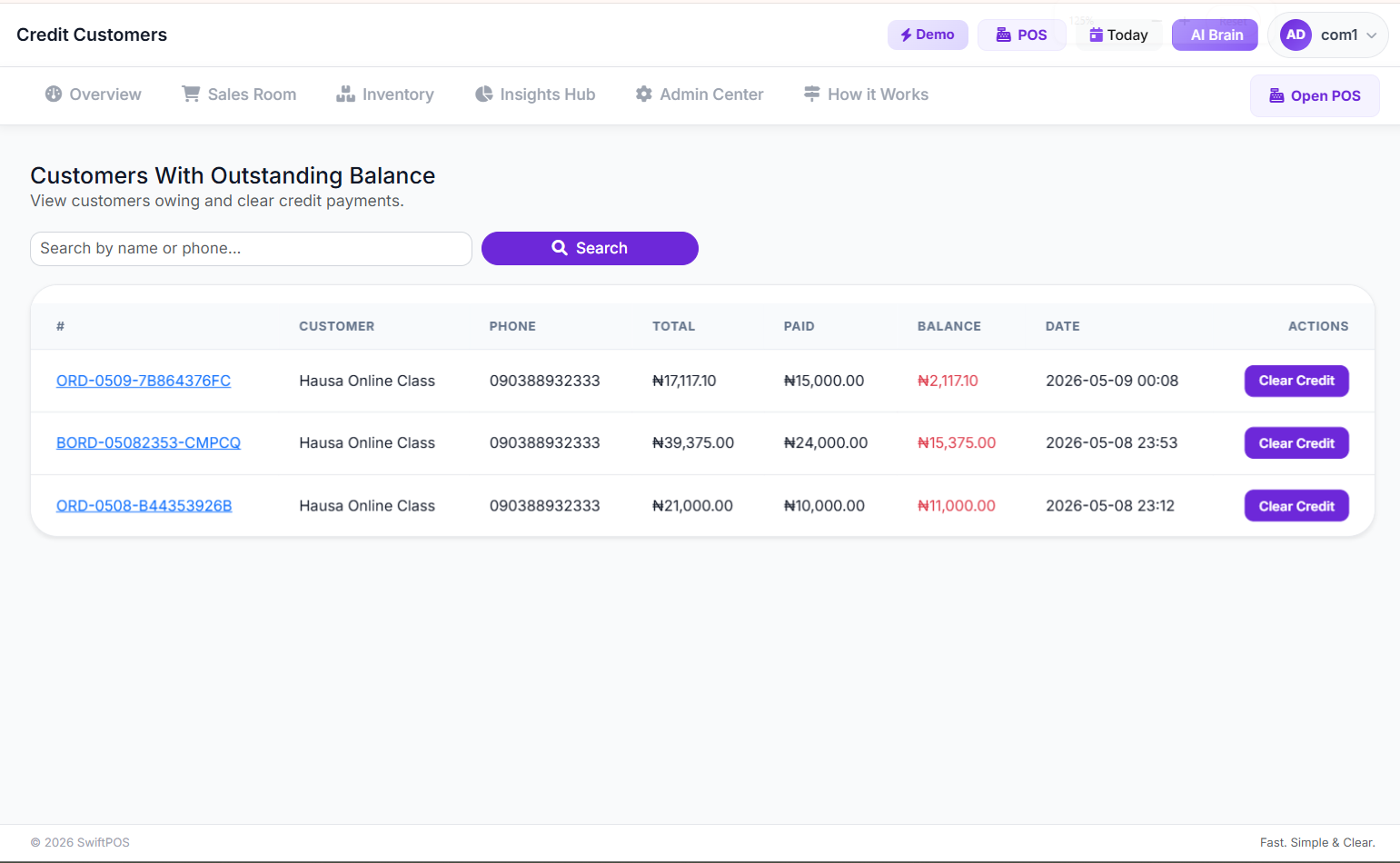
Customer Credit Profiles — Every Debt Tracked Automatically
When you make a credit sale on SwiftPOS, the system automatically attaches the transaction to that customer's profile. You can see at a glance:
- Total amount owed by each customer
- A full history of all credit transactions and payments
- Date each credit was issued and when payments were made
- Outstanding balance in real time
No more cross-referencing notebooks. No more "I thought they paid already." Every entry is timestamped, recorded, and protected.
Staff Cannot Manipulate What They Cannot Touch
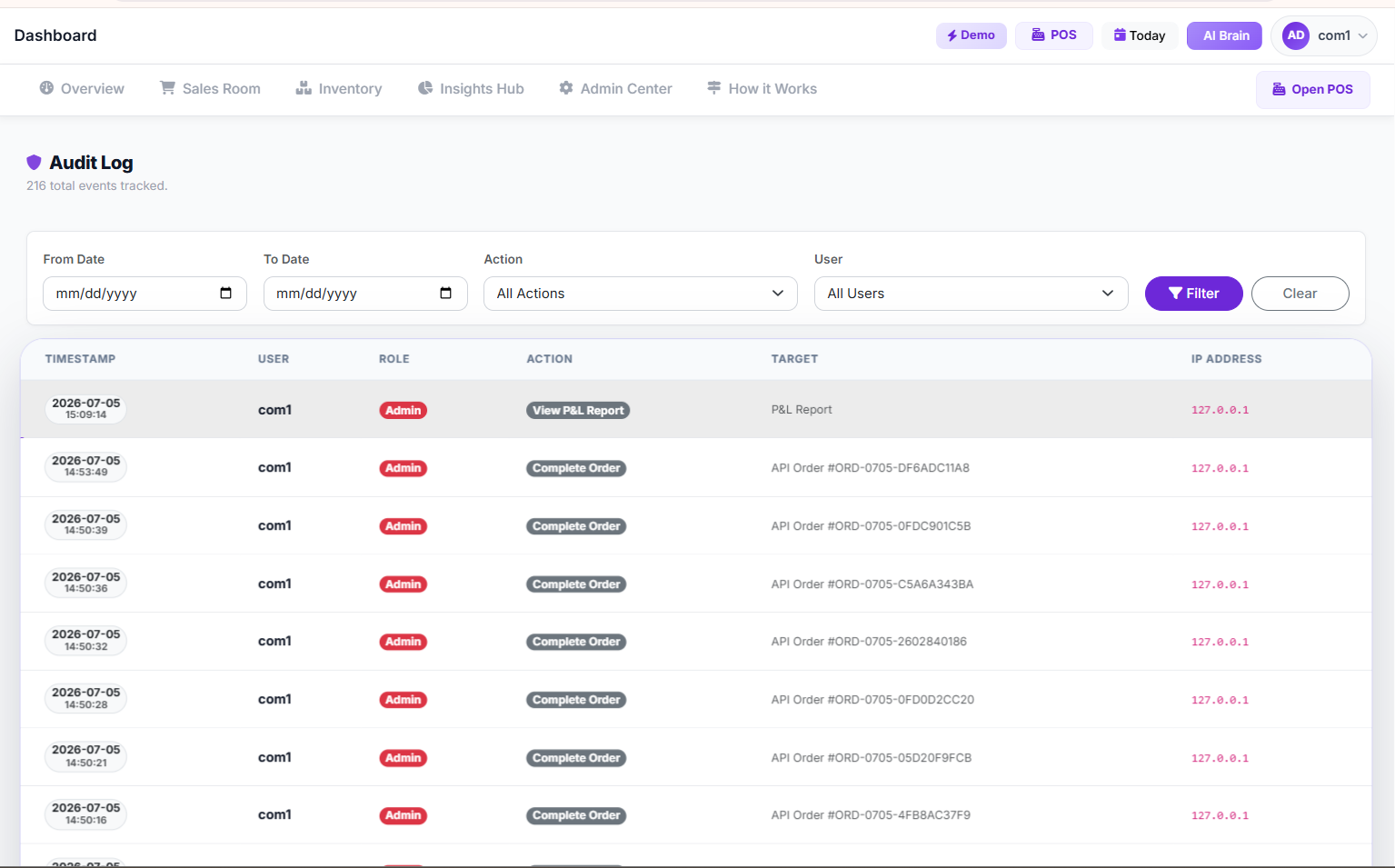
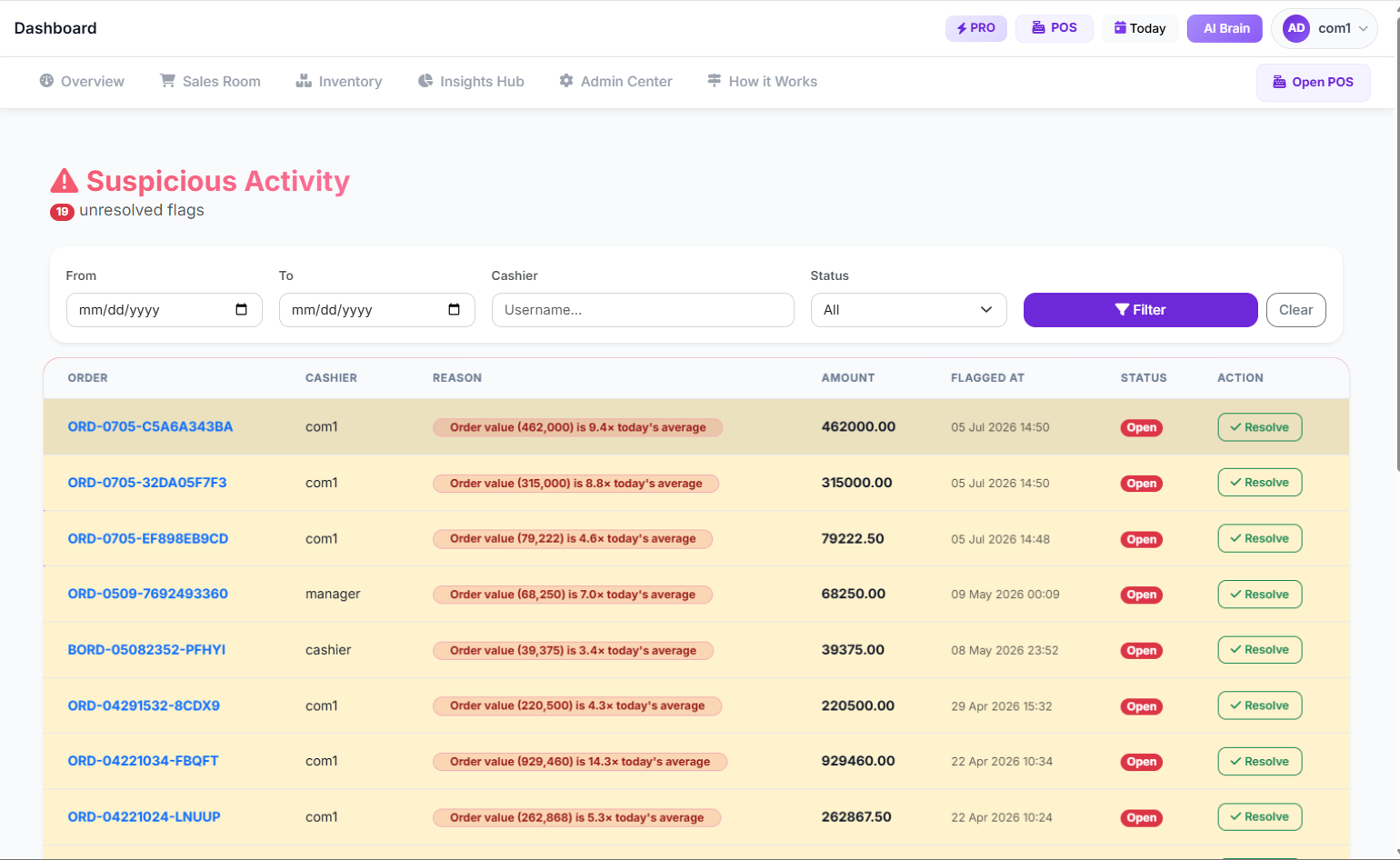
One of the biggest credit-related losses in Nigerian retail shops comes from staff. Staff can erase notebook entries, pocket cash payments, or issue credit to friends. With SwiftPOS, every transaction is logged digitally with a timestamp and the staff member's ID. The audit log captures every change — and the suspicious activity monitor flags anything unusual.
Real-Time Sales and Credit Reports
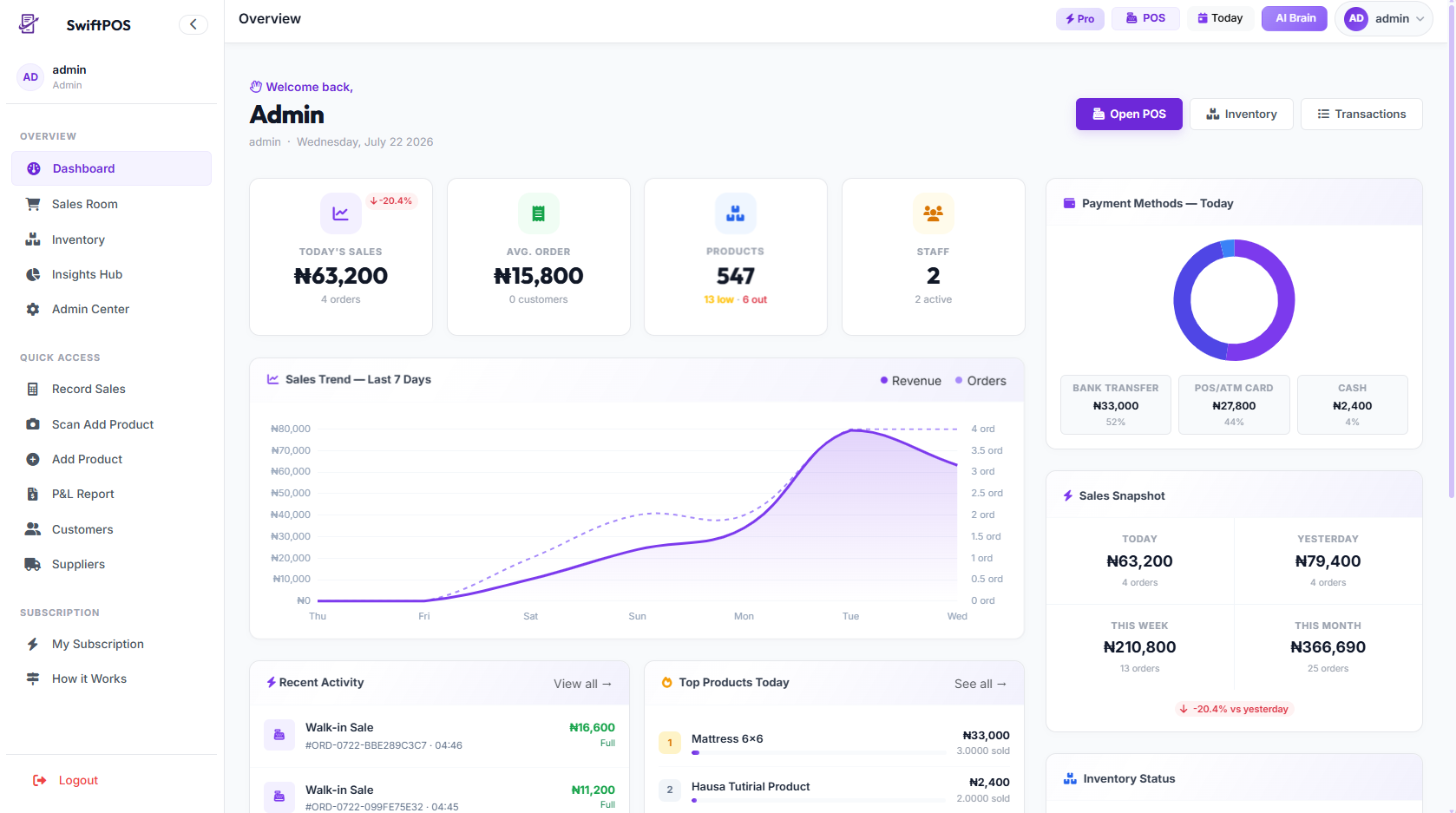
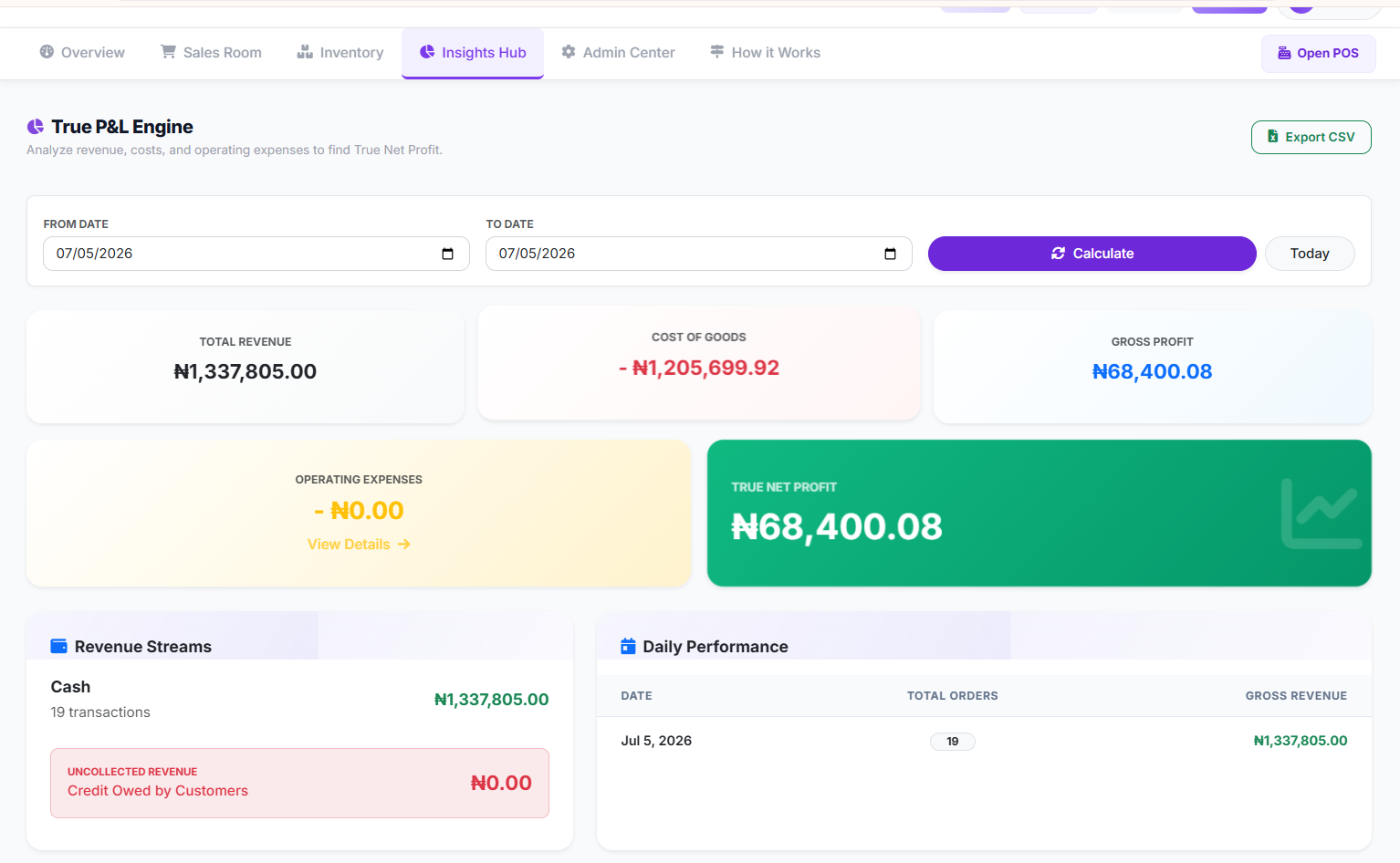
At any moment, you can open your SwiftPOS dashboard and see exactly how much total credit is outstanding across all customers, how your daily credit sales compare to cash sales, and whether your overall business is profitable. This is data that helps you make decisions — not guesses.
Transaction History You Can Filter and Export
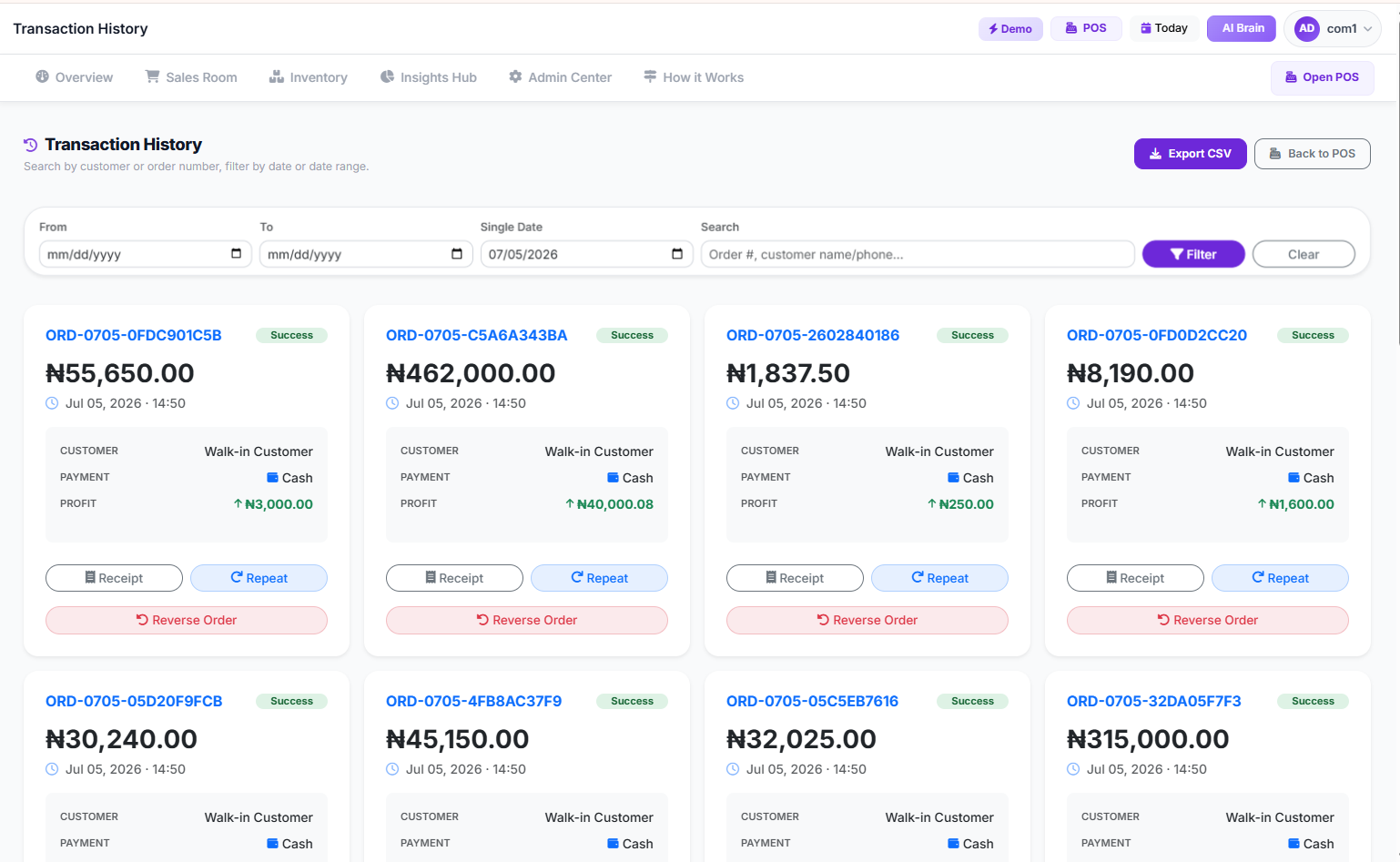
If a customer disputes a payment, you don't have to argue from memory. Simply pull up the transaction history, filter by that customer's name, and show them every entry. SwiftPOS keeps a full, exportable log of every sale — cash and credit — that you can filter by date, customer, or staff member.
Want to know more about all the features SwiftPOS offers? Visit the SwiftPOS features page.
SwiftPOS Pricing: Affordable for Every Stage of Your Business
One of the most common worries shop owners have about switching to a digital POS is cost. SwiftPOS is designed to be accessible for small businesses in Nigeria, with plans starting at just ₦3,000 per month.
- Starter Plan — ₦3,000/month: Ideal for very small shops. Includes inventory management, customer credit system, POS terminal, and basic sales reports.
- Standard Plan — ₦6,000/month: For growing stores. Adds barcode POS, full P&L reports, audit logs, bulk product import, and data export.
- Pro Plan — ₦12,000/month: For established businesses. Unlimited orders, multi-branch support, suspicious activity detection, and advanced audit logs.
Every plan includes a 1 month free when you subscribe annually. Check the full details at swiftpos.ng/pricing.
Pro Tips for Collecting Credit Debts in Nigerian Retail
Even with a great tracking system, collecting credit can still be tricky. Here are some advanced tactics that experienced Nigerian shop owners use:
- Set a "credit suspension" policy publicly. Put up a small sign in your shop that states your credit limit and your cutoff policy. When customers see it written on the wall, they take it more seriously than a verbal warning.
- Offer a small discount for early payment. Some shop owners tell customers: "If you pay by Thursday, I'll take off ₦200." This creates a financial incentive without damaging the relationship.
- Use WhatsApp receipts. After every credit transaction, send the customer a WhatsApp message with the amount owed. This creates a written record the customer cannot dispute and serves as a soft reminder.
- Know when to stop giving credit. If a customer consistently fails to pay by the agreed date, reduce or eliminate their credit limit. It's not personal — it's business protection.
- Involve your staff in collection. Train your cashiers to politely remind customers of outstanding balances when they come in to shop again. A non-confrontational reminder at the point of the next purchase is often enough.
How to Use SwiftPOS to Manage Multi-Branch Credit Sales
If you run more than one shop location, credit tracking becomes exponentially harder. A customer might buy on credit at your Surulere branch, then come to your Ikeja branch and claim they already paid. Without a unified system, you're flying blind.
SwiftPOS Pro supports multi-branch management, which means customer credit records are accessible across all your locations. A staff member at any branch can instantly see a customer's outstanding balance before extending further credit. This is a game-changer for growing retail businesses.
Read more about managing multiple branches effectively: How to Manage Multiple Shop Branches in Nigeria Without Losing Control.
Frequently Asked Questions
How do I track credit sales in a provision store without a computer?
The most reliable manual method is a dedicated hardcover ledger with one page per customer. Record the date, items, value, and any payments made. However, manual records are prone to errors, tampering, and loss. A digital system like SwiftPOS is far more reliable and costs less than most people expect.
What is the best way to collect outstanding credit from customers in Nigeria?
The best approach combines clear upfront policies (credit limit, repayment deadline), regular follow-up (WhatsApp messages or calls before the due date), and a firm "no new credit until balance is cleared" rule. Having a written or digital record makes the conversation easier and removes room for disputes.
Does SwiftPOS have a customer credit system?
Yes. SwiftPOS includes a built-in customer credit system that tracks each customer's balance, records every credit transaction with a timestamp, and gives you a full history of payments and outstanding amounts. It is available from the Starter plan at ₦3,000 per month.
Can I manage credit sales across multiple shop branches with SwiftPOS?
Yes. The SwiftPOS Pro plan supports multi-branch management, meaning customer records — including credit balances — are accessible across all your locations. This prevents duplicate credit from being extended to the same customer at different branches.
Is SwiftPOS affordable for small provision stores in Nigeria?
Yes. The Starter plan starts at ₦3,000 per month, which is less than the cost of a printer cartridge. For a provision store doing even modest daily sales, the amount recovered from better-tracked credit debts will far exceed the subscription cost within the first month.
What happens if my internet goes down — will I lose my credit records?
SwiftPOS is a cloud-based system, which means your data is stored securely online and accessible from any device once your connection is restored. You won't lose historical records even if your internet drops temporarily. Learn more: Can Your POS System Work Without Internet?
Conclusion: Stop Letting Credit Sales Eat Your Profit
Credit sales are not inherently bad for your provision store — the problem is untracked, unmanaged credit. Every naira that walks out of your shop on credit and doesn't come back is a direct hit to your profit margin, your cash flow, and your ability to restock and grow.
The good news is that tracking and collecting credit sales in Nigeria doesn't have to be complicated or expensive. With the right system — whether you start with a disciplined ledger or move directly to a tool like SwiftPOS — you can take control of every credit transaction, reduce disputes, prevent staff manipulation, and recover money that would otherwise be lost.
The businesses that win in Nigerian retail are the ones that treat every naira seriously. That starts with knowing who owes you, how much, and when it's due. SwiftPOS gives you exactly that — automatically, reliably, and affordably.
Also worth reading: Why Every Retail Shop in Nigeria Needs Proper Record Keeping in 2026
Ready to Take Control of Your Credit Sales?
SwiftPOS helps provision stores and retail businesses across Nigeria track sales, manage customer credit, monitor staff activity, and generate instant reports — all in one affordable cloud system.
Or message us directly on WhatsApp: +234 916 460 1810
🎁 Get 1 month free when you subscribe annually on any plan.

How Much Does It Cost to Start a Clothing Business in …
Oct 17, 2026
How Much Does It Cost to Open a Cosmetics Shop in Nige…
Oct 17, 2026
How to Start a Cosmetics Business in Nigeria: A Step-b…
Oct 17, 2026