10 Best Small Businesses to Start in Nigeria With ₦1 Million
SwiftPOS Team
Published October 27, 2026

A staggering 63% of small businesses in Nigeria fail within their first three years, and a significant chunk of that failure often boils down to a lack of proper planning and a clear understanding of startup costs. Think about it: many aspiring entrepreneurs jump in with enthusiasm, a decent product idea, and perhaps ₦1 million in hand, only to realise halfway that their capital isn't enough to cover essential operational expenses beyond just initial stock. This is why getting a clear picture of what you actually need to start a profitable small business in Nigeria is not just helpful, it's absolutely critical. Let’s talk about the 10 Best Small Businesses to Start in Nigeria With ₦1 Million and how to make sure your capital actually takes you somewhere.
A small bustling provision store in a lagosThe Reality Check: What Nobody Tells You About Starting a ₦1 Million Business
Most online guides will paint a rosy picture, telling you that ₦1 million is more than enough to start almost anything. While it's a decent startup capital for many ventures, the truth on the ground in Nigeria, especially in 2026, is far more nuanced. You see, the real costs often get glossed over. We're talking about things like rent, which is typically paid annually here, not monthly. Or the constant need for a generator because NEPA will always be NEPA, eating into your profits with fuel costs.
Consider a small provision store in, say, Ikorodu. You might budget ₦500,000 for initial stock, which sounds great. But then you remember the annual shop rent of, say, ₦187,500. Add shelves for ₦75,000, a small generator for ₦80,000, and initial working capital of ₦50,000 for utilities and transportation. Suddenly, your ₦1 million is looking a lot less like a goldmine and more like a tightrope. This is the part most people don't expect. They focus on the product, but neglect the infrastructure and the ongoing operational burn rate. Understanding these hidden costs is the first step to truly building a profitable small business.
What You Actually Need to Get Started
Before we even dive into specific business ideas, let's get brutally honest about the prerequisites. Having a ₦1 million business isn't just about having cash; it's about having a plan.
Non-Negotiables:
- A Solid Business Plan: Not just in your head. Write it down. Even if it's a one-page summary. It forces you to think through everything.
- Business Registration (CAC): Don't skip this. For a sole proprietorship or business name, it's typically ₦20,000 to ₦50,000. It gives you credibility and opens doors.
- Location, Location, Location: This is critical for any retail or service business.
- Small Shop Rent (Annual): Budget anywhere from ₦80,000 (rural/suburban) to ₦300,000 (high-traffic urban area like certain parts of Ikeja).
- Kiosk/Container Rent (Annual): ₦50,000 to ₦150,000.
- Initial Stock/Equipment: This is your core product or service delivery tool.
- Initial Stock (e.g., provisions, phone accessories): ₦200,000 to ₦700,000, depending on what you're selling.
- Basic Tools/Equipment (e.g., sewing machine, small oven): ₦100,000 to ₦400,000.
- Display Shelves/Counters: ₦50,000 to ₦150,000. Presentation matters!
- Generator (Small "I-pass-my-neighbour"): ₦60,000 to ₦120,000. This is non-negotiable in Nigeria. Power is not guaranteed.
- Working Capital (Monthly): ₦30,000 to ₦80,000 for the first 1-2 months. This covers utilities, transport, and unexpected costs. Don't touch your main capital for this.
Nice-to-Haves (but quickly becoming essential):
- POS Machine for Payments: ₦25,000 to ₦50,000. Customers expect card payments now.
- Basic Marketing/Promotional Materials: ₦15,000 to ₦50,000 (flyers, social media ads). You need to tell people you exist!
- Staff Salary (Per Month, 1 assistant): ₦40,000 to ₦70,000. If you plan to scale, you'll need help.
The Complete Step-by-Step Breakdown
Alright, let's roll up our sleeves. If you have ₦1 million and want to start a business in Nigeria, here’s a breakdown of how to approach it. This isn't just about throwing money at an idea; it's about strategic deployment.
Step 1: Deep Market Research and Niche Identification
Before you spend one kobo, you need to know who you're selling to and what they really need. Don't just pick a business because it sounds good. Go to markets like Balogun or Alaba, observe, talk to people. What problems are they facing? What products are always in demand?
For instance, if you're thinking of a phone accessories store, go to Computer Village. What brands are trending? Are people looking for quality originals or affordable alternatives? What's the average markup? This research will help you identify a profitable small business niche and confirm if your ₦1 million business idea has legs.
Step 2: Craft Your Business Plan and Budget (Realistically)
This is where you map out your startup capital. Don't skip this. A good business plan doesn't have to be a 50-page document; a solid one-pager can do the trick. It should cover:
- Executive Summary: What's your business, and why will it succeed?
- Products/Services: What are you selling?
- Market Analysis: Who are your customers? Who are your competitors?
- Marketing Strategy: How will customers find you?
- Operations Plan: How will you run the day-to-day?
- Financial Projections: This is key. How much do you need, what are your expected sales, and when do you break even?
Step 3: Legal Registration and Compliance
Registering your business with the Corporate Affairs Commission (CAC) is a must. It legitimizes your operation and makes it easier to open a business bank account, access loans, and build trust with customers and suppliers. A sole proprietorship or business name registration typically costs between ₦20,000 and ₦50,000.
Beyond CAC, understand any local permits or licenses required. A food vendor will have different requirements than a fashion boutique. Check with your local government council. Ignorance is not an excuse, and fines can eat into your startup capital.
Step 4: Secure Your Location and Set Up Shop
Finding the right location is paramount for any retail business. A busy street corner in Festac Town for a mini-mart, or a stall within a popular market for a clothing business. Negotiate rent fiercely – remember, it's usually annual. Once secured, focus on functional setup.
Prioritize essential shelving, a secure counter, and a reliable power source (that generator). Don't overspend on aesthetics initially. Get the basics right. A simple, clean, and well-organized space is more important than fancy decor when you're working with a ₦1 million budget.
Step 5: Source Initial Inventory or Equipment
This is where your research from Step 1 pays off. For a provision store, head to wholesale markets like Mile 12 or trade fairs to get the best prices. If it's fashion, consider Aba or Kano textile markets for good margins. Always buy in bulk where possible to reduce per-unit cost.
Negotiate with suppliers. Build relationships. A good supplier can offer credit or better terms as your business grows. Remember to factor in transportation costs for your goods. That N200,000 worth of stock from Onitsha won't magically appear in your Lagos shop.
Step 6: Implement a Robust Business Management System
Many small businesses in Nigeria make the mistake of relying on paper ledgers or basic Excel sheets. This is fine for a few sales, but as you grow, it becomes a nightmare. How do you track inventory accurately? How do you know your actual profit margins after expenses? How do you manage customer debt without confusion?
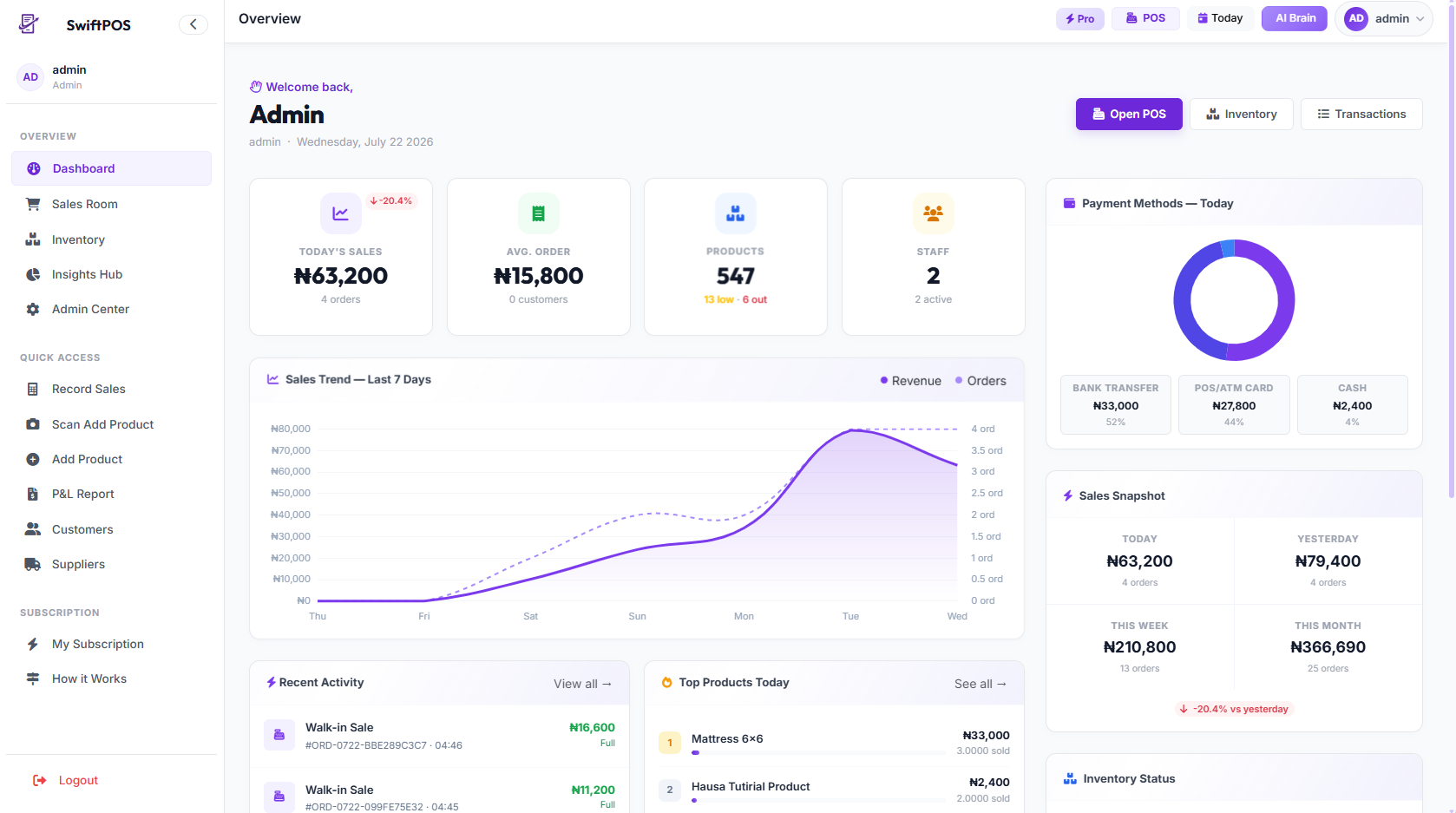
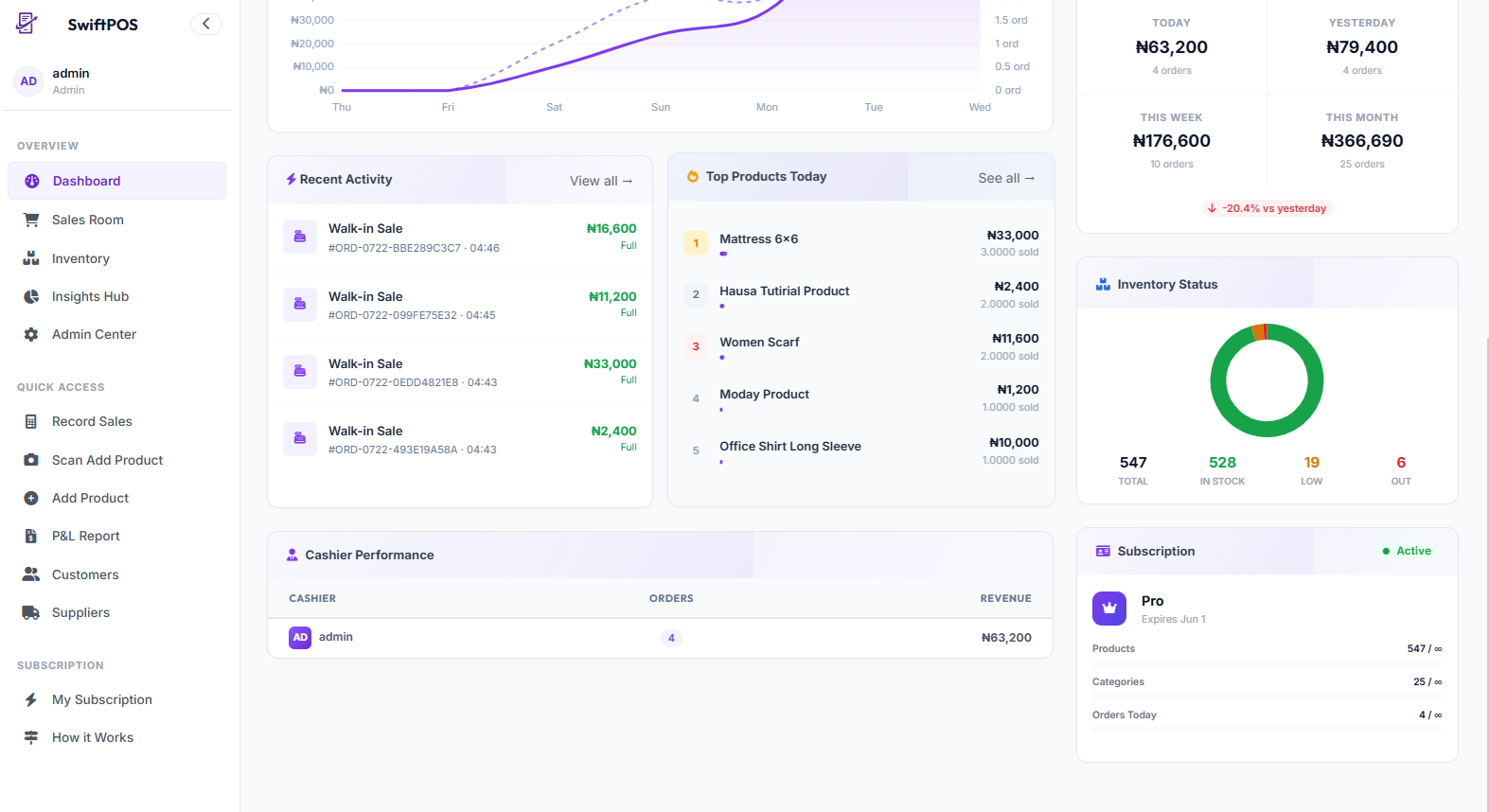
This is where a system like SwiftPOS NG becomes invaluable. It's more than just a cash register; it's a complete business management and Point-of-Sale (POS) platform designed for Nigerian retailers. You can use it to sell products quickly, accept different payment methods, manage your stock across categories, track customer debts, and even monitor staff activity. Imagine knowing exactly which products are selling fastest or when you need to restock before you run out – that’s the power of good data.
 Dashboard Overview 1
Step 7: Hire and Train Your Team (If Needed)
If your business requires an assistant, hire carefully. Look for someone trustworthy and eager to learn. Pay them fairly (₦40,000 - ₦70,000 per month for an entry-level assistant). Train them not just on sales, but on customer service and how to use your business tools, like a POS system.
Clear roles and responsibilities prevent confusion. For instance, with a system like SwiftPOS, you can set staff permissions so your cashier can handle sales without accessing sensitive financial reports or inventory adjustments. This helps prevent theft and keeps your financial data secure.
Step 8: Marketing and Grand Opening
You've done the hard work; now tell the world! Start with simple, cost-effective marketing. Hand out flyers in your neighbourhood, create a WhatsApp Business profile, and use targeted Facebook/Instagram ads if your budget allows (even ₦5,000 can make a difference).
A grand opening, even a small one, creates buzz. Offer opening discounts or a small freebie. The goal is to get people through your door and talking about your business. Word-of-mouth is still king in Nigeria, but you need to give people something to talk about.
Step 9: Monitor, Analyze, and Adapt
Your work doesn't stop after opening. This is a continuous process. Keep a close eye on your sales, expenses, and customer feedback. Are certain products not selling as expected? Are your marketing efforts yielding results?
Tools like SwiftPOS NG can provide you with business insights, showing you sales trends, product performance, and even forecasting when stock might run out. This data is gold. It helps you make informed decisions, adapt to market changes, and ensure your ₦1 million business stays profitable. Don't be afraid to pivot if something isn't working.
5 Mistakes That Cost Nigerian Business Owners the Most
Starting a 1 million business is exciting, but pitfalls abound. I've seen countless businesses make these mistakes, and they almost always lead to financial trouble.
- Ignoring Proper Record-Keeping: This is a silent killer. Many small shop owners rely on memory or scribbled notes. How can you truly know if you're making a profit if you don't track every sale, every expense, and every item in your inventory? A provision store owner in Ojota once told me he thought he was making ₦150,000 profit monthly, but after a month of tracking, he realized it was barely ₦60,000 after accounting for generator fuel, staff salaries, and damaged goods. This is why manual retail management is costing Nigerian shops money.
- Mixing Business Funds with Personal Funds: This is a recipe for disaster. Your business account should be separate from your personal account. When you dip into business funds for personal needs, you lose sight of your actual cash flow and profitability. It's like pouring water into a leaky bucket and wondering why it's never full.
- Underestimating Operational Costs: Everyone budgets for stock and rent, but what about the small, recurring costs? Daily transport, data, generator maintenance, occasional repairs, security levies – these add up quickly. A barber in Yaba calculated he spent nearly ₦15,000 monthly on just diesel and bulb replacements alone. These are the hidden costs of manual retail operations in Nigeria that you're missing.
- Neglecting Inventory Management: Overstocking ties up capital, and understocking leads to lost sales. Imagine a mini-mart in Port Harcourt always running out of popular soft drinks during peak hours. That's money walking out the door. Without a system to track what's coming in and going out, you're essentially flying blind. You need to know how to predict when products will run out of stock in Nigeria.
- Failing to Adapt to Customer Payment Preferences: In 2026, people expect options. Cash, POS, bank transfer, mobile money. If you can only accept cash, you're turning away a significant portion of potential customers. A small boutique in Lekki lost a ₦50,000 sale because their POS machine was faulty, and the customer didn't have cash.
How to Know If You're on Track (Success Metrics)
To ensure your ₦1 million business is not just surviving but thriving, you need to track key metrics. These are your compass in the entrepreneurial journey.
- Sales Revenue: How much money are you bringing in daily, weekly, and monthly? A good target for a small retail business in its initial phase might be ₦150,000 - ₦400,000 monthly. If your revenue is consistently below your break-even point, you need to re-evaluate your strategy.
- Profit Margin: This is the real indicator of health. After deducting the cost of goods sold and all operational expenses, what percentage of your revenue is profit? Aim for a 15% - 35% profit margin. If it's lower, your pricing might be off, or your costs are too high. SwiftPOS can help you calculate your true net profit after operating expenses.
- Customer Retention Rate: Are your customers coming back? Loyal customers are gold. If 70% of your customers are repeat buyers, you're doing something right.
- Inventory Turnover: How quickly are you selling your stock? A high turnover means your products are in demand and your capital isn't tied up. If items sit on shelves for months, you have dead stock.
- Expense-to-Revenue Ratio: What percentage of your revenue goes towards expenses? Keep this as low as possible. If it's consistently above 70-80%, you have an efficiency problem.
 Dashboard Overview 2
Real Questions People Ask (FAQ)
Q1: Is ₦1 million truly enough to start a profitable small business in Nigeria in 2026?
Yes, it can be. But it requires meticulous planning, smart allocation of funds, and a realistic understanding of all costs involved, not just initial stock. Many businesses, especially retail or service-based ones, can launch successfully with this startup capital if managed well.
Q2: Which are the best small businesses to start in Nigeria with ₦1 million that have high demand?
Provision stores, phone accessory shops, small fashion boutiques (especially for ready-to-wear), barbershops/salons, small eateries (e.g., local fast food, akara spots), laundry services, and even small-scale online retail (dropshipping or local sourcing) are all high-demand options that can start with this budget. The key is to find a niche within these broader categories.
Q3: How quickly can I expect to break even with a ₦1 million business?
Breaking even depends heavily on your business type, profit margins, and operational efficiency. Generally, for a well-managed small retail business in Nigeria, you might expect to break even within 6 to 18 months. However, some businesses with very high turnover and low overheads can achieve it faster. For example, a busy food kiosk in a university area might break even in 3-4 months, while a boutique might take 9-12 months.
Q4: What's the biggest risk when starting a 1 million business in Nigeria?
The biggest risk isn't usually a lack of capital, but rather poor management of the capital you have. This includes inadequate market research, unrealistic budgeting, poor inventory control, and failing to track your finances accurately. Many entrepreneurs also struggle with finding reliable staff and dealing with inconsistent power supply.
Q5: How important is technology for a small business with limited startup capital?
Extremely important. Even with a ₦1 million budget, investing in essential technology like a good POS system can save you money in the long run by preventing losses from theft, improving inventory accuracy, and providing data to make better business decisions. It's not a luxury; it's an efficiency tool that drives profit. You can find out more about the benefits of a POS system for Nigerian retailers on our blog.
Your Next Move
Starting a business in Nigeria with ₦1 million is absolutely achievable, but it demands more than just passion. It requires smart planning, realistic budgeting, and the right tools to manage your operations effectively. Don't let your hard-earned capital disappear into avoidable mistakes.
Ready to take control of your business, manage your stock, track sales, and understand your true profits? Explore how SwiftPOS NG can transform your retail operations. You can even try it for free for 14 days. Visit app.swiftpos.ng to get started today.
Top 10 Profitable Businesses to Start in Nigeria With …
Oct 27, 2026
How to Start a Retail Business in Nigeria With ₦500,00…
Oct 27, 2026
How to Start a Bakery Business in Nigeria: A Step-by-S…
Oct 24, 2026