How Much Does It Cost to Open a Cosmetics Shop in Nigeria?
SwiftPOS Team
Published October 17, 2026
The fluorescent lights of the small shop flickered, casting long shadows over the rows of shea butter, imported foundations, and local organic creams. Ngozi stared at the ledger, the numbers for last month’s sales not quite adding up. A knot tightened in her stomach – another bottle of serum, a popular imported brand, was missing from stock, and she couldn't account for it. This wasn't just about the missing product; it was about the nagging question: how much does it really cost to open a cosmetics shop in Nigeria, and am I even managing it right?
Woman organizing cosmetics in a brightly lit shopWhy Most People Get This Wrong from Day One
Look, I've seen it countless times. Someone gets a brilliant idea for a beauty business, maybe they've got a passion for skincare or makeup, and they jump right in. They think, "Oh, I just need to buy some products and find a small space." That's where the trouble starts. You underestimate the true cosmetics startup cost in Nigeria, and before you know it, you're bleeding money from places you didn't even know existed.
The biggest mistake? Not doing your homework on the full scope of capital needed. Many aspiring cosmetics shop owners only budget for rent and initial stock. They forget about the small, yet significant, expenses that pile up quickly. Things like business registration, proper shelving that makes your products attractive, and even a reliable generator – because NEPA will always be NEPA, right? You can't run a beauty business without consistent power for your lighting and POS system. It’s these hidden costs that can cripple your dreams faster than you can say "limited edition lipstick."
I remember one client in Ikeja who planned everything down to the last lipstick shade but forgot to factor in adequate marketing for her grand opening. She had a beautiful shop, fantastic products, but no one knew she existed. She spent weeks just waiting for customers to stumble in. That’s a mistake you can’t afford in 2026. Understanding the full beauty business capital required upfront saves you headaches and heartbreaks later.
Before You Do Anything: The Foundation Work
Before you even think about ordering your first batch of lip gloss, you need to lay a solid foundation. This isn't just about money; it's about structure. Trust me, skipping these steps will cost you more in the long run.
Here’s what you need to sort out:
- Business Plan (Your Roadmap): This isn't just a fancy document for the bank. It's for you. What's your niche? Who are your customers? What's your unique selling proposition? Are you focusing on luxury imports, affordable local brands, or organic products? This defines your entire business. Take your time here – a few weeks of solid planning can save you years of struggle.
- Market Research (Know Your Customers): Walk around Balogun Market, visit malls in Lekki, check out local beauty supply stores in your target area. What are people buying? What are they complaining about? What price points are working? This helps you determine your initial stock and pricing strategy.
- Legal Structure & Registration: You need to make this official.
- Business Registration (CAC): For a sole proprietorship, you're looking at about ₦25,000 to ₦35,000. If you're going for a Limited Company (which offers more protection as you grow), budget ₦50,000 to ₦70,000. This is non-negotiable. It gives your business legitimacy and allows you to open a corporate bank account.
- NAFDAC Registration (If Applicable): If you plan to formulate your own cosmetics, import products directly, or repackage bulk items under your brand, NAFDAC registration is critical. This can cost anywhere from ₦150,000 to ₦500,000 per product category. Don't play with this; penalties for non-compliance are severe. This process can take several months, so start early.
- Funding Strategy: How are you getting the money? Personal savings? Loans from family? A small business loan? Be realistic about what you can raise. Over-leveraging yourself from day one is a recipe for disaster.
The Step-by-Step Path (What Actually Works)
Alright, you've done your homework. Now, let's get into the practical steps to actually open your cosmetics shop in Nigeria. This is where the beauty business capital starts to get allocated.
Step 1: Secure Your Location & Make It Shine
Your shop's location and appearance are your first impression. Don't skimp here, but don't overspend either.
- What to do: Find a location with good foot traffic that aligns with your target customers. A small space in a busy market like Yaba might be perfect for affordable brands, while a more upscale boutique might thrive in a mall in Victoria Island. Once you have the space, fit it out.
- Why it matters: People buy with their eyes, especially in cosmetics. A clean, well-lit, and organized shop inspires confidence in your products.
- Common shortcut that backfires: Settling for a cheap, poorly located shop or using rickety old shelves. It makes your premium products look cheap, and customers won't trust the quality.
- Specific action item: Visit at least 5 potential locations. Get quotes for annual rent and shop fitting. Budget for Shop Rent (Annual): ₦80,000 (for a small stall in a local market) to ₦2,500,000 (for a prime spot in a Lagos mall). For Shop Fitting/Shelving: ₦150,000 (basic wooden shelves) to ₦700,000 (modern glass displays and good lighting).
Step 2: Source Your Initial Stock Wisely
This is the heart of your cosmetics business. Your inventory needs to be diverse enough to attract customers but not so vast that you tie up all your capital.
- What to do: Identify your core product categories – skincare, makeup, haircare, fragrances. Find reliable suppliers. For local products, you might go directly to manufacturers or their main distributors. For imported goods, look for reputable wholesalers, perhaps in Alaba International Market or online through verified platforms.
- Why it matters: The right stock attracts the right customers. Quality and authenticity are paramount in the beauty industry.
- Common shortcut that backfires: Buying cheap, unverified products from unknown sources. You risk selling counterfeits, damaging your reputation, and facing legal issues. Also, overstocking on niche products that don't sell quickly.
- Specific action item: Create a detailed list of your initial product mix. Research 3-5 suppliers for each major category. For Initial Stock Purchase: Budget ₦300,000 (for a very small selection of local brands) to ₦3,000,000 (for a wider range of popular imported and local brands).
Step 3: Power Up Your Operations
You can't run a modern business without reliable power and a way to track things.
- What to do: Invest in a good generator. Even if you're in an area with relatively stable power, you'll need it. Also, get a proper system to manage your sales and inventory. Paper ledgers and Excel sheets might seem cheap, but they're costing you more than you think in lost sales, forgotten stock, and wasted time.
- Why it matters: Power ensures your lights are on, your POS works, and your customers are comfortable. A good POS system prevents theft, tracks sales, and tells you what's actually making money.
- Common shortcut that backfires: Relying solely on public power or using manual record-keeping. You'll lose sales during outages, misplace stock, and have no real idea of your profit.
- Specific action item: Purchase a reliable generator. Budget for a Small Generator: ₦80,000 to ₦250,000. And for your sales and inventory, consider a system like SwiftPOS NG. It's built for Nigerian businesses, helping you manage products, track sales, monitor stock across branches if you grow, and even identify suspicious activity. This ensures you know exactly what’s selling, what’s expiring, and what needs restocking – a critical part of managing a cosmetics shop Nigeria. For a POS Machine/Basic Accounting Software: ₦40,000 to ₦120,000.
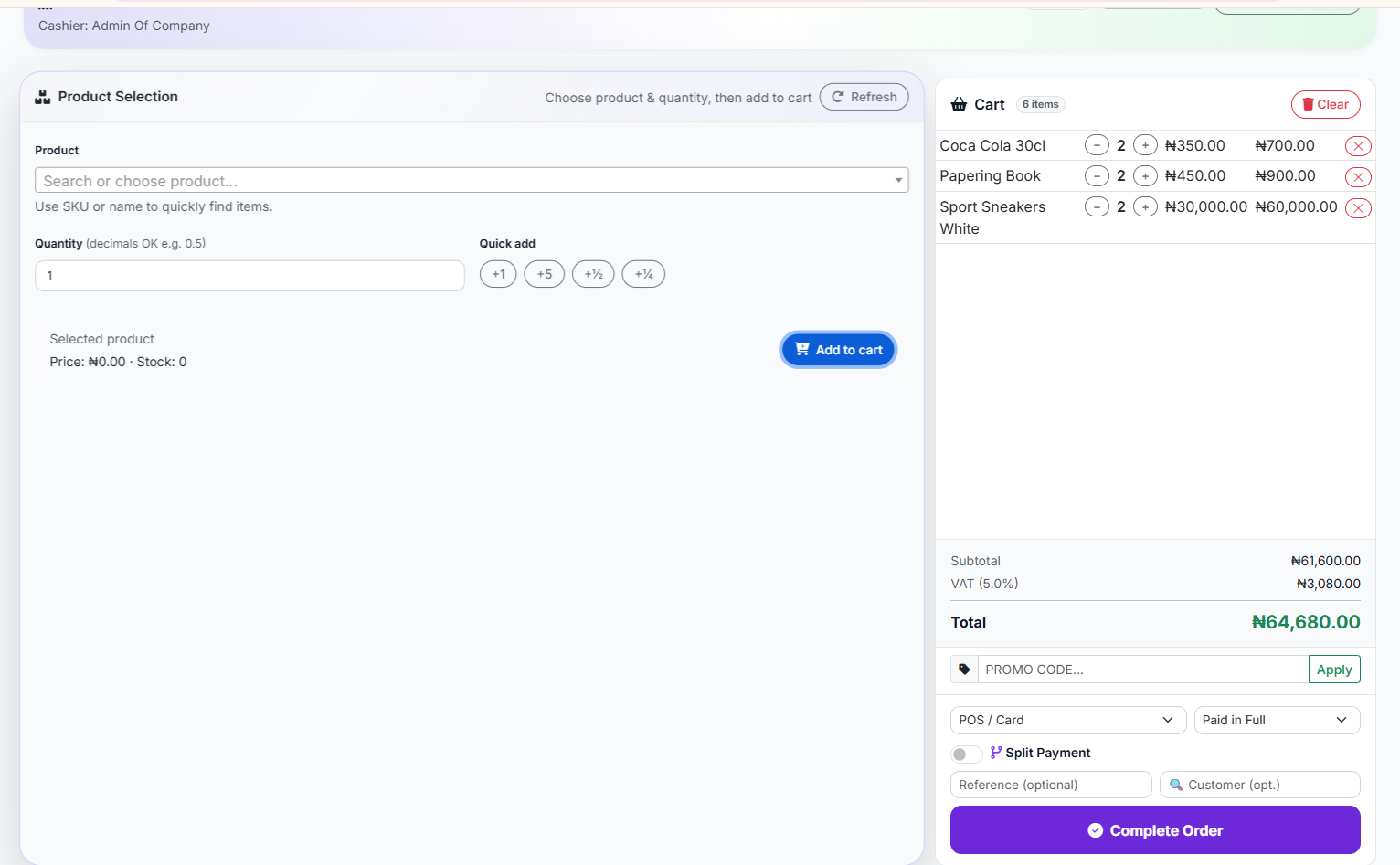 Classic POS Interface (List select)
SwiftPOS NG offers a classic POS interface for quick and easy sales processing.
Step 4: Set Up Your Sales & Display Area
This is where the magic happens – where customers interact with your products and make purchases.
- What to do: Get a sturdy display counter and a functional cashier desk. Think about how customers will browse and how you'll process payments efficiently.
- Why it matters: A well-designed counter makes transactions smooth and professional. It also provides a secure space for your POS system and cash.
- Common shortcut that backfires: Using a flimsy table as a cashier desk. It looks unprofessional, is prone to damage, and doesn't offer any security.
- Specific action item: Source a good quality display counter and cashier desk. Budget for a Display Counter/Cashier Desk: ₦50,000 to ₦180,000.
Step 5: Build Your Team (Even if it's Just One)
You can't do everything yourself forever. Even if you start alone, consider when you'll need help.
- What to do: If you plan to hire staff, even just one sales assistant, define their role, responsibilities, and salary. Look for someone passionate about beauty and good with people.
- Why it matters: Good staff can significantly enhance the customer experience and allow you to focus on growing the business. Poor staff can drive customers away and even steal.
- Common shortcut that backfires: Hiring unqualified or untrustworthy staff just because they're cheap or related. This can lead to poor sales, bad customer service, and even theft.
- Specific action item: If hiring, budget for Staff Salary (Monthly, 1 Sales Assistant): ₦45,000 (entry-level in a smaller town) to ₦90,000 (experienced in a major city like Lagos). Remember, you'll need to pay this monthly.
Step 6: Get the Word Out
No one will buy from you if they don't know you exist. Marketing is not an afterthought.
- What to do: Start with a clear, attractive sign for your shop. Then, think about digital marketing – a strong Instagram presence is vital for a cosmetics business. Consider local flyers or a small launch event.
- Why it matters: Marketing drives awareness and brings customers through your door. For a beauty business, visual appeal on social media is non-negotiable.
- Common shortcut that backfires: Thinking "if you build it, they will come." In Nigeria, you have to actively tell people you're open for business. Relying only on word-of-mouth takes too long.
- Specific action item: Design and install a clear shop sign. Set up your business Instagram page. Budget for Marketing/Signage (Initial): ₦30,000 (simple banner) to ₦150,000 (illuminated sign and a targeted social media push).
The Numbers That Will Make or Break You
Now, let's talk real money. This is the part where you see the true cosmetics startup cost in Nigeria. These are not just figures; they are your roadmap to financial stability.
Here’s a breakdown of what you really need to factor in for your initial capital and ongoing costs.
One-Time Startup Costs (The Capital You Need to Start):
| Item | Low-End Estimate (₦) | High-End Estimate (₦) |
|---|---|---|
| Business Registration (CAC) | 25,000 | 70,000 |
| NAFDAC Registration (if applicable) | 150,000 | 500,000 |
| Shop Rent (Annual) | 80,000 | 2,500,000 |
| Shop Fitting/Shelving | 150,000 | 700,000 |
| Initial Stock Purchase | 300,000 | 3,000,000 |
| Generator (Small) | 80,000 | 250,000 |
| Display Counter/Cashier Desk | 50,000 | 180,000 |
| POS Machine/Basic Software | 40,000 | 120,000 |
| Marketing/Signage (Initial) | 30,000 | 150,000 |
| Miscellaneous/Contingency | 100,000 | 500,000 |
| TOTAL ESTIMATED STARTUP COST | 1,005,000 | 7,970,000 |
Honestly, that high-end number might surprise some people. But if you’re looking to open a premium cosmetics shop in a prime Lagos location, selling a wide range of imported brands, these figures are very real for 2026. For a modest shop in a less expensive area, you could start with just over ₦1 million. That's your beauty business capital.
Monthly Running Costs (What You Need to Keep the Doors Open):
| Item | Low-End Estimate (₦) | High-End Estimate (₦) |
|---|---|---|
| Staff Salary (1 Sales Assistant) | 45,000 | 90,000 |
| Monthly Electricity (Generator fuel + grid) | 20,000 | 80,000 |
| Internet/Communication | 5,000 | 15,000 |
| Restocking (Ongoing) | 100,000 | 500,000 |
| Marketing (Ongoing) | 10,000 | 50,000 |
| Miscellaneous (Cleaning, repairs) | 15,000 | 40,000 |
| TOTAL ESTIMATED MONTHLY COST | 195,000 | 775,000 |
This means after you’ve spent your initial capital, you need to be generating enough sales to cover at least ₦195,000 to ₦775,000 every single month just to break even on operational costs. This doesn't even include paying yourself!
Expected Revenue Timelines:
Let's be honest about this: you won't be profitable from day one.
- Break-even: Most new retail businesses in Nigeria take 6 to 12 months to consistently cover their operating costs.
- Profitability: Expect to see consistent net profit after 12 to 24 months, assuming you're managing your business well and your marketing is effective.
> "Many entrepreneurs focus so much on sales, they forget profit is what keeps the lights on. If you don't know your true costs, you don't know your true profit."
Growth After Launch: The Next 90 Days
You've opened your doors, the shop looks great, and you've made your first few sales. What next? The first 90 days post-launch are critical for building momentum and establishing your brand in the competitive cosmetics shop Nigeria market.
- Monitor Your Sales Daily: Don't wait until month-end. Look at what's selling and what's just sitting there. Are people buying more skincare or makeup? Which brands are flying off the shelves? This helps you adjust your stock orders quickly. A good system like SwiftPOS NG can give you real-time sales reports and even highlight your best-performing products, so you don't have to guess.
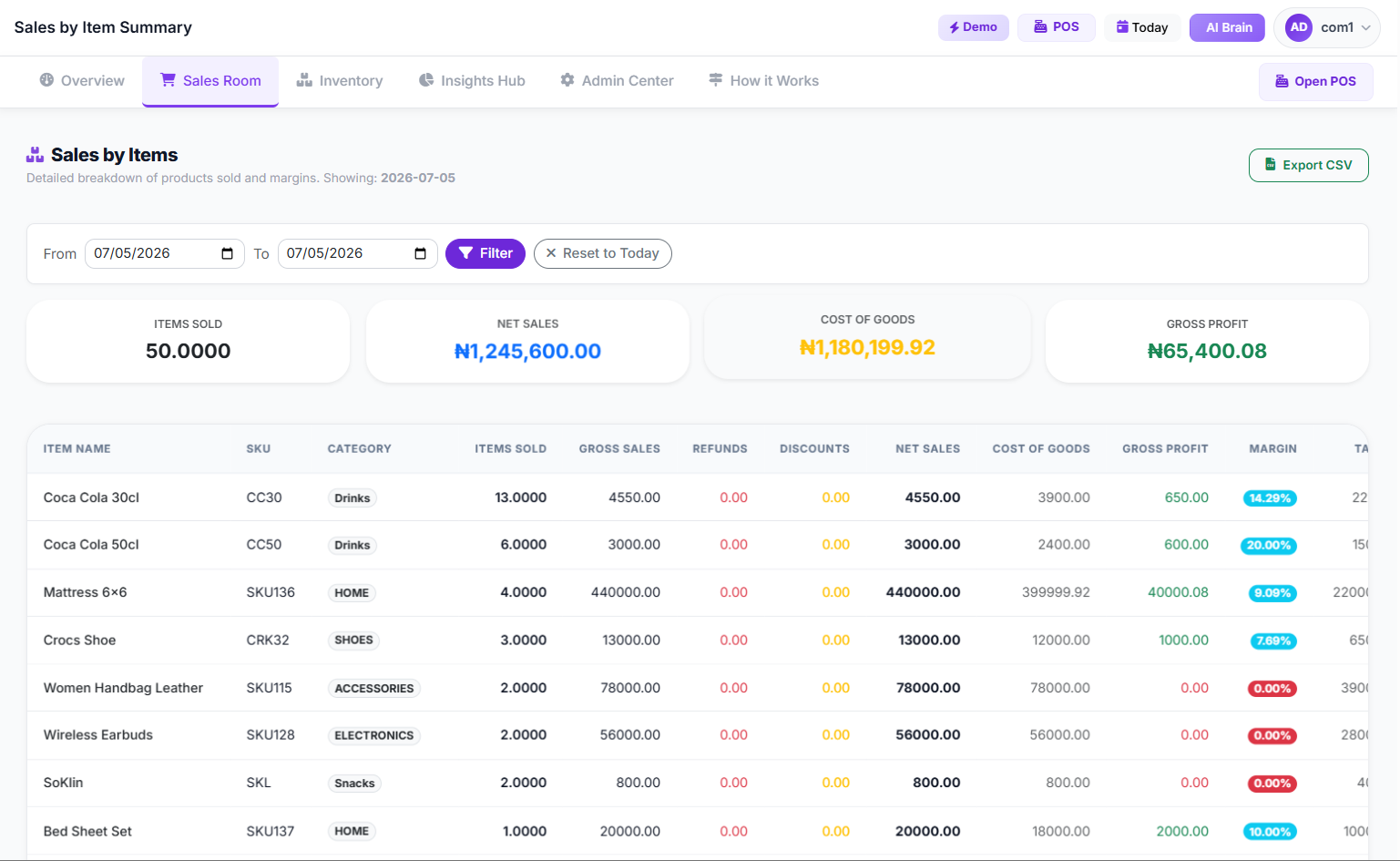 Sales By Item Page
SwiftPOS NG provides detailed sales-by-item reports to help you understand product performance.
- Engage with Customers: Ask them what they like, what they're looking for, and what products they wish you carried. Their feedback is gold. Use this to refine your product offerings and improve your customer service.
- Build Your Online Presence: Keep your Instagram active. Post high-quality images and videos of your products. Run small promotions or giveaways to build your follower count and engagement. Show your shop, show your products, show happy customers.
- Manage Your Inventory Tightly: This is where many new businesses bleed money. Overstocking means cash tied up in products that aren't moving. Understocking means lost sales. Use your POS system to track inventory levels, set reorder points, and identify slow-moving or expired products. SwiftPOS NG can even help you with stock forecasting, predicting when you'll run out of popular items so you can restock proactively. This is especially important for cosmetics with expiry dates. You don't want to be selling expired products, ever.
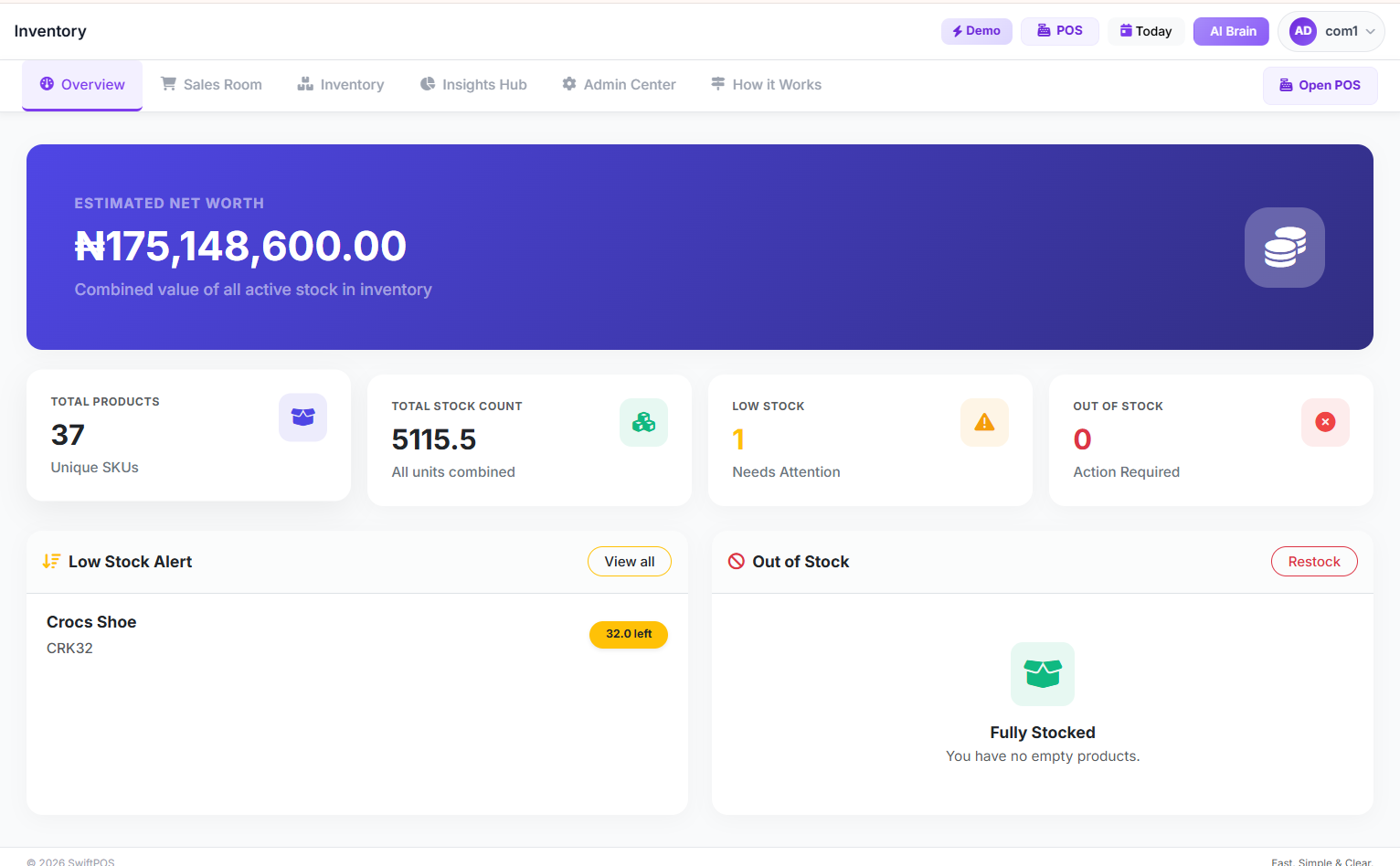 Inventory Dashboard
The SwiftPOS NG inventory dashboard gives you an overview of your stock levels and helps identify issues.
- Track Every Naira: Know your expenses. Every single one. From generator fuel to marketing spend. Compare it against your revenue. Are you making a profit? If not, where can you cut costs or increase sales? You need to understand your true net profit, not just how much money came in.
FAQ: Answers to What You're Actually Googling
Q1: How much capital do I really need to start a small cosmetics shop in a local market in Lagos in 2026?
For a small cosmetics shop in a local market like Yaba or Ikotun, you're looking at a minimum initial capital of around ₦1,005,000 to ₦2,500,000. This covers basic rent, simple shelving, initial stock of popular local and affordable imported brands, a small generator, and essential registration. Don't forget to have some extra cash for unexpected costs.
Q2: Is a cosmetics business profitable in Nigeria?
Yes, a cosmetics business can be very profitable in Nigeria, but it's also highly competitive. Profitability depends on several factors: your location, target market, product selection, pricing strategy, and most importantly, your ability to manage costs and inventory efficiently. Margins on some products can be as high as 30-50%, but you need volume and tight control to see real profit.
Q3: How long does it take to register a cosmetics business with CAC and NAFDAC?
Registering your business with the Corporate Affairs Commission (CAC) can take as little as 3-7 working days for a sole proprietorship, and 1-3 weeks for a limited company, assuming all documents are in order. NAFDAC registration, however, is a more rigorous process. For a new product or importer, it can take anywhere from 3 to 6 months, sometimes longer, depending on the product type and how quickly you provide all required documentation and samples. Start NAFDAC processes early if you need it.
Q4: What are the biggest mistakes new cosmetics shop owners make in Nigeria?
The biggest mistakes include:
- Underestimating startup costs: Not budgeting for everything from generator fuel to proper marketing.
- Poor inventory management: Overstocking slow-moving items, understocking popular ones, and not tracking expiry dates. This leads to wasted capital and lost sales.
- Ignoring customer service: Treating customers poorly or not engaging with them to understand their needs.
- Lack of proper record-keeping: Not knowing what's selling, what's profitable, or where money is going. This is why a good POS system is essential.
- Inconsistent power: Not having a reliable backup power source, which can disrupt sales and damage equipment.
Q5: Can I start a cosmetics business from home in Nigeria with less capital?
Absolutely. Starting from home or online (e-commerce) significantly reduces your overheads like shop rent and extensive shop fittings. You can begin with a smaller initial stock purchase, focusing on a niche, and use social media marketing. Your beauty business capital would be much lower, perhaps starting from ₦300,000 to ₦800,000, primarily for initial stock, a good phone/camera, and marketing. As you grow, you can then consider opening a physical shop.
Ready? Here's Where to Start
Starting a cosmetics shop in Nigeria is a fantastic venture, but it's not for the faint of heart. It requires careful planning, a realistic budget, and relentless execution. You've seen the numbers, you know the steps. The key is to start small, learn fast, and manage every aspect of your business with precision.
If you're serious about not just opening, but succeeding, you need tools that work as hard as you do. Don't let manual errors or guesswork eat into your profits. Explore how SwiftPOS NG can help you manage your sales, stock, staff, and finances from day one. It's built for Nigerian businesses like yours, helping you track every product, every sale, and every kobo, so you can focus on making your beauty business shine. Take the first step towards a well-managed business today. Check out our features and see how we can help you grow.

How Much Does It Cost to Start a Clothing Business in …
Oct 17, 2026
How to Start a Cosmetics Business in Nigeria: A Step-b…
Oct 17, 2026
Restaurant Startup Cost in Nigeria: Your Complete Guide
Oct 16, 2026