How To Set Wholesale And Retail Prices For Products in Nigeria — Complete Guide for Shop Owners
SwiftPOS Team
Published May 01, 2026
If you run a shop in Nigeria — whether it's a provision store in Aba, a supermarket in Abuja, or a wholesale distributor in Lagos — you already know the pressure of how to set wholesale and retail prices for products in Nigeria. Price too high and customers walk away. Price too low and you're running at a loss without even knowing it. Getting this balance right is one of the most important skills any Nigerian business owner can develop.
In this guide, we'll break down exactly how to set wholesale and retail prices the right way — with practical examples tailored to Nigerian market realities. We'll also show you how tools like SwiftPOS make the entire process automatic, accurate, and stress-free.
Start your free SwiftPOS trial today →
Why So Many Nigerian Shops Get Pricing Wrong
Pricing errors are more common than most shop owners admit — and the consequences are serious. Here's what typically goes wrong:
- No separation between wholesale and retail prices. Many shop owners sell to both walk-in customers and bulk buyers at the same price, leaving significant money on the table.
- Guesswork and "feeling." Without a system, prices are set based on gut instinct rather than actual cost calculations — leading to months of operating at a loss.
- Staff selling at unauthorized prices. When price lists aren't enforced digitally, cashiers and sales staff can adjust prices manually, opening the door to abuse and revenue leakage.
- Naira fluctuations catch shops off guard. With the ever-changing exchange rate, shop owners who import goods often forget to update their selling prices after restocking at a higher cost — and end up selling at a loss.
- No record of what margin they're actually making. Many Nigerian retailers are busy making sales but have no clear picture of actual profit margins per product.
These are not small problems. Collectively, they can silently drain a business over months. The solution starts with understanding how pricing actually works.
How to Set Wholesale and Retail Prices for Products in Nigeria
Here is a simple, step-by-step framework that works for Nigerian businesses of every size:
Step 1: Know Your Cost Price (CP)
Before you can set any selling price, you must know exactly what it cost you to acquire or produce each product. This includes:
- Purchase price from your supplier
- Transport and logistics costs
- Import duties or clearing fees (if applicable)
- Storage or handling costs
Example: You buy a carton of noodles for ₦6,500 from your distributor in Lagos, and spend ₦300 on transport. Your real cost price is ₦6,800.
Step 2: Calculate Your Markup
Markup is the percentage you add on top of cost price to arrive at a selling price. Nigerian retailers typically work with:
- Wholesale markup: 5% – 15% (lower margin, higher volume)
- Retail markup: 20% – 50% (higher margin, lower volume per customer)
The right markup for your business depends on your industry, competition, and operating costs. A pharmacy has different margin realities than a provision store.
Example: At a 10% wholesale markup, your noodles carton sells for ₦7,480. At a 30% retail markup per pack (12 packs in a carton), each pack retails at ₦736.
Step 3: Set Two Separate Price Tiers
This is where most Nigerian shops fail — they have only one price. A proper pricing system has at minimum:
- Retail Price (RP): For walk-in customers buying one or a few units
- Wholesale Price (WP): For bulk buyers, market traders, or regular large-quantity customers
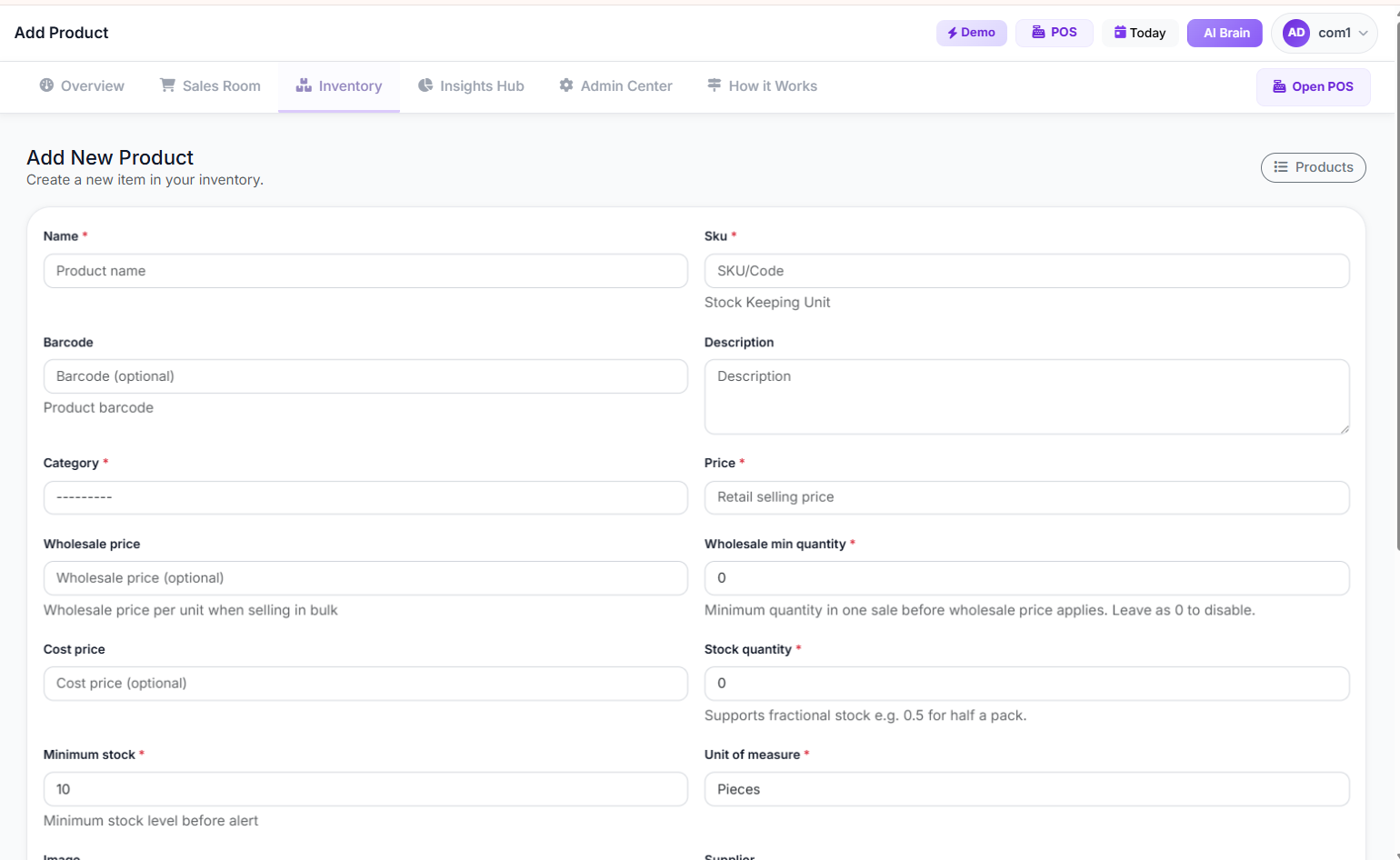
Some businesses add a third tier — a VIP or loyalty price — for their best customers. SwiftPOS supports all of this natively.
Step 4: Factor in Operating Costs
Your selling price must cover more than just the cost of goods. Add a portion of your monthly running costs — rent, NEPA bills, generator fuel, staff salaries, data, and POS charges — into your markup calculation. Many Nigerian shop owners skip this step and wonder why the money never stays.
Tip: Add at least 5–8% to your base markup to account for overhead, depending on your shop size.
Step 5: Check the Market
After calculating your prices, compare them with what competitors in your area are charging. You don't need to undercut everyone — but your prices should be defensible. If yours are 30% higher with no visible reason, customers will notice.
Step 6: Review Prices After Every Restock
This is critical in Nigeria's current economic climate. Whenever you restock at a new (usually higher) cost, your selling prices must be updated immediately — before those goods are sold. Failing to do this is one of the most common causes of quiet losses in Nigerian retail.
How SwiftPOS Makes Wholesale and Retail Pricing Effortless
Knowing the theory is great — but enforcing it across your shop, with multiple staff members and hundreds of products, is where most businesses struggle. That's exactly what SwiftPOS is built for.
Here's how SwiftPOS handles wholesale and retail pricing for Nigerian businesses:
✅ Multiple Price Levels Per Product
SwiftPOS lets you set retail price, wholesale price, and VIP/loyalty price for every single product in your catalogue. When a customer buys above a certain quantity, the system automatically applies the wholesale price — no manual intervention, no room for staff to manipulate figures.
✅ Real-Time Cost Price Tracking
Every time you receive new stock, SwiftPOS updates your cost price. Your gross margin per product is always visible, so you know exactly how much profit you're making — in real time, not at the end of the month.
✅ Price Change Alerts
Restocked a product at a higher cost? SwiftPOS flags it and prompts you to review the selling price before the item goes back on sale. This one feature alone can save Nigerian shop owners thousands of naira monthly.
✅ Staff Price Control
With SwiftPOS, only authorized managers can change prices. Cashiers sell at the price set in the system — nothing more, nothing less. This eliminates one of the most common forms of staff theft and price manipulation in Nigerian retail.
✅ Wholesale Customer Profiles
You can tag specific customers as wholesale buyers in SwiftPOS. Whenever they make a purchase, the system automatically applies their wholesale pricing tier — seamlessly, without any awkward price negotiation at the counter.
Try SwiftPOS free for 3 days — no credit card needed →
Pro Tips for Nigerian Shop Owners
- Never set prices in your head. Always calculate from cost price upwards. Intuition is not a pricing strategy — especially when the naira is moving.
- Review all prices at least once a month. Markets shift fast in Nigeria. A product you priced in January may be costing you 15% more by March. Monthly reviews protect your margins.
- Separate your wholesale customers into a list. Know who your bulk buyers are, what they buy, and how often. This lets you negotiate better deals with your own suppliers based on predictable volume.
Frequently Asked Questions
What is the difference between wholesale price and retail price?
Wholesale price is the lower price offered to buyers purchasing in bulk — typically traders, distributors, or businesses. Retail price is the higher price charged to individual end consumers buying smaller quantities. The gap between the two is your wholesale margin.
How do I calculate wholesale price for my products in Nigeria?
Start with your cost price (including transport and logistics), then add a markup of 5–15% depending on your industry and volume expectations. Make sure your wholesale price still covers a reasonable portion of your overhead costs, not just the cost of goods.
Does SwiftPOS support multiple pricing tiers for wholesale and retail?
Yes. SwiftPOS allows you to set retail price, wholesale price, and loyalty/VIP price for every product. The system automatically applies the correct tier based on the customer type or quantity purchased — no manual adjustment needed.
How quickly can I set up wholesale pricing in SwiftPOS?
Most shop owners complete their initial product and pricing setup within one business day. SwiftPOS supports bulk product upload via spreadsheet, so if you already have a product list, setup is even faster. The SwiftPOS support team is also available to help Nigerian businesses get started.
Is SwiftPOS affordable for small shops in Nigeria?
Yes — SwiftPOS is specifically priced for the Nigerian market. Plans start from a few thousand naira per month, and there is a free 3-day trial so you can experience the full system before committing. For small shops, the revenue recovered from better pricing control typically far outweighs the subscription cost.
Conclusion
Setting the right wholesale and retail prices for your products in Nigeria isn't just about making a sale — it's about building a sustainable, profitable business. With the right framework (know your costs, set tiered prices, review regularly) and the right tools, you can take full control of your margins and stop leaving money on the table.
SwiftPOS was built specifically to help Nigerian retailers and wholesalers do this without stress — automatically, accurately, and at scale. Whether you run one shop or ten branches, the principles are the same and the system handles the heavy lifting.
Ready to take control of your pricing? Start your free SwiftPOS trial today and see the difference a proper system makes.
Ready to Set Smarter Prices and Grow Your Business?
Join hundreds of Nigerian shop owners using SwiftPOS to manage wholesale and retail pricing, track margins, and protect their revenue — automatically.
Start Your Free 3-Day Trial →No credit card required. Setup in minutes. Built for Nigeria.

How to Know If Your Business Is Actually Profitable: A…
Oct 08, 2026
How to Stop Cash Leakage in Your Business: A Comprehen…
Oct 04, 2026
How to Start a Food Business with Low Capital: A Step-…
Oct 01, 2026