5 Best POS Systems for Small Businesses in Nigeria (2024)
SwiftPOS Team
Published September 28, 2026
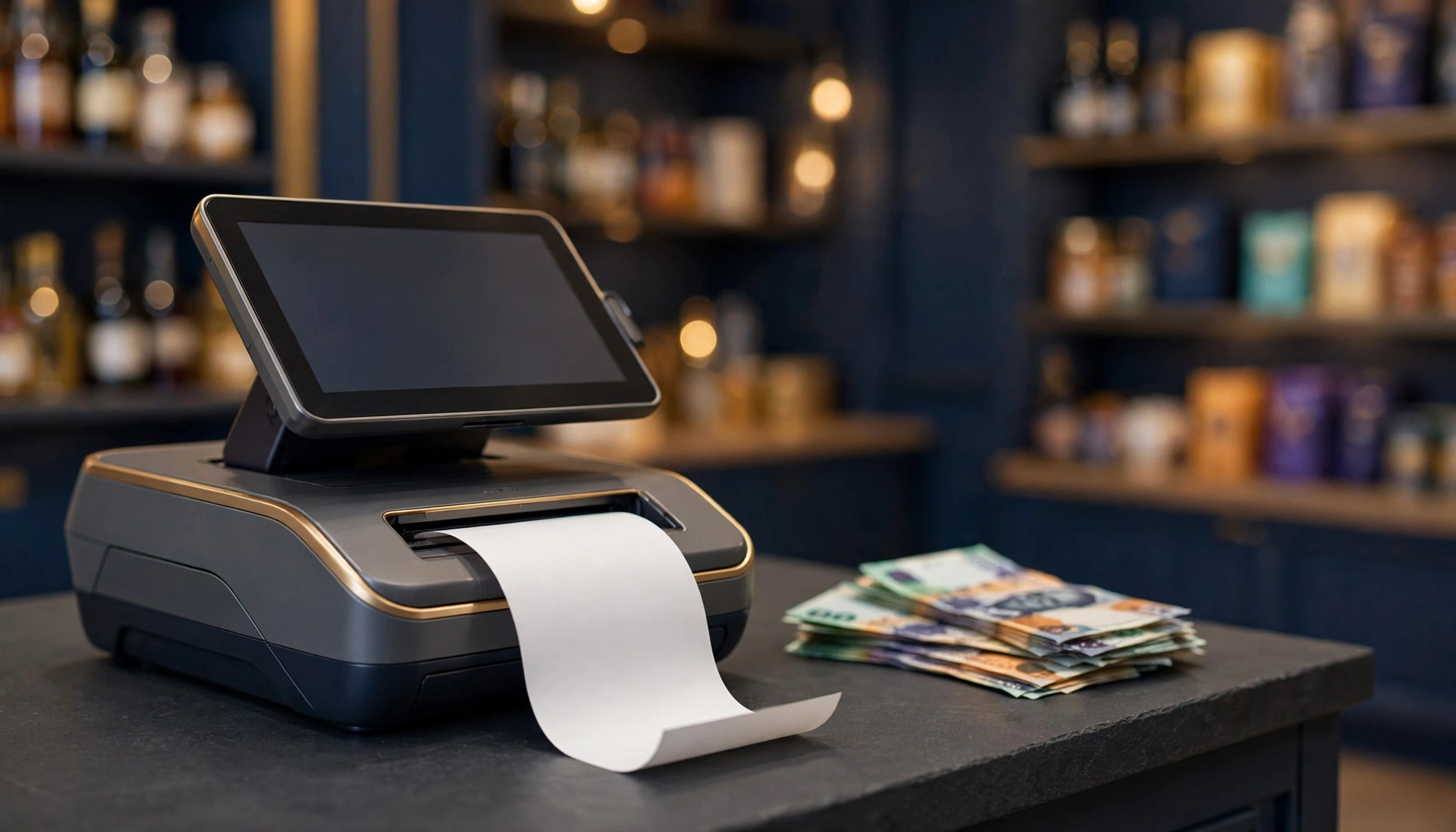
Are you tired of losing track of sales, struggling with inventory counts, or constantly second-guessing your business's true financial health? Many Nigerian small business owners face these exact frustrations daily, often relying on outdated manual methods that drain time and money. The good news is, in 2026, technology offers powerful solutions.
Nigerian shop owner smiling at a modern posThe Hidden Costs of Manual Operations in Today's Market
Running a small business in Nigeria is challenging enough without the added burden of inefficient systems. Imagine the time spent manually reconciling daily sales, trying to pinpoint missing stock, or calculating profit margins by hand. These aren't just minor inconveniences; they are significant revenue leaks. Research shows that manual retail operations can incur substantial hidden costs, impacting everything from customer satisfaction to long-term profitability.
Consider a typical provision store in Lagos. Without a proper Point-of-Sale (POS) system, they might spend ₦15,000 to ₦30,000 monthly on staff hours dedicated solely to inventory checks and sales reconciliation. That's a minimum of ₦180,000 to ₦360,000 annually that could be reinvested or saved. Furthermore, stock discrepancies due to manual tracking can lead to losses of 5% to 10% of inventory value. For a business with ₦500,000 worth of stock, that's ₦25,000 to ₦50,000 lost monthly, or up to ₦600,000 annually. These figures quickly add up, turning what seems like a small operational choice into a major financial burden.
Another critical pain point is the inability to accurately track customer credit. Many small businesses in Nigeria extend credit to loyal customers, but without a robust system, managing these debts can become a nightmare. A forgotten payment or an incorrectly recorded partial payment can lead to significant unrecovered funds, directly impacting cash flow. Manual systems also make it nearly impossible to identify your best-selling products or understand peak sales hours, hindering your ability to make informed business decisions and truly increase sales in your retail shop.
Why a Modern POS System is Essential for Nigerian Small Businesses in 2026
In 2026, the competitive landscape for Nigerian small businesses demands efficiency and data-driven decisions. A modern POS system goes far beyond a simple cash register; it's a comprehensive business management tool. These systems are designed to automate sales, manage inventory, track customer information, and provide valuable insights into your business performance. This automation frees up valuable time, reduces errors, and allows business owners to focus on growth strategies rather than administrative tasks.
For instance, consider a pharmacy in Abuja. With a proper POS, they can easily track expiry dates of medicines, preventing losses from expired stock—a critical feature for health-related businesses. A boutique owner in Port Harcourt can use sales data to identify which clothing styles are popular and which are slow-moving, informing future purchasing decisions and reducing dead stock. This level of insight is simply unattainable with traditional bookkeeping methods. The shift from manual processes to integrated POS software is not just an upgrade; it's a necessity for survival and growth in the current Nigerian market. You can explore more about making this transition in our guide on why Nigerian retailers should stop using spreadsheets.
Modern POS systems also enhance the customer experience. Faster checkout times, accurate pricing, and the ability to accept various payment methods (cash, POS/card, bank transfer, mobile money) contribute to customer satisfaction and repeat business. In an economy where every customer interaction counts, providing a seamless checkout experience can be a significant differentiator.
Adopting a Smarter Approach to Retail Management
The smarter approach for Nigerian small businesses involves integrating their sales, inventory, customer, and financial data into one cohesive system. This means moving away from disparate spreadsheets, manual ledgers, and guesswork. The goal is to gain a real-time, 360-degree view of your operations, enabling proactive decision-making rather than reactive problem-solving.
This integrated approach begins with a Point-of-Sale (POS) system as its central hub. When a sale occurs, it doesn't just record the transaction; it simultaneously updates inventory levels, tracks customer purchase history, contributes to daily sales reports, and informs profit calculations. This interconnectedness eliminates the need for redundant data entry and drastically reduces the potential for human error. For businesses with multiple branches, this approach is even more critical, allowing for centralized management and inventory tracking across all locations, as detailed in our guide on multi-branch retail.
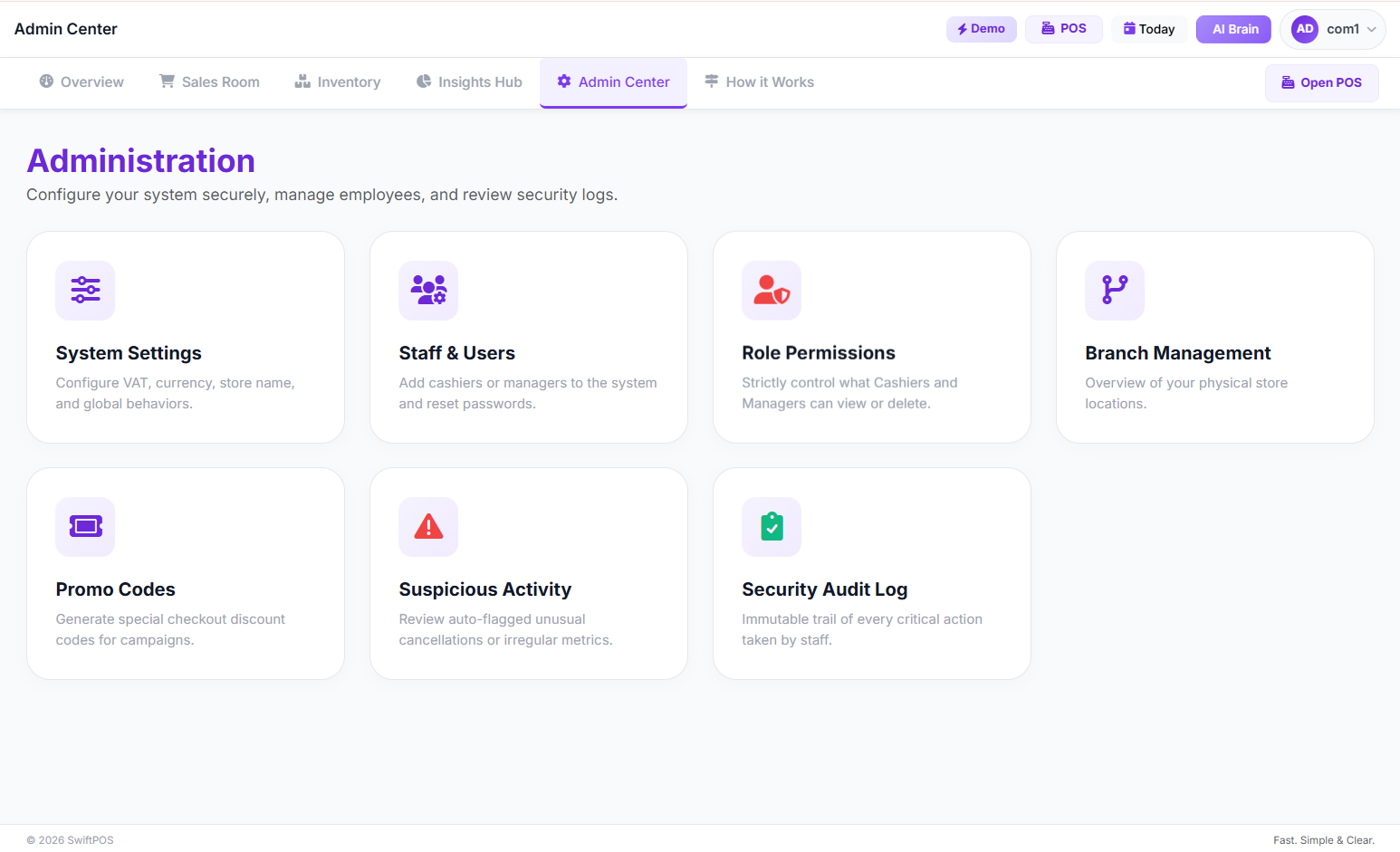 Admin Center Hub showing various management options
Beyond sales, a smart retail management system should also incorporate expense tracking, supplier management, and staff performance monitoring. By recording all operating expenses directly within the system, a business owner can get a clear picture of their true net profit, not just gross revenue. Understanding these financial flows is crucial for sustainable growth. Similarly, managing suppliers and purchase orders digitally ensures better stock control and accountability. This holistic view empowers business owners to identify inefficiencies, capitalize on opportunities, and steer their business towards greater profitability.
The Best POS for Small Business in Nigeria: SwiftPOS NG
For Nigerian small businesses seeking a robust, all-in-one solution, SwiftPOS NG stands out as a leading contender for the best POS for small business in Nigeria. It's designed specifically for the local market, integrating sales, inventory, customer management, staff control, and financial reporting into one user-friendly platform. SwiftPOS NG helps businesses like supermarkets, pharmacies, boutiques, and provision stores manage their operations efficiently, providing useful insights and even leveraging AI to streamline tasks.
SwiftPOS NG offers various POS modes, including Classic, Smart Grid, and Barcode POS, catering to different business needs and checkout speeds. This flexibility ensures that whether you run a busy supermarket or a boutique, your sales process is optimized.
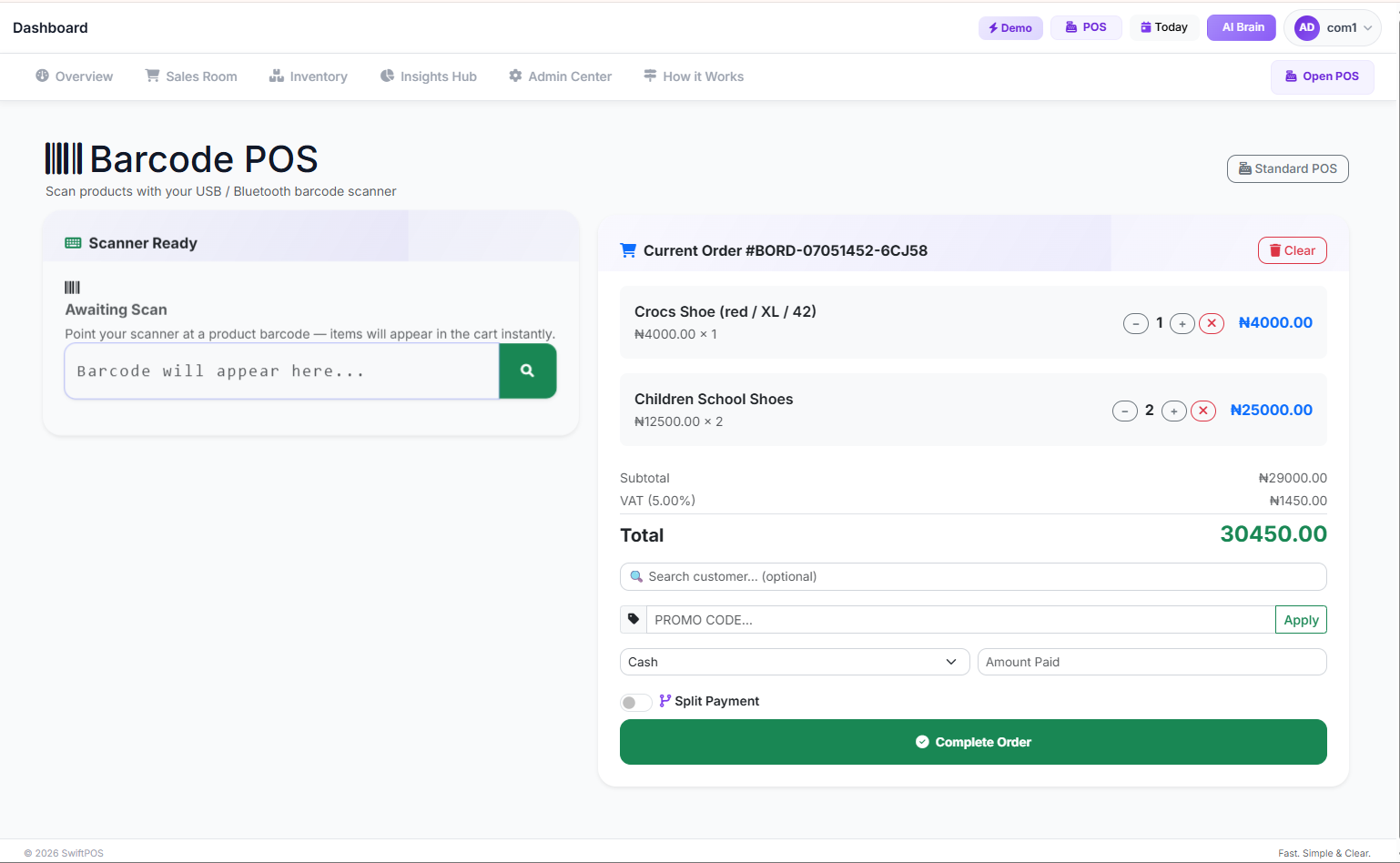 Barcode POS Interface showing product scanning
Beyond sales, its comprehensive inventory management features allow you to track stock quantities, expiration dates, and even manage product variants like different sizes and colours. For businesses with multiple locations or a central warehouse, SwiftPOS NG facilitates seamless stock transfers and maintains separate inventory balances for each branch. This is crucial for maintaining optimal stock levels and preventing stockouts or overstocking, issues discussed in our article on inventory management mistakes.
What truly sets SwiftPOS NG apart for small businesses is its focus on providing a complete management ecosystem. It helps track customer debts, manage suppliers, monitor staff activities, and even offers detailed profit and loss statements by recording operating expenses. This means you get a clear picture of your business's financial health, helping you make informed decisions. The system is also designed to work offline, ensuring your sales operations continue even with internet connectivity issues—a vital feature in the Nigerian context. You can explore a detailed list of its capabilities on the SwiftPOS NG features page.
Proof: Manual vs. Modern POS System
Let's look at a side-by-side comparison of how a traditional, manual system stacks up against a modern POS solution for a typical Nigerian small business.
| Feature / Aspect | Traditional Manual System (e.g., pen & paper, Excel) | Modern POS System (e.g., SwiftPOS NG) |
|---|---|---|
| Sales Tracking | Handwritten ledgers, basic Excel sheets. Prone to errors, slow to reconcile. | Automated recording, real-time updates, multiple payment options. Fast and accurate. |
| Inventory Management | Manual stock counts, guesswork. High risk of stockouts, overstocking, and expiry losses. | Real-time inventory updates, automated low-stock alerts, expiry date tracking, bulk import. |
| Customer Management | Physical notebooks, difficult to track purchase history or outstanding credit. | Digital customer directory, credit tracking, payment history, loyalty programs. |
| Reporting & Insights | Time-consuming manual calculations for sales, profit. Limited insights. | Automated sales reports, profit & loss statements, best-seller identification, staff performance. |
| Error Rate | High. Human errors in calculation, data entry, and reconciliation are common. | Low. Automation significantly reduces errors, improving data accuracy. |
| Time Efficiency | Very low. Significant time spent on administrative tasks daily. | High. Automates routine tasks, freeing up staff and owner time. |
| Cost (Hidden) | High. Losses from errors, stock shrinkage, unrecovered debt, wasted staff time. | Low. Reduced losses, improved efficiency, better decision-making leading to higher profits. |
| Scalability | Extremely difficult to scale with growth, especially with multiple branches. | Designed for growth, easily supports multiple branches and increasing product lines. |
| Security | Vulnerable to theft, fraud, and data loss (e.g., lost ledger). | Secure data storage, staff permissions, audit trails, suspicious activity flagging. |
| Initial Setup Cost | Minimal (cost of stationery, basic computer). | Moderate (POS terminal: ₦80,000 - ₦350,000; Software: ₦50,000 - ₦150,000 annually). |
| Running Cost | Low (stationery, basic electricity). | Moderate (Software subscription: ₦5,000 - ₦15,000 monthly; Internet: ₦2,500 - ₦7,000 monthly). |
This comparison clearly shows that while the initial outlay for a modern POS system might seem higher, the long-term benefits and cost savings far outweigh the perceived 'cheapness' of manual methods. The return on investment for a POS system in Nigeria is often quick and substantial.
Frequently Asked Questions about POS Systems for Small Businesses
What is the typical cost of a POS system for a small business in Nigeria?
The cost varies based on features and hardware. A basic POS terminal can cost between ₦80,000 and ₦150,000. More advanced systems with integrated printers and scanners might range from ₦180,000 to ₦350,000. Software subscriptions typically cost between ₦5,000 and ₦15,000 per month, or ₦50,000 to ₦150,000 annually for discounted plans. Don't forget one-time setup fees (₦10,000 - ₦40,000) and annual maintenance (₦20,000 - ₦70,000). For a detailed breakdown, see our blog on POS system ROI.
Can a POS system work without an internet connection in Nigeria?
Yes, many modern POS systems, like SwiftPOS NG, are designed with offline capabilities. This means you can continue to process sales even if your internet connection is interrupted. Transactions are then synchronized once connectivity is restored. This is a crucial feature for businesses operating in areas with unstable internet. You can learn more about this in our article: Can Your POS System Work Without Internet?
How long does it take to set up a POS system for a small business?
Setup time depends on the complexity of your business and the system chosen. For a simple setup, you might be operational within a few hours or a day. For businesses with extensive product catalogs or multiple branches, it could take a few days to a week to import all data and train staff. Many providers offer assisted setup and tutorials to guide you through the process. SwiftPOS NG provides a step-by-step onboarding guide to help Nigerian retailers.
What are the key benefits of using a POS system over traditional methods?
The primary benefits include increased efficiency, reduced errors, real-time inventory tracking, better financial reporting, improved customer management, and enhanced security. A POS system helps you make informed business decisions, reduce losses from theft or spoilage, and provide a faster, more professional checkout experience for your customers. These benefits directly contribute to higher profits and sustainable growth.
Is it difficult to train staff to use a new POS system?
Modern POS systems are designed to be user-friendly with intuitive interfaces. Most staff can learn the basics of processing sales within a few hours of training. Advanced features might take a bit longer, but the investment in training pays off quickly through reduced errors and increased productivity. Many systems offer different user roles and permissions, allowing you to tailor access based on staff responsibilities. Our guide on how to set staff access permissions can help.
What kind of hardware do I need for a POS system?
At a minimum, you'll need a device to run the software (a tablet, smartphone, or computer), a receipt printer, and potentially a barcode scanner. An integrated card reader is also highly recommended. The specific hardware depends on your business volume and type. Some businesses opt for all-in-one POS terminals, while others prefer tablet-based systems. You can find more information in our guide on complete POS hardware setup for supermarkets.
How does a POS system help with inventory management?
A POS system automatically updates stock levels with every sale, purchase, or return. It can track products by category, variant, and even expiry date. Features like automated low-stock alerts, stock adjustment records, and bulk import/export capabilities streamline inventory control, helping you avoid stockouts and identify slow-moving items. This is crucial for managing your retail inventory efficiently.
Can a POS system help me manage customer credit and debt?
Yes, many POS systems include customer relationship management (CRM) features. They allow you to create a customer directory, track individual purchase histories, and manage outstanding credit. You can record partial payments, view debt balances, and see a complete payment history for each customer, significantly improving your ability to recover funds.
What is the return on investment (ROI) for a POS system?
The ROI for a POS system typically comes from reduced errors, increased sales efficiency, better inventory management (leading to less waste and fewer stockouts), improved customer loyalty, and valuable business insights that enable smarter decision-making. While the exact ROI varies, many Nigerian businesses find that a good POS system pays for itself within months through these tangible and intangible benefits. Our blog on calculating true value for Nigerian retailers can provide more insights.
What should I look for when choosing the best POS for small business in Nigeria?
When selecting a POS system, consider ease of use, features relevant to your business type (e.g., expiry tracking for pharmacies, variant management for boutiques), offline capabilities, customer support, pricing structure, and scalability. It's also vital to choose a system designed with the Nigerian market in mind, like SwiftPOS NG, which understands local payment methods and operational challenges. For a comprehensive guide, check out our retail POS system checklist.
Ready to Transform Your Business?
Stop letting manual processes hold your business back. Embrace the efficiency and insights that a modern POS system can offer.
Get Started with SwiftPOS NG Today!

Cost to Open a Mini Supermarket in Nigeria: A Detailed…
Sep 28, 2026
10 Best Retail POS Systems for 2026: Unbiased Reviews …
Sep 27, 2026
7 Best Retail POS Systems for Small Businesses in 2026…
Sep 27, 2026