Pharmacy Profit Margins in Nigeria: What to Expect
SwiftPOS Team
Published October 11, 2026

You know, I've seen pharmacies in Lagos and Abuja pull in a monthly revenue of up to ₦5,000,000 in 2026. That's not profit, mind you, but it shows you the kind of money that moves through these businesses. What you keep at the end of the day, your actual pharmacy profit margin, that's a whole different ball game. It's often much smaller than most people think, and it's where the real work begins for any pharmacy business in Nigeria.
Busy pharmacist attending to a customer in aThe Silent Killer: Unseen Costs Eating Your Pharmacy Profit in Nigeria
Many pharmacy owners, especially those just starting out or running a single shop, focus so much on sales that they forget about the things silently eating away at their pharmacy income. It's like pouring water into a bucket with holes you can't see. You feel busy, you see money coming in, but at the end of the month, the account balance doesn't quite match the effort.
Let's talk about some of these silent killers. First, you've got your stock management. I remember one pharmacy owner in Surulere, a young pharmacist, always complaining about how much capital was tied up in inventory. He'd buy in bulk to get discounts, which is smart, but then half of those drugs would sit on the shelves, sometimes expiring, while popular ones ran out. He once told me he lost about ₦150,000 in a quarter just from expired paracetamol and antimalarials. That's a direct hit to your pharmacy profit Nigeria.
Then there’s the issue of shrinkage — not just theft, but also misplacement, damage, or even staff taking products without proper record. In a busy urban pharmacy, with monthly revenues between ₦2,000,000 and ₦5,000,000, even a 2% shrinkage rate means you're losing ₦40,000 to ₦100,000 every single month. That money isn't just gone; it's lost profit. And how do you even track that if you're using paper ledgers or basic Excel sheets? It's nearly impossible to pinpoint where the leaks are. This is one of the biggest hidden costs of manual retail operations in Nigeria.
Another big one, especially in our Nigerian context, is power. That generator isn't running itself, is it? Fuel costs alone can be staggering. For a small pharmacy, you might spend ₦30,000 to ₦80,000 monthly on electricity bills and another ₦50,000 to ₦150,000 on generator fuel if you rely heavily on it. And those figures are just for running the lights and AC; imagine if you have a cold chain unit for vaccines or sensitive medications. That fridge needs constant power, and any interruption can lead to spoiled stock, which again, is money down the drain.
<blockquote cite="https://swiftpos.ng/blog/hidden-costs-of-manual-retail-operations-in-nigeria-what-youre-missing-beyond-pos/">
"Many Nigerian retailers focus solely on sales figures, ignoring the silent, continuous drain of inefficient manual processes. This oversight isn't just about missing a few naira; it's about fundamentally misunderstanding your business's true profitability."
</blockquote>
You also have to factor in staff salaries. A pharmacist in a major city like Lagos can earn anywhere from ₦120,000 to ₦250,000 a month, and an assistant will take home ₦50,000 to ₦90,000. These are fixed costs you need to cover before you even think about your own take-home. When these costs aren't properly managed or accounted for, your expected pharmacy business profit starts looking very different from the reality.
Why the Usual Advice Doesn't Work for Pharmacy Profit Margins
Most business guides, the ones written for markets outside Nigeria, they'll tell you to focus on increasing sales or negotiating better supplier prices. And yes, those things are important, don't get me wrong. But here in Nigeria, with our unique challenges, that's often just scratching the surface.
Let's be honest about this: you can sell a million naira worth of drugs, but if your inventory system is a mess, you're losing money to expired stock, or your staff is giving out unauthorized discounts, then you're just working harder for less. I've seen owners try to squeeze every kobo from suppliers, only to lose ten times that amount to poor stock rotation.
Another common piece of advice is to just "track everything." But how? With pen and paper? I had a client, a small pharmacy in Ogba, who swore by his ledger books. He had about four different books: one for sales, one for purchases, one for credit, and another for expenses. Every evening, he'd spend hours trying to reconcile them. It was a manual, tedious process that left him exhausted and, frankly, still guessing his true pharmacy profit margin. He was so busy tracking, he didn't have time to actually analyze or strategize. And when a staff member made a mistake, tracing it back was a nightmare. That's why traditional bookkeeping versus POS software is a critical discussion for Nigerian retailers.
You know, many people think that if they just open a pharmacy, the profits will roll in because drugs are always in demand. While demand is high, the competition is also fierce, and supplier prices can fluctuate wildly. Relying on just "high demand" without tight internal controls is a recipe for disappointment. What happens when a competitor opens right next door and starts undercutting your prices? If you don't know your exact costs and margins for each product, how can you respond strategically without eating into your already thin pharmacy profit Nigeria? You can't just guess.
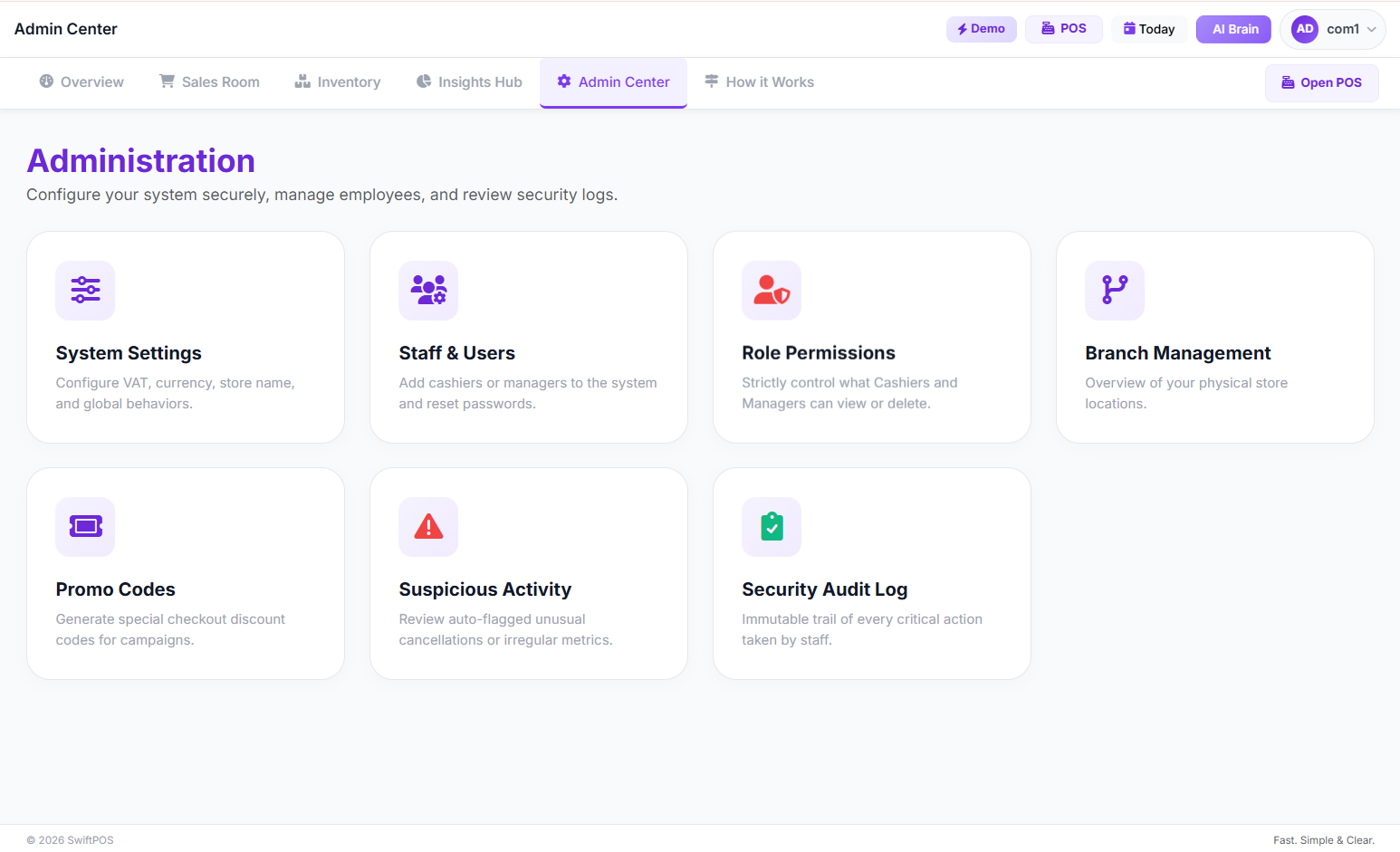 Admin Center Hub
The Better Way: Precision Management for Your Pharmacy Profit
So, if simply selling more or negotiating harder isn't enough, what's the better way? It’s about precision management. It’s about knowing exactly what’s happening in your business, down to the last tablet and kobo. This means moving beyond guesswork and manual records to a system that gives you clarity and control.
Here’s how you can approach it:
1. Master Your Inventory, Down to the Last Pill
This is foundational for any retail business, but especially for pharmacies where expiration dates and specific storage conditions are critical. You need to know:
- What you have in stock, at all times.
- Where it is located (if you have multiple branches or a storeroom).
- When each item expires.
- The exact cost of each item, not just the bulk price.
Think about it: if you buy a carton of paracetamol for ₦1,500 and it contains 100 packs, your cost per pack is ₦15. If you sell it for ₦25, your gross profit is ₦10. But if 10 of those packs expire, your effective cost for the remaining 90 packs just went up, and your profit per pack just dropped. Understanding these nuances is key to a healthy pharmacy profit margin.
2. Track Every Kobo, Not Just Sales
Sales are vanity, profit is sanity. You need to track not just what comes in, but everything that goes out. This includes your rent (which can range from ₦150,000 in a rural area to ₦2,500,000 annually in prime Lagos Island), utilities, salaries, and even the small, seemingly insignificant expenses like cleaning supplies or generator repairs.
Many small business owners dump all their business and personal expenses into one account. That’s a huge mistake. Separate them. Categorize every business expense. This way, you can clearly see where your money is going and identify areas where you can cut down without impacting quality. For example, if you realize you're spending ₦187,500 a month on internet and phone calls, maybe it's time to review your providers.
3. Understand Your True Profitability Per Product
Not all products are created equal when it comes to pharmacy business profit. Over-the-counter (OTC) drugs might give you a gross profit margin of 15% to 35%. Prescription drugs, due to competition and regulations, often sit lower, around 10% to 25%. Medical devices and supplies? Those can be higher, sometimes 20% to 40%.
You need to know which items are your cash cows and which are just taking up shelf space. This information helps you make smarter purchasing decisions and optimize your stock. You might realize that while prescription drugs bring in volume, it's those high-margin medical supplies that really boost your pharmacy income.
4. Empower Your Staff, But With Control
Your staff are crucial. They are the face of your business. But without proper controls, they can also be a source of profit leakage. I'm not talking about outright theft all the time, though that happens. It's often simple mistakes: wrong prices, unauthorized discounts, or not recording credit sales properly.
You need a system where staff can perform their duties efficiently but where sensitive actions require manager approval. This protects your business and also helps train your staff to be more responsible. For instance, imagine a cashier giving a ₦5,000 discount without authorization. That's ₦5,000 directly out of your pocket.
5. Embrace Technology, Even If You're Small
This is perhaps the most important step. In 2026, relying solely on manual ledgers or basic spreadsheets is like trying to drive a car from the 1980s on the Lagos-Ibadan Expressway. You'll get left behind. Technology isn't just for big supermarkets; it's for every small business that wants to grow.
A proper Point-of-Sale (POS) and inventory management system can automate most of what I've talked about. It gives you real-time data, helps you track expenses, manages inventory, and provides crucial insights into your business performance. I've seen businesses transform their operations and significantly improve their pharmacy profit margins just by making this switch. It's about working smarter, not just harder. You can learn more about how to set staff access permissions in retail software.
How SwiftPOS NG Fits Into This
Now, you might be thinking, "Emeka, this sounds great, but how do I actually do all this without becoming a full-time accountant or stock manager?" That's where a system like SwiftPOS NG comes in. It's built specifically for Nigerian businesses like yours, helping you implement these precision management strategies without the headache.
For example, when I talk about mastering your inventory, SwiftPOS NG allows you to track stock by expiration dates and even set up low-stock alerts. So, instead of finding expired drugs on your shelf, you get a warning that your paracetamol is about to run out or that certain antibiotics are nearing their expiry date. This helps you move those products or reorder before it's too late. It can also handle unit conversions, so if you buy a carton of drugs and sell in strips or packs, it manages that automatically. No more manual calculations.
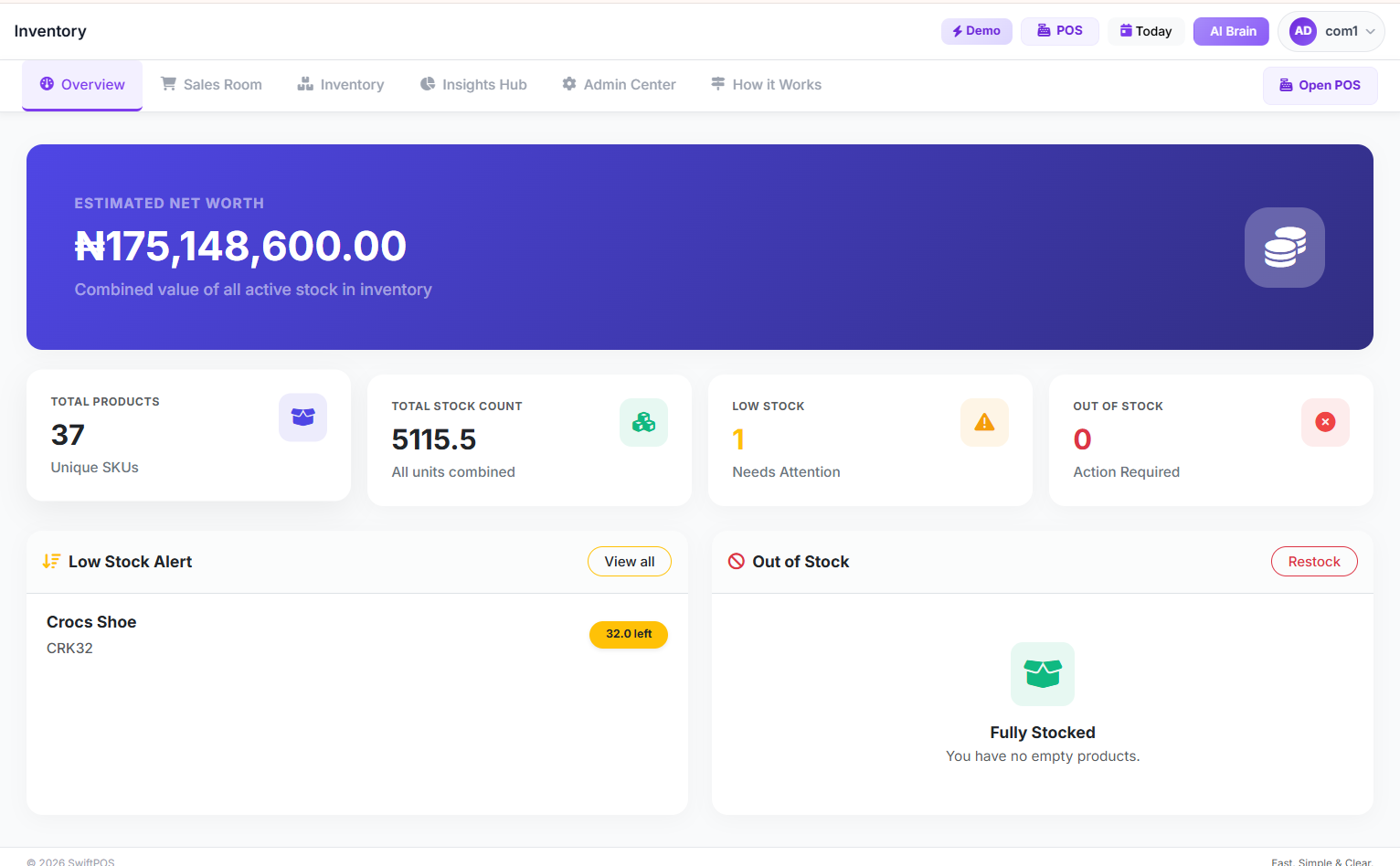 Inventory Dashboard
When it comes to tracking every kobo, SwiftPOS NG isn't just a cash register. It lets you record all your operating expenses – from your monthly internet bill to your generator fuel costs – and categorize them. This means you can see your true net profit, not just your sales revenue. You can finally answer the question, "Am I actually making money?" It also helps you track customer credit and debt, which is a major pain point for many Nigerian businesses.
And for understanding profitability per product, the system gives you detailed sales reports and profit analysis on each item. You can quickly see which drugs are your highest margin sellers and which ones are just gathering dust. This kind of insight is gold for optimizing your purchasing and pricing strategies to maximize your pharmacy profit Nigeria.
It also helps with staff control. You can set different user roles and permissions, ensuring that your cashiers can process sales efficiently, but manager approval is required for sensitive actions like discounts or voiding transactions. This reduces errors and prevents potential fraud. You can even monitor suspicious activity, like excessive voids, from the admin dashboard.
Side-by-Side: Old Way vs. New Way
Let's break down the difference between the traditional, manual approach and a modern, tech-driven one for managing your pharmacy.
| Feature / Aspect | Traditional Approach (Manual/Excel) | Modern Approach (with SwiftPOS NG) |
|---|---|---|
| Inventory Management | Manual stock counts, paper ledgers, guesswork on expiry, frequent stockouts or overstocking, high waste from expired drugs. | Real-time stock levels, automated expiry date tracking, low-stock alerts, stock forecasting, reduced waste. |
| Sales & Payments | Hand-written receipts, single payment method focus, difficult to track credit sales, errors in calculations. | Fast POS, multiple payment options (cash, card, transfer, split payments), accurate credit tracking, digital receipts. |
| Profit Calculation | Gross profit estimates, net profit is a guess after paying bills, difficult to identify profitable products. | Accurate gross and net profit, expense tracking and categorization, profit analysis per product/category, clear pharmacy profit margin. |
| Staff Management | Limited oversight, difficult to track individual performance, manual error correction, potential for unchecked fraud. | User roles & permissions, manager approvals for sensitive actions, staff activity logs, suspicious activity alerts. |
| Business Insights | Based on gut feeling or rough estimates, reactive decision-making. | Data-driven insights, sales trends, product performance, stock health, proactive decision-making. |
| Scalability | Difficult to expand to multiple branches, inconsistent data. | Easy multi-branch management, central warehouse support, consistent data across locations. |
| Time Spent on Admin | Hours daily on reconciliation, data entry, and manual checks. | Minutes daily, automated reports, more time for customer service and strategic planning. |
The Numbers: What This Actually Means for Your Business
Let's get down to the naira and kobo of how these improvements impact your pharmacy profit margin.
Imagine a small-to-medium pharmacy in a place like Ikeja, with a monthly revenue of about ₦2,500,000.
Scenario 1: Manual Operations
- Gross Profit Margin: Let's say you average 20% across all products. That's ₦500,000.
- Hidden Losses (Expired Stock, Shrinkage, Manual Errors): A conservative 5% of revenue in a manual system, that's ₦125,000 per month.
- Inefficient Purchasing: Overstocking slow-moving items, missing out on bulk discounts for fast-moving ones. Let's estimate this costs you another ₦50,000 in missed opportunities or tied-up capital.
- Operating Expenses (Salaries, Rent, Utilities, Generator):
- Pharmacist: ₦180,000
- Assistant: ₦70,000
- Annual Rent: ₦1,200,000 (₦100,000/month)
- Utilities & Internet: ₦70,000
- Generator Fuel: ₦100,000
- Total Monthly OpEx: ₦520,000
- Estimated Net Profit: ₦500,000 (Gross Profit) - ₦125,000 (Losses) - ₦50,000 (Inefficiency) - ₦520,000 (OpEx) = -₦195,000 (Loss).
Scenario 2: With Smart Management (using a POS like SwiftPOS NG)
- Gross Profit Margin: Still 20%, but now you're optimizing.
- Reduced Losses: By tracking expiry dates and managing inventory properly, you cut shrinkage and expired stock losses by at least 50%. That's a saving of ₦62,500.
- Optimized Purchasing: With data on what sells and what doesn't, you reduce tied-up capital and capture more discounts. Let's say you gain an extra ₦30,000 in efficiency.
- Operating Expenses: These are largely fixed, but better management can lead to smarter utility usage or negotiation. Let's assume they remain ₦520,000.
- Estimated Net Profit: ₦500,000 (Gross Profit) - ₦62,500 (Reduced Losses) + ₦30,000 (Efficiency) - ₦520,000 (OpEx) = -₦52,500 (Loss).
If you can increase your average gross profit margin by just 5% (to 25%) through strategic product mix and pricing, that's an extra ₦125,000 in gross profit.
- New Estimated Net Profit: (₦500,000 + ₦125,000) - ₦62,500 + ₦30,000 - ₦520,000 = ₦72,500 (Profit).
FAQ: Questions Nigerian Business Owners Actually Ask
How much capital do I need to start a pharmacy business in Nigeria in 2026?
Starting a pharmacy isn't cheap. You're looking at a range of ₦2,500,000 to ₦12,000,000 or even more, depending on your location and ambition. This covers:
- Registration (PCN & CAC): ₦150,000 - ₦350,000.
- Shop Rent (Annual): ₦150,000 - ₦2,500,000 (remember, it's annual, so budget upfront).
- Initial Stock Purchase: ₦1,500,000 - ₦10,000,000.
- Shelving & Fixtures: ₦300,000 - ₦1,500,000.
- Drug Fridge/Freezer: ₦150,000 - ₦500,000.
- Generator: ₦200,000 - ₦800,000.
- Plus working capital for salaries, utilities, and unexpected costs.
You can read more about starting a provision store business, which shares some similar startup costs.
What is a good pharmacy profit margin in Nigeria?
Typically, a healthy net profit margin for a well-managed pharmacy in Nigeria ranges from 8% to 18%. Gross profit margins vary by product category, as I mentioned earlier (OTC 15-35%, Prescription 10-25%, Medical Devices 20-40%). The goal is to maximize your net profit by controlling operating expenses and minimizing losses.
How can I increase my pharmacy income without just raising prices?
Focus on efficiency and smart inventory management. Reduce expired stock, prevent shrinkage, optimize purchasing based on sales data, and improve staff accountability. Introduce higher-margin products like medical devices or health supplements. Offer value-added services like basic health screenings. Also, consider creating a customer loyalty program to encourage repeat business. Learning how to increase sales in your retail shop is crucial.
Is it really worth investing in POS software for a small pharmacy?
Absolutely. Think of it as an investment that pays for itself. For a small pharmacy, the monthly cost of a good POS system is a fraction of what you stand to lose from inefficient inventory, unrecorded expenses, or staff errors. It gives you the data you need to make smart decisions, reduce waste, and ultimately increase your pharmacy business profit. It's about stopping money leaks, which are usually far more expensive than the software itself. You can check out the SwiftPOS NG pricing page to see how affordable it can be.
How do I manage staff and prevent theft or errors in my pharmacy?
Set clear staff roles and permissions. Use a system that requires manager approval for discounts, voids, or price changes. Regularly review staff activity logs and look for suspicious patterns. Good inventory management also acts as a deterrent. When every item is accounted for, it reduces opportunities for theft. You can learn more about how to set staff access permissions in retail software.
Take the First Step
Look, running a pharmacy in Nigeria is tough, but it's also rewarding. You're providing an essential service, and you deserve to be profitable. Stop leaving money on the table because of old, inefficient ways of doing things. The first step is acknowledging that there's a better way and being ready to embrace it.
If you're tired of guessing your pharmacy profit margin and want to get a real handle on your business, it's time to upgrade your operations. Check out how SwiftPOS NG can transform your pharmacy business. It's designed to give you the control and insights you need to thrive.

How to Start a Pharmacy Business in Nigeria: A Step-by…
Oct 11, 2026
How to Detect & Prevent Employee Theft in Retail Stores
Oct 11, 2026
How to Know If Your Business Is Actually Profitable: A…
Oct 08, 2026