How to Start a Pharmacy Business in Nigeria: A Step-by-Step Guide
SwiftPOS Team
Published October 11, 2026

Everyone tells you that to start a pharmacy business in Nigeria, you must have a huge capital base, a prime location in Lekki or Maitama, and a fully stocked dispensary from day one. They say if you don't start big, you'll fail. Well, let me tell you, that's often the quickest way to burn through your life savings and end up with a closed shop sign within two years.
I've seen it too many times: eager entrepreneurs, fresh out of pharmacy school or with years of experience, pour everything into an overly ambitious setup, only to realize too late that the market doesn't care about their grand vision if their foundation is shaky. What if I told you that the most successful pharmacies I've seen started small, focused on community needs, and scaled strategically? This guide will show you how to start a pharmacy business in Nigeria with a clear, step-by-step plan that prioritizes sustainability over flash, and profit over prestige.
Modern pharmacy interior with a pharmacist consulting aThe Reality Check: What Nobody Tells You About Starting a Pharmacy in Nigeria
Let's be honest, the pharmacy business in Nigeria is not for the faint of heart. It's regulated, capital-intensive, and highly competitive. What most online guides gloss over are the hidden costs and bureaucratic hurdles that can quickly derail even the best-laid plans. It’s not just about drugs; it’s about permits, power, and people.
First, there's the Pharmacist Council of Nigeria (PCN) registration. This isn't a one-and-done fee. You're looking at initial registration and premises permits that can run you anywhere from ₦150,000 to ₦300,000, depending on your location and the type of pharmacy you're setting up. And that's just to get your foot in the door legally. Then consider annual renewals, which, while smaller, add up.
Then, there's rent. Oh, rent! You might think a small space in a bustling area of say, Ogba, Lagos, will be affordable. Think again. Annual shop rent can swing wildly from a modest ₦80,000 in a quiet town like Ogbomosho to a staggering ₦2,500,000 for a prime spot on Victoria Island. This is an upfront cost you can't escape. Many landlords demand one to two years' rent upfront, plus agency and legal fees. So, that ₦800,000 annual rent for a decent spot in Surulere could mean coughing up ₦1.6 million plus fees before you even buy a single paracetamol.
And let's not even start on power. A reliable generator is not a luxury; it's a lifeline. Drugs need consistent storage temperatures, and customers expect a comfortable, well-lit environment. A small to medium-sized generator will set you back between ₦200,000 and ₦800,000, not including the daily cost of fuel. That's a significant chunk of your initial capital that many overlook in their pharmacy business plan.
These are the realities. They are not meant to discourage you, but to prepare you. Understanding these upfront costs is critical for any aspiring pharmacy owner in Nigeria.
What You Actually Need to Get Started
Before we even talk about specific steps, let's clarify what's genuinely non-negotiable and what can wait. You don't need everything at once, but some things are simply essential for a credible and compliant pharmacy business.
Non-Negotiables (Must-Haves):
- Pharmacist License & PCN Registration: This is ground zero. Without it, you’re not running a pharmacy, you’re running a provision store with extra steps. Budget ₦150,000 to ₦300,000 for initial PCN registration and premises permit.
- Business Registration (CAC): Your business needs a legal identity. Whether it's a sole proprietorship or a limited company, get it registered. This typically costs between ₦25,000 and ₦70,000.
- Suitable Location & Shop Rent: Accessibility and visibility are key. Ensure the space meets PCN requirements (e.g., size, ventilation). Annual rent can range from ₦80,000 to ₦2,500,000.
- Basic Shop Renovation & Fit-out: A clean, professional look instills trust. This means proper flooring, lighting, and a counter. Expect to spend ₦300,000 to ₦1,500,000.
- Initial Drug Stock: You can't sell what you don't have. Start with essential, fast-moving items. This is your biggest outlay: ₦1,500,000 to ₦7,000,000.
- Medical-Grade Refrigerator: Absolutely critical for vaccines, insulin, and other temperature-sensitive medications. Don't skimp here. Budget ₦150,000 to ₦400,000.
- Shelving & Display Units: Organize your products neatly and professionally. Basic metal shelves might cost ₦100,000, while custom wooden displays could hit ₦500,000.
- Generator: As discussed, power is non-negotiable. ₦200,000 to ₦800,000.
- Working Capital: This is your buffer for salaries, utilities, and restocking before you break even. Aim for 3-6 months of operating costs: ₦500,000 to ₦2,000,000.
- Advanced POS System with Inventory Management: While crucial for growth, you can start with manual records and upgrade. However, if you want to avoid inventory headaches from day one, consider it early. (More on this later).
- Air Conditioning: Improves customer comfort and drug stability, but a good fan can suffice initially.
- Elaborate Marketing & Signage: A simple, clear sign is enough to start. You can invest in illuminated signs and extensive marketing later. Budget ₦50,000 to ₦200,000 for basic signage.
- Multiple Staff: You might be able to manage with just yourself and a pharmacy assistant initially.
The Complete Step-by-Step Breakdown
Now that we understand the landscape, let's map out the journey. This isn't just a checklist; it's a strategic pathway to building a sustainable pharmacy business.
Step 1: Develop Your Pharmacy Business Plan
Before you spend a single naira, you need a solid pharmacy business plan. This isn't just a document for the bank; it's your roadmap. It forces you to think through every aspect of your business: your vision, mission, target market (e.g., families, elderly, specific health conditions), competitive analysis (who are your rivals and what do they do well/poorly?), marketing strategy, operational plan, and most importantly, your financial projections.
Don't just copy templates. Spend time researching your local community. Are there many existing pharmacies? What services do they lack? Perhaps a pharmacy in a residential area of Ikorodu needs to focus more on children's medications and basic first aid, while one near a hospital in Abuja might need to stock more specialized drugs. Your plan should reflect these nuances. This is where you calculate your estimated pharmacy startup cost thoroughly.
- Actionable Tip: Visit at least five pharmacies in your target area. Observe their customer flow, product offerings, pricing (if visible), and general ambiance. Talk to people in the community to understand their health needs and challenges.
Step 2: Secure Funding and Handle Legal Registration
With a clear plan, you can confidently seek funding. This might come from personal savings, family and friends, or small business loans. Be realistic about what you can get. Once funding is secured, immediately move to legalities.
First, register your business name with the Corporate Affairs Commission (CAC). This could be a sole proprietorship if you're starting very small, but many opt for a Limited Liability Company (LTD) for better protection and future scalability. Budget ₦25,000 for a simple business name registration, up to ₦70,000 for an LTD. Next, and this is crucial for how to start pharmacy Nigeria, tackle the Pharmacist Council of Nigeria (PCN) registration. This involves registering yourself as a superintendent pharmacist and obtaining premises approval. This is a rigorous process ensuring you meet all professional and facility standards.
- Actionable Tip: Start the PCN registration process early. It can be time-consuming, involving inspections and document submissions. Get a clear checklist from the PCN office or website and follow it religiously.
Step 3: Find and Fit-Out Your Ideal Location
Location, location, location! For a pharmacy, this means visibility, accessibility, and proximity to your target market. A busy street corner in a residential area, near a hospital, or within a bustling market square (like parts of Balogun Market, though that might be too chaotic for a pharmacy) could be ideal. Once you've identified a suitable space, negotiate the rent and get your tenancy agreement in writing.
After securing the space, it's time for the fit-out. This includes basic renovations like painting, installing proper lighting, creating a dispensing area, and setting up your consultation counter. Ensure your space meets PCN requirements for storage, sanitation, and patient privacy. Don't forget security measures like sturdy doors, locks, and possibly CCTV.
- Actionable Tip: Before signing a lease, confirm with PCN whether the location meets their standards. A pre-inspection visit from a PCN official (if possible) or a thorough review of their guidelines can save you from costly mistakes.
Step 4: Procure Initial Stock and Essential Equipment
This is where a significant chunk of your capital goes. Your initial drug stock should focus on fast-moving, essential medicines: analgesics, antimalarials, antibiotics (with caution and proper dispensing protocols), cough and cold remedies, basic first aid supplies, and common over-the-counter (OTC) medications. Don't forget health supplements, baby products, and personal care items, which often have higher profit margins. Source your drugs from reputable wholesalers to ensure authenticity and good pricing. Avoid grey market suppliers.
Simultaneously, acquire your essential equipment: the medical-grade refrigerator, sturdy shelving, a dispensing counter, a computer, a reliable POS system, and your generator. For managing your inventory and sales efficiently, especially with expiry dates, a robust system is invaluable. This is where a solution like SwiftPOS NG comes in handy. It helps you track every product, from paracetamol to specialized antibiotics, ensuring you know what's in stock, what's selling, and what's about to expire. This kind of detailed inventory management is non-negotiable for a pharmacy.
- Actionable Tip: Create a detailed inventory list for your initial stock. Prioritize items based on local demand and profitability. Negotiate credit terms with your suppliers if possible, even if it's just for a few days, to ease cash flow.
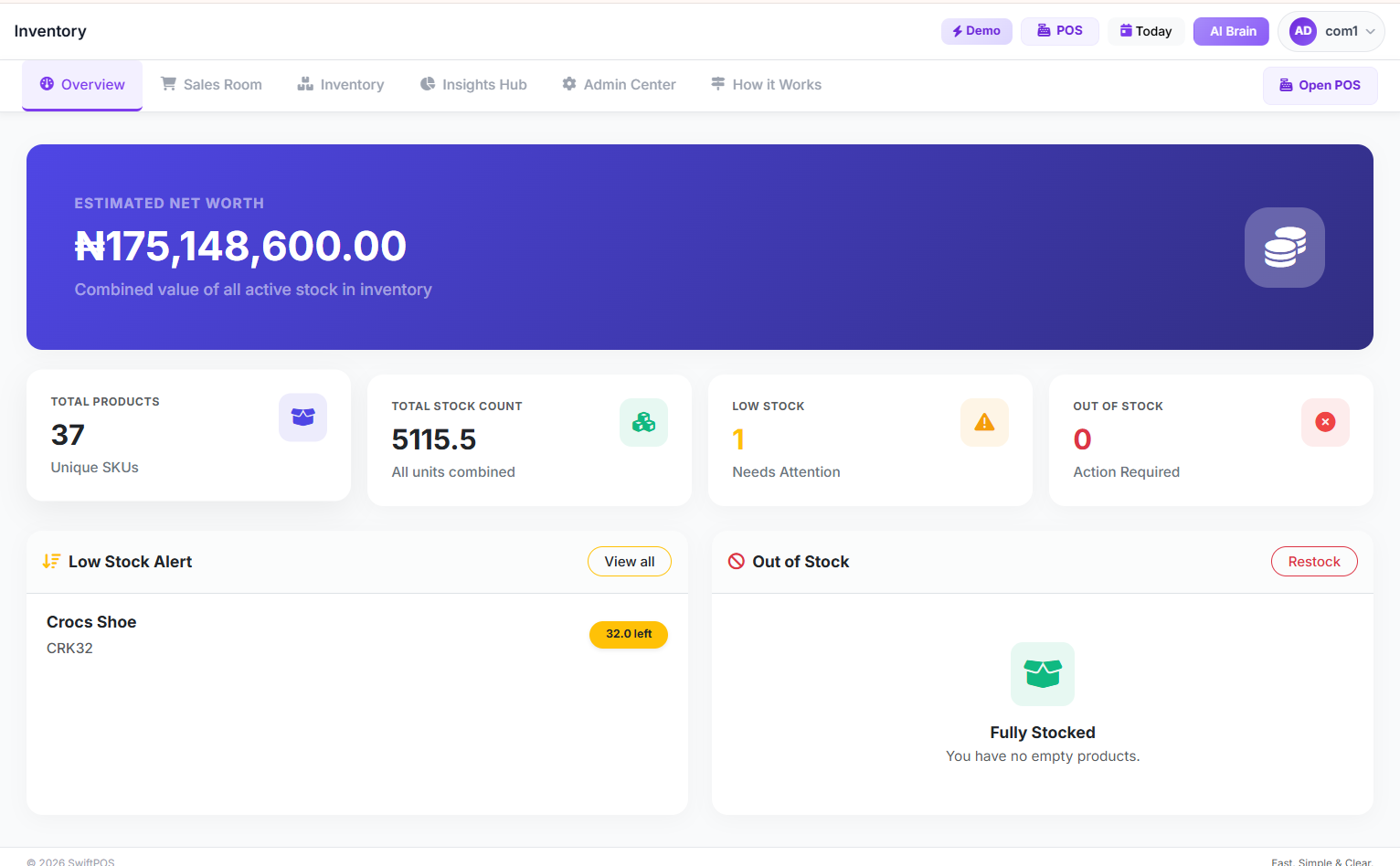 Inventory Dashboard
Step 5: Staffing and Operational Setup
As the owner and superintendent pharmacist, you'll be the backbone. But you'll likely need a pharmacy assistant or two to help with customer service, stock arrangement, and basic administrative tasks. Recruit carefully; they are the face of your business when you're busy. Ensure they are trustworthy and possess good communication skills. Their monthly salary could range from ₦50,000 to ₦90,000.
Set up your operational procedures: how you handle prescriptions, manage patient records, track sales, conduct stock takes, and manage waste. Establish clear protocols for drug dispensing, especially for prescription-only medicines. Your pharmacy business plan should have detailed operational guidelines.
- Actionable Tip: Train your staff thoroughly on customer service, basic first aid (if applicable), and how to handle common customer inquiries. Emphasize confidentiality and ethical conduct. Regularly review their performance.
Step 6: Marketing and Grand Opening
Even a pharmacy needs marketing! Start with a clear, visible sign outside your shop. Word-of-mouth is powerful in Nigeria, so encourage satisfied customers to tell others. Offer excellent service, provide sound health advice, and maintain a clean, well-stocked environment. Consider local flyers, community health talks, or partnerships with local clinics or doctors.
For your grand opening, make a bit of a splash. Offer small discounts on OTC items, free blood pressure checks, or free health advice for the first few days. This creates buzz and brings people through your doors.
- Actionable Tip: Leverage local community groups and social media (even WhatsApp groups) to announce your opening. A simple post with your location and opening hours can reach many potential customers.
5 Mistakes That Cost Nigerian Business Owners the Most
Starting a pharmacy is challenging, and mistakes can be very expensive. Here are five common pitfalls I've seen over the years:
- Underestimating Working Capital: Many business owners focus heavily on startup costs (rent, stock) but forget the ongoing expenses before profit kicks in. You need money to pay salaries, utility bills (which can be ₦30,000 to ₦150,000 monthly), and restock popular items before your sales truly cover everything. Running out of cash for operations is a silent killer.
- Poor Inventory Management: This is critical for a pharmacy. Not tracking expiry dates means selling expired drugs (illegal and dangerous) or throwing away unsold stock, which is money down the drain. Not knowing what sells means you tie up capital in slow-moving items while fast-movers are out of stock, leading to lost sales and frustrated customers. I once saw a pharmacy owner in Ibadan lose almost ₦700,000 in a year due to expired stock alone because they used a paper-based system.
- Ignoring Compliance and Regulations: The PCN is no joke. Operating without proper licenses, failing to renew permits, or not adhering to dispensing standards can lead to hefty fines, business closure, and even imprisonment. Don't cut corners here. The cost of non-compliance far outweighs the cost of doing things right.
- Neglecting Customer Service: In a competitive market, people will go where they feel valued. A rude assistant, a pharmacist who seems too busy to answer questions, or a consistently messy shop will drive customers away. Your reputation is everything. A customer who feels heard and helped will become a loyal patron and bring others.
- Lack of Financial Tracking: If you don't know your daily sales, your monthly expenses, your profit margins on different drug categories, or your true net profit, you're flying blind. Many small business owners mix personal and business finances, making it impossible to see if the business is truly profitable. You need clear records to make informed decisions.
How to Know If You're on Track (Success Metrics)
So, you've opened your doors. How do you know if you're actually succeeding or just treading water? Here are key metrics every pharmacy owner in Nigeria should track:
- Daily Sales Revenue: Are you hitting your daily targets? Track this consistently. If your average sale is ₦5,000 and you need to make ₦50,000 a day to cover costs, you know you need 10 customers.
- Average Transaction Value (ATV): How much does each customer spend on average? If your ATV is low, perhaps you need to upsell related products (e.g., recommend Vitamin C with a cold remedy) or focus on higher-margin items.
- Inventory Turnover Rate: How quickly are you selling your stock? A high turnover rate for essential drugs is good; it means you're not tying up capital. A low turnover for certain items might mean you're overstocked or they're not in demand. For a pharmacy, this needs to be closely monitored for expiry dates.
- Gross Profit Margin: This is your revenue minus the cost of goods sold. Are you buying smart and pricing effectively? Knowing your margins helps you decide which products to push.
- Customer Retention Rate: Do customers come back? Loyal customers are your most valuable asset. Excellent service and reliable stock keep them coming.
- Expiry Rate/Shrinkage: How much stock are you losing to expiry, damage, or theft? This should be as close to zero as possible. This is where a system that tracks expiration dates, like SwiftPOS NG, becomes invaluable, alerting you before products become unsellable. You can easily see your to keep an eye on these metrics.inventory dashboard
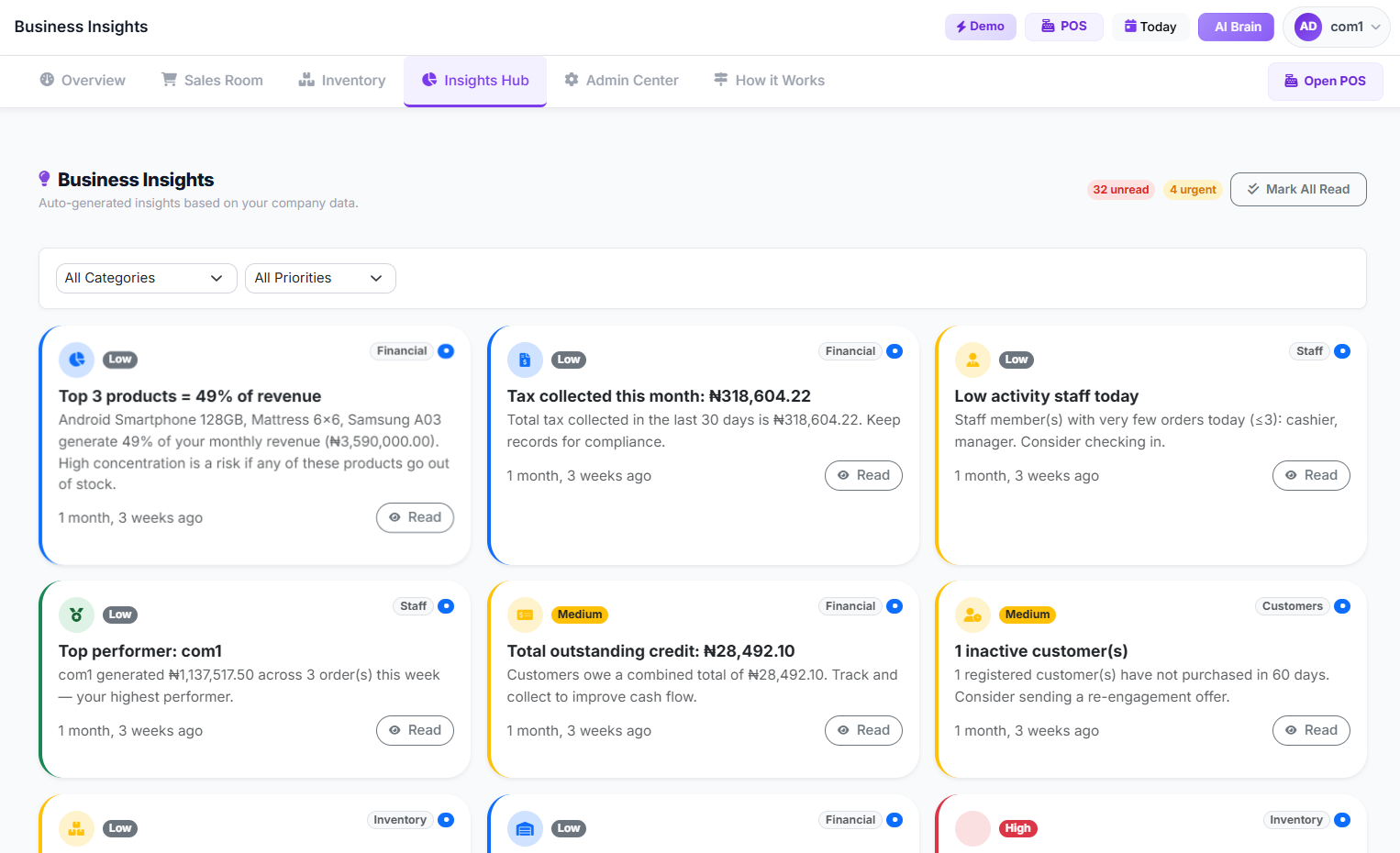 Business Insights Page
Regularly reviewing these metrics helps you identify problems early and make data-driven decisions. You can't improve what you don't measure. For more on tracking success, check out our guide on 7 Key Retail Metrics Nigerian Businesses Must Track for Profit Growth.
Real Questions People Ask (FAQ)
Q1: How much capital do I really need to start a pharmacy business in Nigeria in 2026?
Realistically, for a small to medium-sized community pharmacy, you're looking at a total startup cost ranging from ₦3,000,000 to ₦12,000,000. This figure covers everything: registration, rent (usually 1-2 years upfront), renovation, initial drug stock, essential equipment like a medical fridge and generator, and crucial working capital for the first few months. Starting with anything less than ₦3,000,000 is extremely challenging and risky, especially if you're aiming for a well-stocked pharmacy in a decent location.
Q2: Is a pharmacy business profitable in Nigeria?
Yes, a pharmacy business can be very profitable in Nigeria, given the constant demand for healthcare services and medicines. However, profitability depends heavily on effective management, strategic pricing, good customer service, and strict inventory control. Margins on some OTC drugs and supplements can be quite good, while prescription drugs might have tighter margins but higher volume. Poor management, especially regarding expired stock or excessive operational costs, can quickly erode profits.
Q3: What are the most important licenses and permits needed for a pharmacy in Nigeria?
The two absolute most important are your Pharmacist Council of Nigeria (PCN) registration (both for you as a superintendent pharmacist and for your premises) and your Corporate Affairs Commission (CAC) business registration. Beyond these, you might also need local government permits for operation and waste disposal, depending on your specific location and local council requirements. Always check with your local government authority.
Q4: How do I source genuine drugs for my pharmacy to avoid counterfeits?
Sourcing genuine drugs is paramount for patient safety and your reputation. Always buy from accredited and reputable pharmaceutical wholesalers and manufacturers. Avoid unknown suppliers, especially those offering unusually low prices. Ask for certificates of analysis and ensure proper storage and transportation of drugs. Building strong relationships with a few trusted suppliers is key. NAFDAC also plays a role in regulating drug quality, so ensure your suppliers comply with their standards.
Q5: Can I start a pharmacy business in Nigeria without being a pharmacist?
No, you cannot directly own and operate a pharmacy in Nigeria without being a registered pharmacist yourself, or having a registered pharmacist as a superintendent pharmacist who is legally responsible for the operations. The PCN regulations are very clear on this: a pharmacy must be supervised by a qualified and registered pharmacist. If you are not a pharmacist, you could invest in a pharmacy business, but you would need to partner with a qualified pharmacist who takes on the superintendent role and legal responsibilities.
Your Next Move
Starting a pharmacy business in Nigeria is a journey that demands diligence, capital, and commitment. It's not a get-rich-quick scheme, but a vital service that can be immensely rewarding both financially and communally.
Your next step is to take this information and refine your own pharmacy business plan. Don't just read; act. Start sketching out your budget, researching locations, and understanding the PCN requirements in detail. And as you plan, think about how you'll manage the day-to-day operations, especially your precious inventory. Explore tools like SwiftPOS NG for seamless management from day one.
Ready to take control of your pharmacy's future? Visit SwiftPOS NG to see how our system can help you manage sales, inventory, and insights, ensuring your pharmacy thrives in 2026 and beyond.

Pharmacy Profit Margins in Nigeria: What to Expect
Oct 11, 2026
How to Detect & Prevent Employee Theft in Retail Stores
Oct 11, 2026
How to Know If Your Business Is Actually Profitable: A…
Oct 08, 2026