Why Smart Nigerian Shop Owners Are Ditching Manual Methods for Cloud POS Software in 2026
SwiftPOS Team
Published April 18, 2026
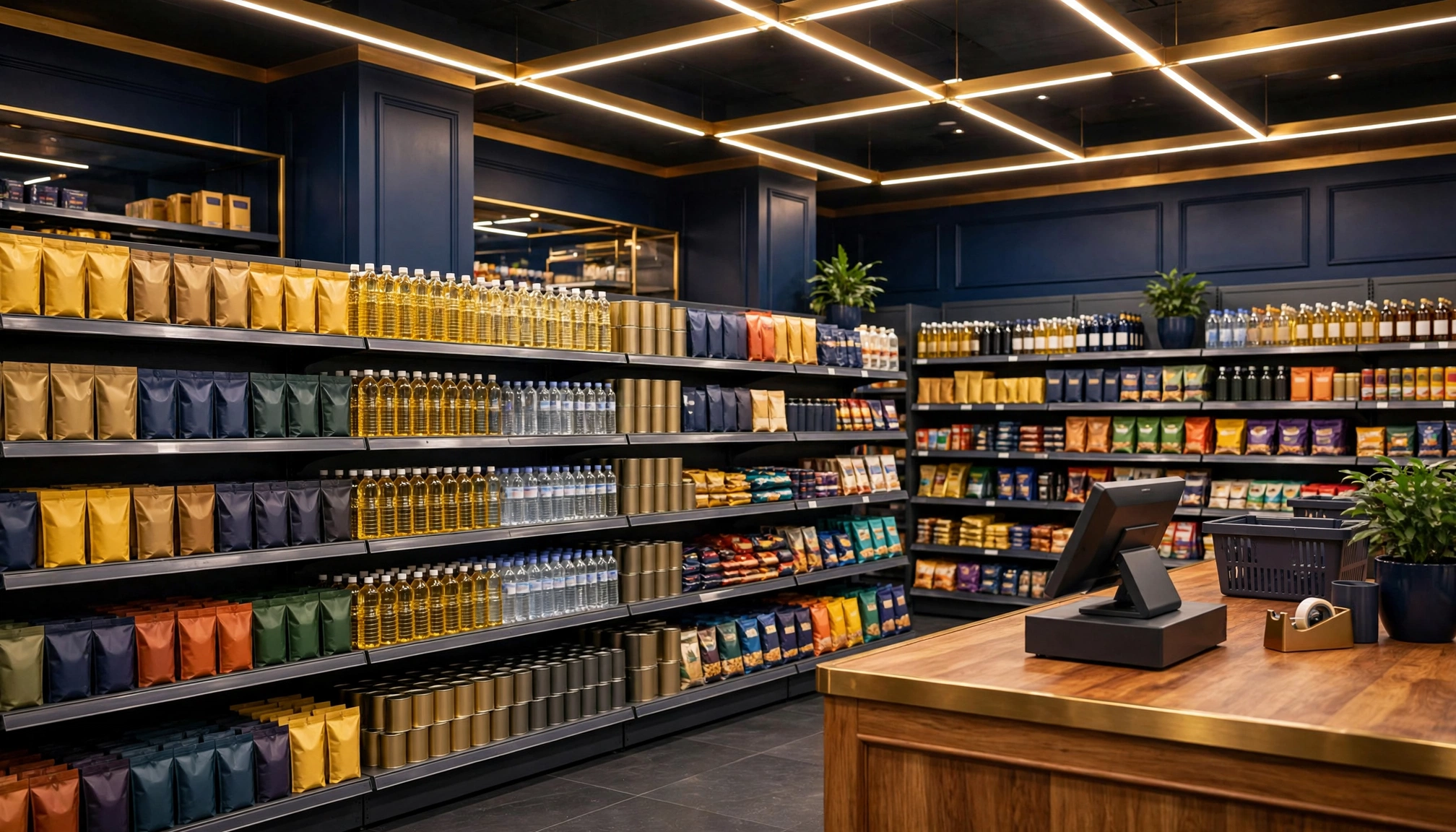
Something is shifting across Nigerian retail in 2026 — and if you pay attention, you'll notice it in the details. The provision store on your street that used to write prices in chalk now has a tablet behind the counter. The supermarket that kept ledgers in three notebooks now closes at the same time every day because reconciliation takes five minutes, not two hours. The pharmacy owner who used to wake up at night worrying whether the revenue matched the stock? She checks her phone dashboard at 9pm and sleeps peacefully.
These are not big chains. These are local Nigerian business owners, just like you — who made one decision that changed how their shops run. They moved from manual methods to a cloud-based POS system. And the difference it made was not subtle.
This article is a clear-eyed look at why that shift is happening, what it means for businesses that make the switch — and what it costs those that don't. If you've been on the fence about whether a POS system is "really necessary" for your shop, this is the article you need to read before the end of the month.

The Old Way Is Costing You More Than You Think
Let's be honest about what "manual methods" actually looks like for most Nigerian shop owners in 2026. It's a combination of some or all of the following: a physical sales ledger that gets updated inconsistently, a separate notebook for customer credit, stock counted by walking the floor and estimating, receipts written by hand (or not at all), end-of-day totals that sometimes match and sometimes don't, and a staff member whose job is basically to remember prices.
This system isn't just slow. It's actively leaking money. Here's where the leaks happen:
- Stock shrinkage you can't explain. When you can't reconcile what was sold against what's on the shelf, you don't know if your stock vanished due to theft, breakage, supplier errors, or just bad counting. All of those losses sit invisibly in your numbers.
- Customer credit you can't fully collect. The notebook only tells you the current figure — not the full history, not the overdue dates, not which customers are chronic problems. So collection is inefficient and uncomfortable.
- Sales data you can't use. Without records, you can't identify your top sellers, your slowest movers, your busiest hours, or your most valuable customers. Every buying decision you make is a guess.
- Staff you can't fully verify. When transactions aren't digitally logged, there's always a gap between what staff say happened and what actually happened.
We've broken down the financial weight of these problems in detail in our post on the true cost of manual bookkeeping for growing retail businesses. The numbers are not comfortable reading — but they are necessary ones.

What "Cloud POS" Actually Means for a Nigerian Shop Owner
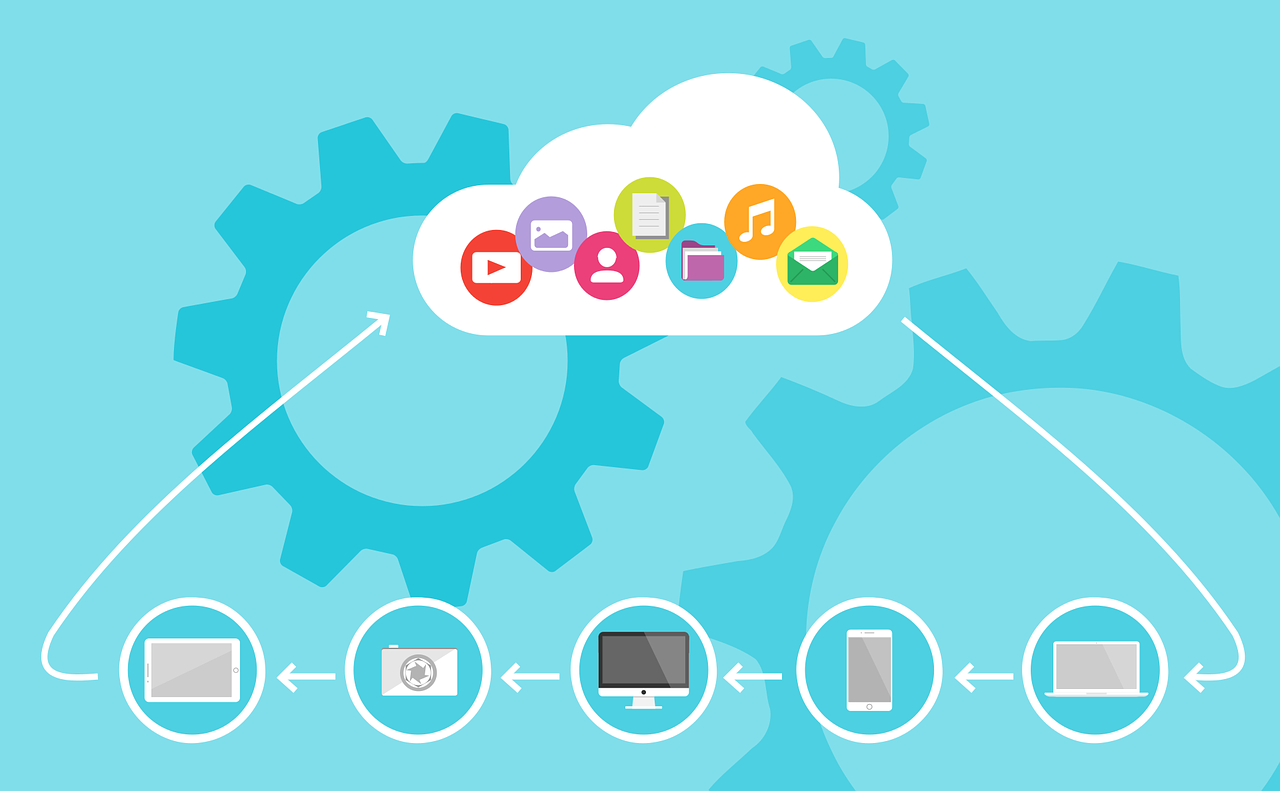
The phrase "cloud POS" can sound technical and distant — like something for large corporations, not provision stores in Surulere or supermarkets in Enugu. But what it actually means in practice is straightforward: your sales data, inventory, customer records, and staff activity are all stored and processed online, accessible from any device, any time, from anywhere.
That means three things that matter enormously to a Nigerian retailer:
- You don't lose data when a device breaks. Everything is in the cloud. Your phone gets stolen, your computer dies, a staff member quits and takes the notebook — none of that touches your business records.
- You can check your business from anywhere. Whether you're at the market, in church, or traveling to visit your supplier, you can open an app and see what's selling, what your daily revenue is, and whether anything unusual is happening.
- You don't need expensive hardware. A cloud POS runs on the device you already have. A tablet, a laptop, a smartphone. No ₦300,000 terminal required. Just software — and good software can start at a fraction of the cost of what most shop owners spend on a bad month of untracked losses.
Forbes explains cloud computing as technology that lets businesses access software, storage, and data via the internet rather than local hardware. In retail, that's exactly the shift that separates old-school shop management from modern business operation.

The 7 Real Problems a Cloud POS Solves That Manual Methods Cannot
Let's go specific. Here are the exact problems Nigerian shop owners face — and exactly how a cloud POS like SwiftPOS addresses each one.
Problem 1: You Don't Know Your Real Profit
You see money coming in, but you don't know if that money represents genuine profit or just revenue that's been eaten by costs, theft, and poor buying decisions. With SwiftPOS, your Profit and Loss report is generated automatically, every day. You see revenue, cost of goods sold, and gross profit — clearly, without building a spreadsheet. This kind of financial clarity is what separates shops that grow from those that stagnate.
Problem 2: Stock Discrepancies You Can't Trace
You buy 200 units of noodles. You sell... something. You do a count and there are 60 left. Where did the other 30 go? With manual records, you'll never know. With SwiftPOS's inventory system, every stock movement is tracked — what came in, what was sold, what was returned, and what can't be accounted for. That visibility is the only way to genuinely stop stock leakage.
Problem 3: Customer Credit Is Out of Control
You know roughly how much people owe you. But you can't tell who owes the most, who's overdue, or what the total outstanding figure actually is. SwiftPOS has a dedicated customer credit module that tracks every customer's outstanding balance, full purchase history, and payment records. You see who your most reliable customers are — and who needs to be cut off. We covered this in depth in our guide on managing customer credit in Nigerian retail shops.
Problem 4: Staff Accountability Is a Constant Worry
You can't be in the shop 24 hours a day. And when you're not there, you're trusting staff to record sales accurately, handle cash correctly, and not abuse credit accounts. That trust is hard to maintain without systems. SwiftPOS logs every transaction against the staff member who processed it, keeps an audit trail of every action taken, and — on Pro plan — flags suspicious activities automatically. If your shop is losing money and you can't explain why, staff accountability is where to look first.

Problem 5: You're Always Running Out of Stock at the Wrong Time
Festive period comes, your bestsellers run dry. A supplier is delayed. Your shelves are half-empty right when customer traffic is highest. SwiftPOS gives you low stock alerts so you're always reordering before you run out — not after. Automating your reordering process alone can recover thousands of naira per month in missed sales.
Problem 6: You Have Multiple Branches With No Central View
If you run more than one shop, manually consolidating information from each location into something meaningful is a full-time job. SwiftPOS Pro gives you multi-branch visibility — every location's sales, inventory, and staff activity in one dashboard, accessible from your phone. Managing multiple branches without losing control requires exactly this kind of centralised system.
Problem 7: You Can't Clearly See What's Working and What Isn't
Without data, every business decision — what to stock, what to promote, what to drop, which staff member to trust with more responsibility — is intuition-based. Intuition is not always wrong, but it's not reliable. SwiftPOS's reporting turns your daily operations into data: top products, peak hours, best customers, highest-performing staff, most and least profitable categories. That data makes every decision sharper.

SwiftPOS: Built Specifically for Nigerian Retail
This is not a generic international software that's been loosely adapted for Nigeria. SwiftPOS was designed with Nigerian retailers in mind — the way shops actually operate, the challenges that actually come up, and the budget realities of running a business in this economy.
Here's what that looks like in practice:
- Offline capability — your POS keeps working even when NEPA takes light or your internet goes down. Sales still process. Data syncs when connection is restored.
- Naira-native pricing — no currency confusion, no conversion, no hidden charges in dollars. Everything is straightforward and locally structured.
- Affordable pricing that scales with your business — Starter at ₦3,000/month for growing shops, Standard at ₦6,000/month for established businesses, Pro at ₦12,000/month for multi-branch and high-volume operations.
- Barcode scanning support — if your products have barcodes, SwiftPOS Standard and Pro support scanner-based checkout for faster service at the counter.
- Bulk product import — if you're moving from an existing system or spreadsheet, you can import your entire product list at once instead of entering items one by one.
- Branded receipts — your shop name, logo, and contact on every receipt. Professional presentation that builds customer trust.
See the full list of SwiftPOS features here to understand what each plan includes.
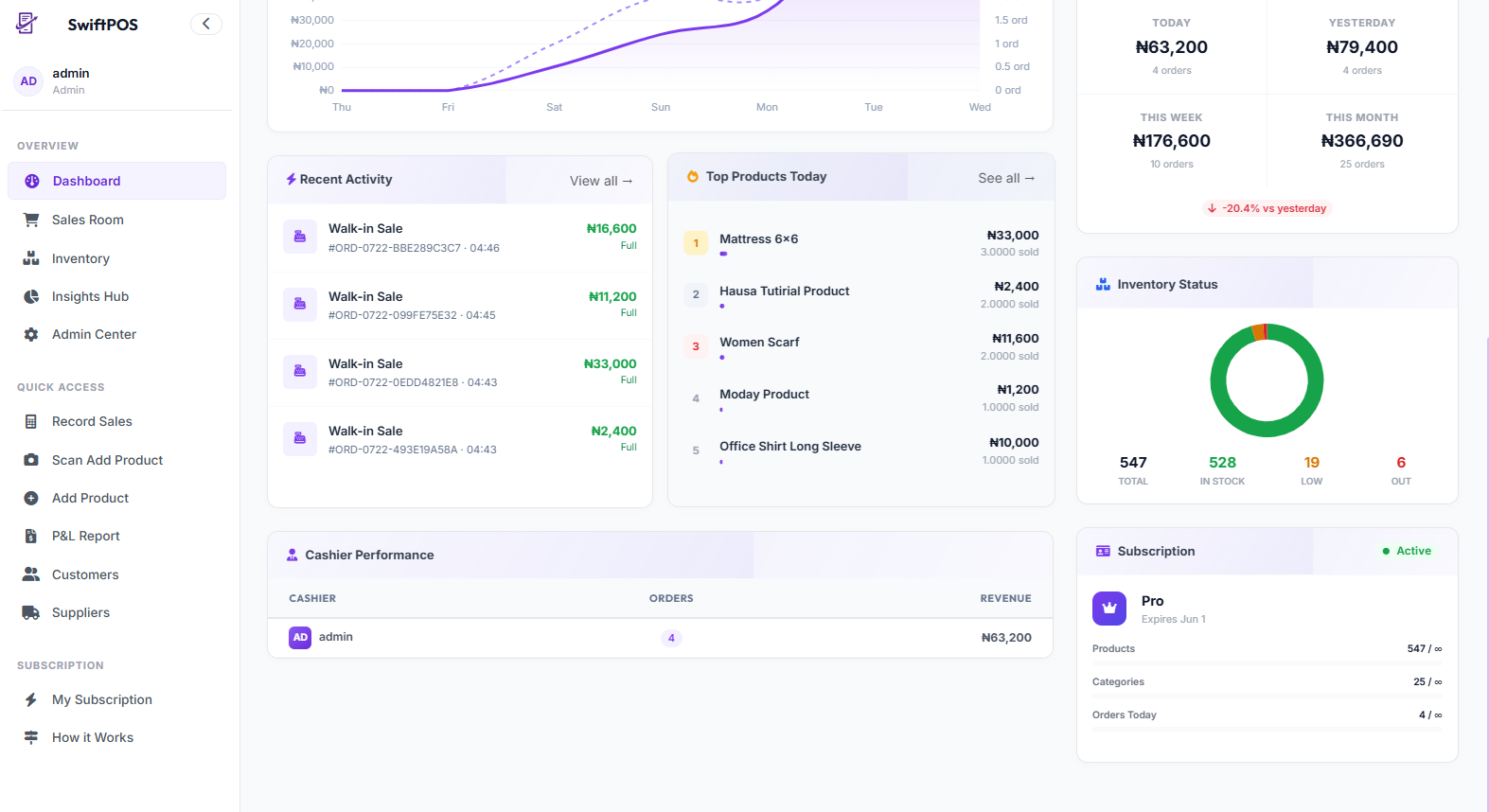
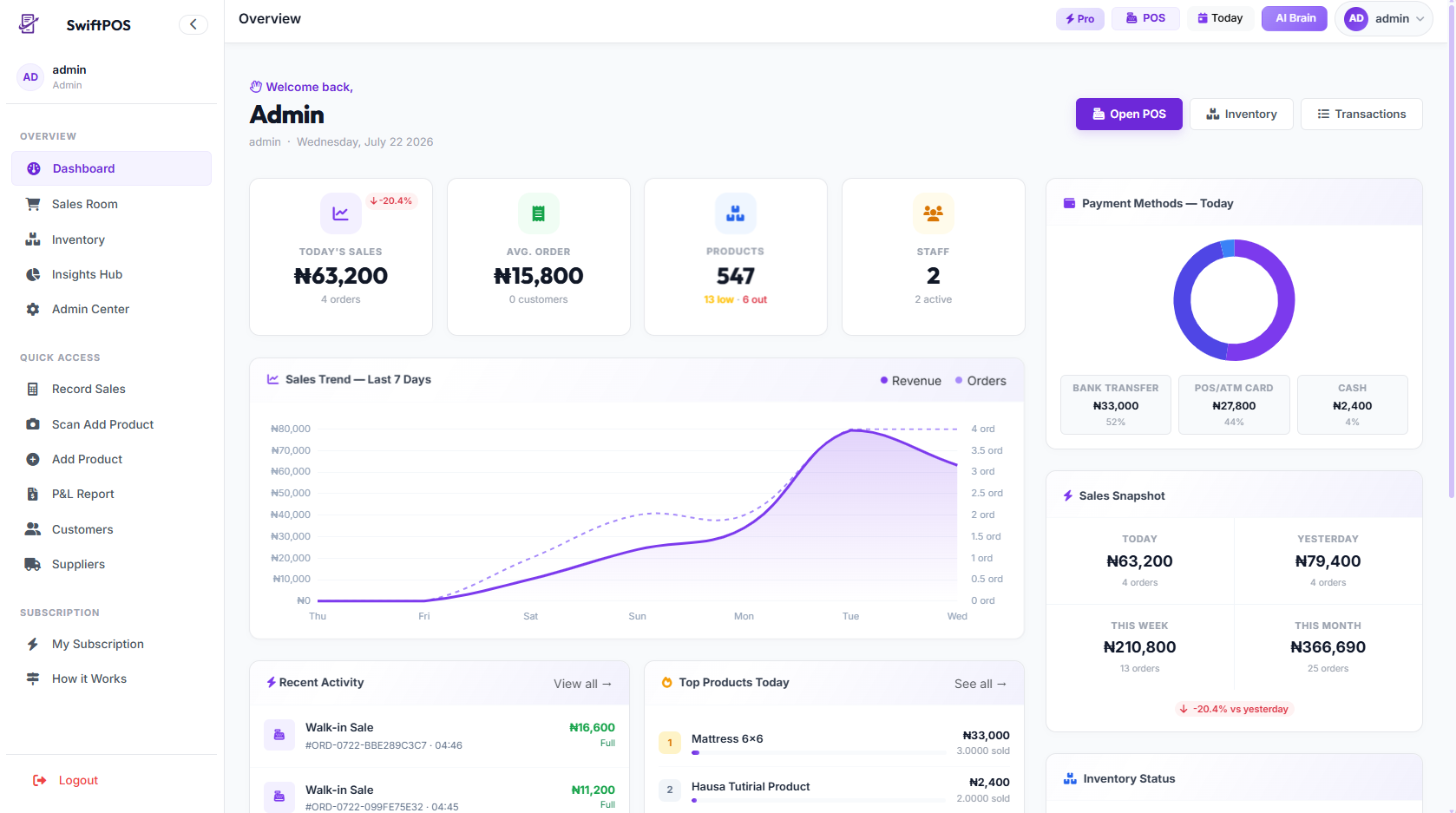
The SwiftPOS main dashboard — total revenue, daily performance, and business health at a glance.
What Nigerian Shop Owners Are Saying After the Switch
The most common thing shop owners say after getting properly set up on a cloud POS system isn't "wow, it's so advanced." It's something much simpler: "I finally know what's actually going on in my shop."
That clarity — knowing your real daily sales, knowing your actual stock, knowing who owes you and who's been reliable — changes the way you make decisions. You stop reacting to problems and start preventing them. You stop guessing at what to restock and start ordering based on data. You stop trusting memory and start trusting your system.
According to McKinsey's research on retail digitisation, businesses that adopt integrated digital management tools see measurable improvements in operational efficiency within the first 90 days. That timeline is consistent with what SwiftPOS users across Nigeria report.

The Cost of Waiting
Every month you run your business without a proper system is a month where you're absorbing preventable losses. Stock that walks out the door unaccounted for. Customer credit that slips past the follow-up date. A staff member who knows the receipts aren't being tracked. A buying decision made on gut instead of data.
These are not hypothetical problems. They are happening right now, in your shop, today — they're just invisible because you don't have the tools to see them. And invisible losses are the most dangerous kind, because they don't feel urgent until they accumulate into a crisis.
Moniepoint's small business research shows that internal operational failures — not market conditions — are the leading cause of small business collapse in Nigeria. A POS system doesn't eliminate all risk. But it eliminates the risks you could have controlled, and that alone is worth the subscription.

How to Choose the Right SwiftPOS Plan for Your Shop
Not every business needs the same level of functionality. Here's a simple way to think about which plan fits where you are right now:
| Your Business | Recommended Plan | Monthly Cost |
|---|---|---|
| Small provision store, mini mart, or single-product shop just getting organised | Starter | ₦3,000 |
| Growing supermarket, pharmacy, or electronics shop with multiple staff and active inventory | Standard | ₦6,000 |
| Multi-branch business, high-volume shop, or serious retailer who needs maximum control and visibility | Pro | ₦12,000 |
All plans include the core POS terminal, inventory management, and customer credit system. As you move up, you gain reporting depth, staff capacity, barcode scanning, audit logs, suspicious activity detection, and multi-branch support. And every plan comes with 1 month completely free when you subscribe annually.
See the complete breakdown at the SwiftPOS pricing page — and if you're not sure which plan fits your business, the team is available directly on WhatsApp to talk it through.
Frequently Asked Questions
Does SwiftPOS work for a small provision store, not just a supermarket?
Absolutely. The Starter plan at ₦3,000/month is built exactly for smaller shops — provision stores, kiosks, pharmacies, mini marts — that want professional-grade inventory tracking and sales management without overpaying for features they don't need. Many of SwiftPOS's users started as single-counter shops and scaled from there.
What happens to my data if my phone or laptop breaks?
Because SwiftPOS is cloud-based, all your data is stored securely online — not on your device. If your hardware fails, you simply log in on a new device and everything is exactly where you left it. Nothing is lost.
Can I use SwiftPOS without internet all the time?
Yes. SwiftPOS supports offline operation — your POS will continue processing sales even when your internet is down. Once connection is restored, everything syncs automatically. This is specifically designed for the Nigerian context where internet consistency isn't always guaranteed. Read more about how a POS system works without internet in our detailed breakdown.
How long does it take to set up SwiftPOS?
Most shop owners are fully operational within a day. If you have many products, the bulk import feature lets you upload your entire product list from a spreadsheet in one step rather than entering items manually one by one.
Is SwiftPOS suitable for a multi-branch business?
Yes — the Pro plan includes full multi-branch support with centralised reporting, separate staff profiles per branch, and a unified dashboard showing all locations from one login. Managing multiple shop branches without losing control is one of the core use cases SwiftPOS was built for.

Further Reading From the SwiftPOS Blog
If this article resonated, these related posts go deeper on specific problems that a cloud POS system solves:
- 📦 Stock Management for Small Businesses in Nigeria: Stop Losing Products, Start Making Real Profit
- 🔍 How to Stop Staff Theft in Your Retail Store: A Complete Manager's Guide
- 📊 POS Software in Nigeria: What the Best Retailers Know That You Don't
- 🏪 How to Run a Supermarket Business Successfully in Nigeria in 2026
- 💰 Is Supermarket Business Profitable in Nigeria? Real Costs, Risks & Profit Insights
- 📱 Cloud POS vs Traditional Cash Registers: Which Is Best for Your Shop in 2026?
Your Shop Deserves a System That Works As Hard As You Do
You didn't start your business to spend your evenings reconciling notebooks. You didn't build your customer base to watch money disappear into gaps you can't explain. You didn't hire staff to constantly wonder whether everything is being handled honestly.
You built your business to grow. And growth — real, sustainable, stress-free growth — starts with clarity. Clarity about your sales. Clarity about your stock. Clarity about your people. Clarity about your profit.
That's exactly what SwiftPOS gives you.
👉 Start today — plans from ₦3,000/month
📲 Talk to us on WhatsApp: +2349164601810
🎁 Subscribe annually and get your first month completely free.

How to Know If Your Business Is Actually Profitable: A…
Oct 08, 2026
How to Stop Cash Leakage in Your Business: A Comprehen…
Oct 04, 2026
How to Start a Food Business with Low Capital: A Step-…
Oct 01, 2026