
How to Reconcile Cash and Sales: End-of-Day Guide

You know, most business advice you hear about reconciling cash and sales at the end of the day sounds simple enough: "Just count the money and compare it to your sales records!" They tell you to just do it. That's what they say. But if you're running a real shop in Lagos, or Kano, or even a small provision store in Ibadan, you know it's never that straightforward. There are always missing notes, extra kobo, or that one POS transaction that didn't quite go through. It's frustrating, right? Forget what those clean, fancy guides tell you. They're missing the real-world chaos. I'm here to tell you why their advice often falls short and how you can actually master how to reconcile cash and sales: end-of-day guide for your Nigerian business, without losing your mind.
A busy cashier in a nigerian supermarket reconcilingWhy Most People Get This Wrong from Day One
The biggest mistake I see small business owners make – and trust me, I've managed three retail shops myself before consulting – is thinking that daily reconciliation is a one-step process. It's not. It's a system. And when you treat it like just 'counting the money,' you set yourself up for failure.
Here's the thing: you’re dealing with human beings, and human beings make mistakes. Your cashier, bless their heart, might miscount change. A customer could claim they paid with a bank transfer that never landed. Or maybe, just maybe, someone pocketed a few notes, hoping you wouldn't notice. This is why proper cashier balancing and retail accounting are critical, not just nice-to-haves.
Think about it. You've got daily sales volume that could range from ₦15,000 for a roadside vendor up to ₦1,000,000 for a busy supermarket in Lekki. That's a lot of transactions to track manually. If you're using a basic calculator, which costs around ₦1,500 – ₦5,000, and a sales record book, maybe ₦800 – ₦2,500 a month, you're already behind. These tools are cheap, but the cost of errors? Much, much higher.
I once worked with a provision store owner in Surulere. Every evening, he'd spend an hour trying to match his sales book to the cash in his drawer. He consistently found a deficit of ₦2,000 to ₦5,000. He just couldn't figure it out. He suspected his staff, but had no proof. The stress was killing him. This isn't just about money; it's about trust and peace of mind. Without a solid system, you're basically operating blind.
Before You Do Anything: The Foundation Work
Before you even think about counting cash, you need to lay some groundwork. This isn't fancy stuff; it's just smart business.
- Define Your "Day": When does your business day actually end? Is it when the last customer leaves at 9 PM, or when your cashier officially clocks out at 10 PM? Be specific. This sets a clear cut-off for your daily reconciliation.
- Assign Responsibility: Who is doing the reconciliation? Is it you, a trusted manager, or the cashier themselves under supervision? Make it clear. For a small shop, it might be you. For a mid-size business, you might need a dedicated bookkeeper, whose monthly salary could be anywhere from ₦80,000 to ₦180,000.
- Secure Your Cash: This sounds obvious, but you'd be surprised. Do you have a small safe or a sturdy cash box? You can get one for ₦10,000 to ₦35,000. It's not just for security overnight; it helps manage your petty cash float, which should be between ₦5,000 and ₦20,000 at the start of each day. This float is crucial for giving change.
- Standardize Payment Methods: Clearly list every way you accept money: cash, POS/card payments, bank transfers, mobile money. Make sure your staff knows how to record each one accurately. If you're accepting card payments, you'll need a POS machine, which costs about ₦25,000 to ₦60,000 to buy, plus transaction fees of 0.5% to 1.5%. Don't forget bank deposit charges, typically ₦50 to ₦200 per deposit.
- Train Your Staff: Don't just assume they know. Show them exactly how to record sales, handle payments, and what to do if there's an error. A well-trained sales assistant, earning ₦40,000 to ₦80,000 monthly, is an asset, not a liability. If you're struggling with staff management, you might find some useful tips on how to set staff access permissions in retail software in Nigeria.
- Get Your Tools Ready: Whether it's a simple notebook, an Excel sheet, or a dedicated POS system, ensure everything is in place before the day begins. This includes starting cash, receipt rolls, and any forms for recording discrepancies.
The Step-by-Step Path (What Actually Works)
Alright, now let's get into the nitty-gritty of daily reconciliation. This is the process I've refined over years, the one that actually gives you peace of mind.
Step 1: Collect All Sales Data (Digital First, Always)
At closing time, the first thing is to gather all your sales figures.
- What to do: If you use a POS system, print out the "End of Day" report or run it digitally. This report should show total sales broken down by payment type (cash, card, transfer, credit). If you're still doing things manually, collect all your sales record books, receipt duplicates, and any notes on credit sales.
- Common shortcut that backfires: Just adding up the cash in the drawer and assuming it matches the total on a few scattered receipts. This is how money disappears, my friend.
- Action item: Generate or compile your total sales for the day, categorized by payment method.
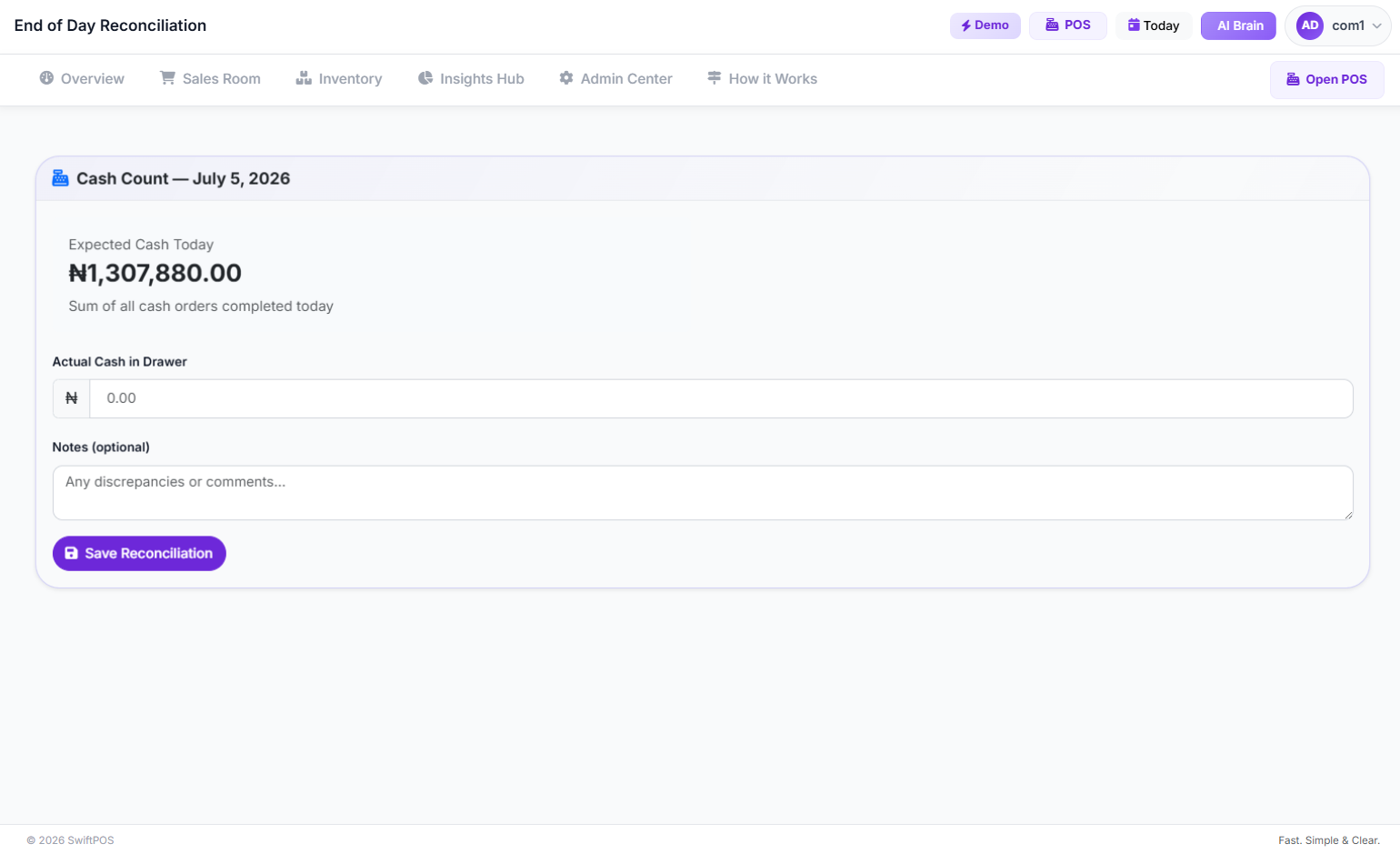 A clean, modern POS interface displaying an end-of-day reconciliation page with sales figures broken down by payment type
Step 2: Count the Physical Cash (Carefully!)
This is where the rubber meets the road. No distractions.
What to do: Have your cashier, or whoever is responsible, count all the physical cash in the till. Separate it by denomination. Then, count the petty cash float that was provided at the start of the day. Remove that float before* you record the day's cash sales. The remaining cash is your actual cash sales for the day.
- Why it matters: Accuracy here is paramount. A single miscounted ₦500 note can throw everything off.
- Common shortcut that backfires: Counting quickly, especially when tired, or letting multiple people count at once. This leads to errors and confusion.
- Action item: Count all physical cash, separate the initial float, and get a clear total for cash sales.
- Pro-tip: For shops with heavy cash flow, like a busy mini-mart doing ₦250,000 – ₦1,000,000 daily, consider using a cash counting machine. It's an investment but saves time and reduces errors.
Step 3: Verify Non-Cash Payments (Every Single One)
Cash isn't the only money coming in, is it?
- What to do: For POS/card payments, get the settlement report from your POS terminal. This report shows the total value of transactions processed through that machine. For bank transfers, check your bank alert records or online banking portal. Every single transfer must be accounted for and matched to a sale. For mobile money, confirm transactions via your service provider's app or SMS records.
- Why it matters: This is where many discrepancies hide. A customer might show you a "successful" transfer screenshot that never actually hit your account. Or a POS transaction could have failed silently.
- Common shortcut that backfires: Trusting customer screenshots or simply taking the cashier's word for it. Never do this. Always verify directly with your bank or payment provider.
- Action item: Obtain official records for all card, transfer, and mobile money payments and sum their totals.
Step 4: Reconcile Sales Against Payments (The Moment of Truth)
Now, bring it all together. This is where you actually reconcile cash and sales.
- What to do: Compare your total cash collected (from Step 2) with the cash sales recorded in your system (from Step 1). Do the same for POS payments, bank transfers, and any other payment method.
- Total Cash Collected vs. System Cash Sales
- Total POS Terminal Report vs. System POS Sales
- Total Verified Bank Transfers vs. System Bank Transfer Sales
- Total Verified Mobile Money vs. System Mobile Money Sales
- Why it matters: This comparison reveals any overages (extra cash) or shortages (missing cash). This is the core of retail accounting.
- Common shortcut that backfires: Ignoring small discrepancies. "Ah, it's just ₦500, no big deal." Those small amounts add up, and they can mask bigger issues.
- Action item: Document any variances immediately. If you're using a proper system, this is where a tool like SwiftPOS NG really shines. It helps you track these variances, associate them with a specific shift or cashier, and gives you a clear picture of your daily performance. It even has an to simplify this step.End Of Day reconciliation page
Step 5: Investigate Discrepancies (Don't Sweep It Under the Rug)
Found a difference? Don't just shrug.
- What to do: If there's a discrepancy, investigate it.
- Cash Shortage/Overage: Re-count the cash. Check for mis-entered sales (e.g., ₦1,500 entered as ₦15,000). Review CCTV footage if available.
- POS/Bank Transfer Mismatch: Check individual transaction IDs. Was a transaction reversed? Did it fail and the customer paid cash instead?
- Why it matters: This isn't about blaming; it's about identifying patterns and preventing future losses. Is there a training issue? A process flaw? Or something more sinister? SwiftPOS, for instance, has an and even flags
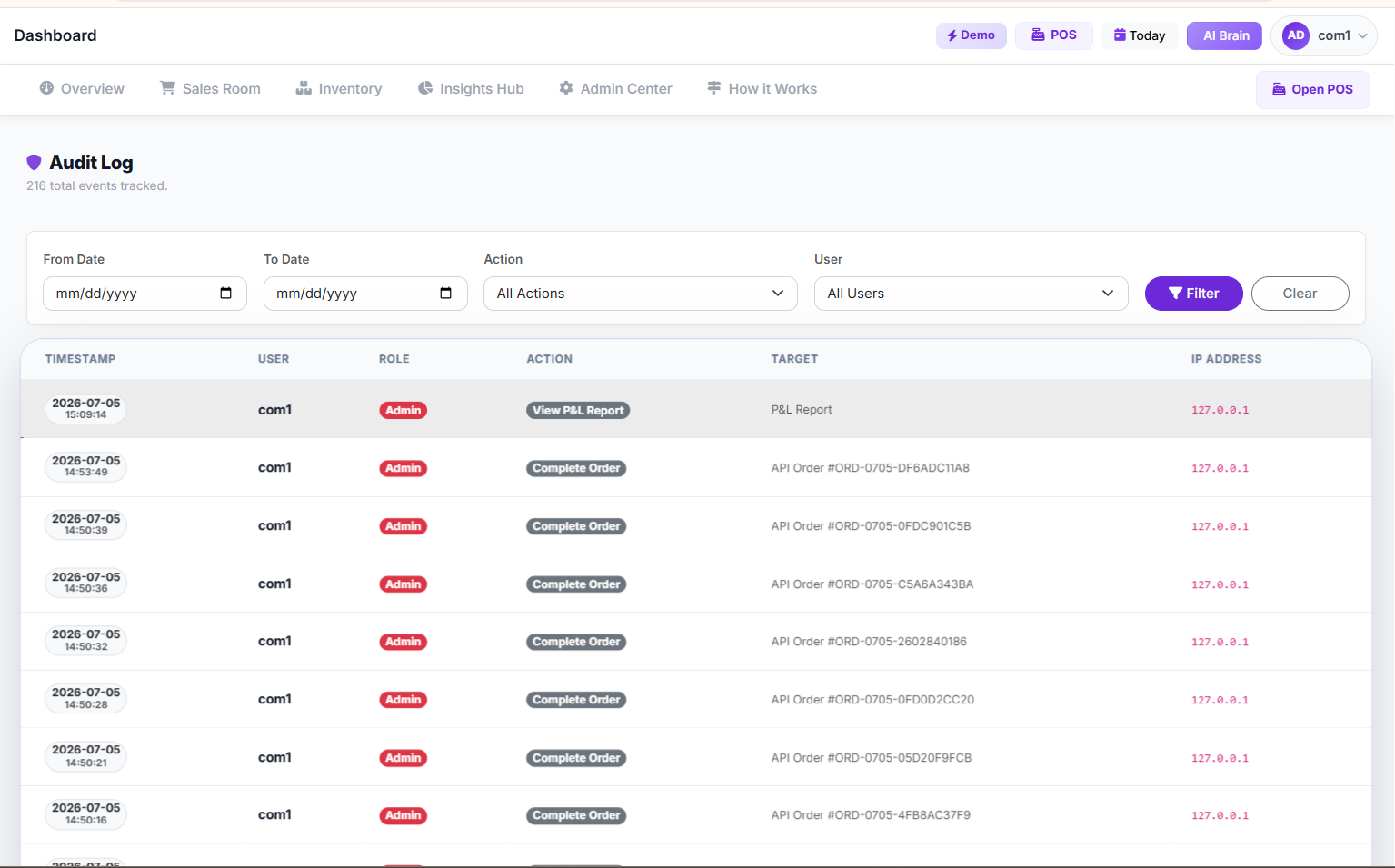 Audit Log Pageto help you pinpoint issues.
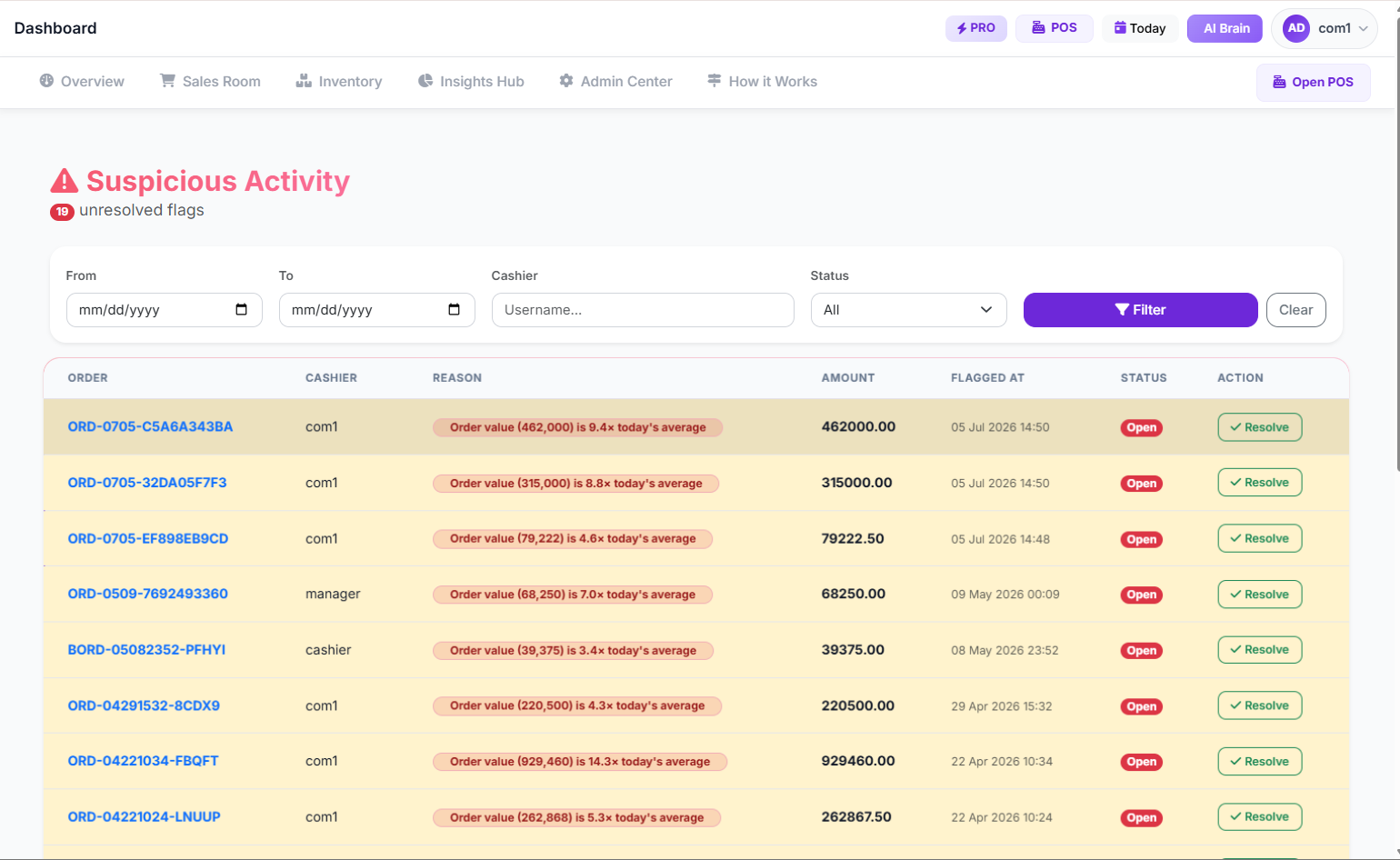 Suspicious Activity Page
- Common shortcut that backfires: Ignoring discrepancies or just making up the difference from your pocket. This teaches staff that accuracy isn't important and hides potential theft.
- Action item: Record the discrepancy, the investigation steps, and any resolution.
Step 6: Prepare for the Next Day
Your day isn't truly done until you're ready for tomorrow.
- What to do: Secure the day's takings. Prepare the petty cash float for the next morning. Ensure all reconciliation documents are filed and signed off.
- Why it matters: A smooth start to the next day depends on a clean close today.
- Common shortcut that backfires: Leaving cash in the register overnight or not preparing the float, causing delays and stress the next morning.
- Action item: Bank the day's earnings (minus the float), secure the float, and organize all paperwork.
 A small business owner using a mobile device
The Numbers That Will Make or Break You
Let's talk money, because that's what this all boils down to, isn't it? Understanding the financial impact of good (or bad) reconciliation is paramount for any Nigerian business owner.
First, consider your daily sales volume. A small trader in Balogun Market might see ₦15,000 – ₦50,000 in sales. A neighborhood provision store could be hitting ₦50,000 – ₦250,000. A busy supermarket in Abuja? Easily ₦250,000 – ₦1,000,000. These numbers are big, and even a 1% error can be significant.
Let's say your daily sales are ₦150,000. A 0.5% cash shortage every day due to errors or pilferage is ₦750. Over a month, that's ₦22,500. Over a year? ₦270,000. That's more than enough to pay a good sales assistant's salary for several months or cover a significant portion of your annual shop rent, which can range from ₦187,500 in a smaller town to ₦3,500,000+ in prime Lagos commercial areas. This is why cash reconciliation isn't just about counting; it's about protecting your profit margin.
What are the costs of not doing this properly?
- Lost Revenue: The most obvious one. Missing cash, unrecorded credit sales, or unverified transfers all eat into your actual profit.
- Shrinkage: This includes theft (internal or external) and administrative errors. Manual systems are breeding grounds for shrinkage. You might be losing 5-10% of your inventory value without even knowing it. Want to know more about this? Read up on Nigerian Retailers: Inventory Management Mistakes Crushing Your Profits.
- Time: How much time do you or your manager spend each evening trying to balance the books? If it's 2 hours a day, and your time is worth ₦2,500/hour, that's ₦5,000 daily, or ₦150,000 monthly. That's a huge hidden cost. This is why manual retail operations in Nigeria are truly expensive.
- Stress and Distrust: Nothing erodes trust faster than unexplained cash discrepancies. It creates tension between you and your staff, and that's bad for business morale.
Growth After Launch: The Next 90 Days
So, you've got your end-of-day reconciliation process locked down. What next? The first 90 days after implementing a solid system are crucial for turning good habits into great results.
- Review Daily, Analyze Weekly: Don't just reconcile; review the reconciliation report daily. Look at the numbers. Are there consistent overages or shortages on specific shifts? Then, once a week, sit down and analyze the trends. Are cash sales up? Are POS payments steady? This helps you understand your business's pulse. A system that offers an or
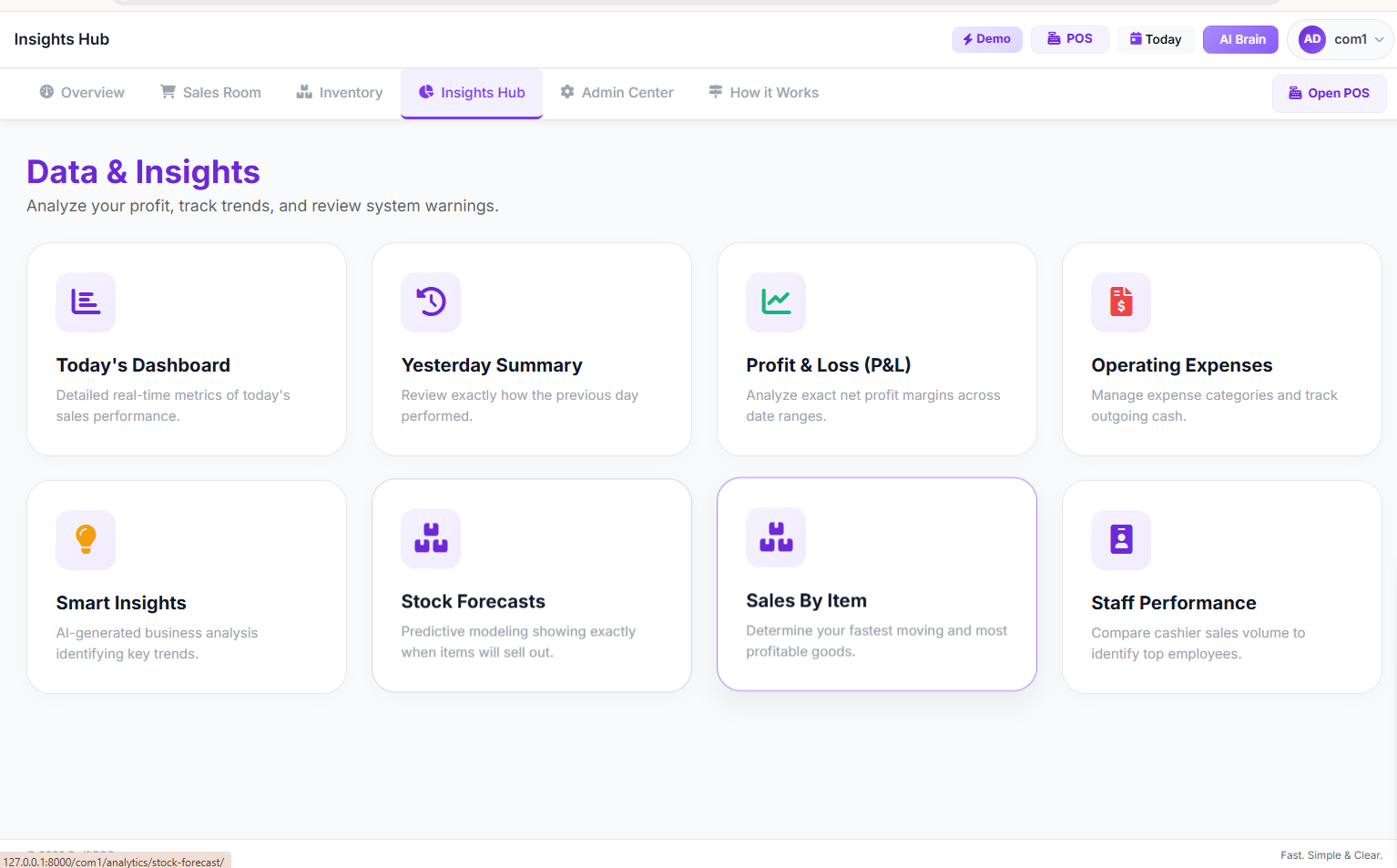 Insights Hubcan make this analysis much easier.
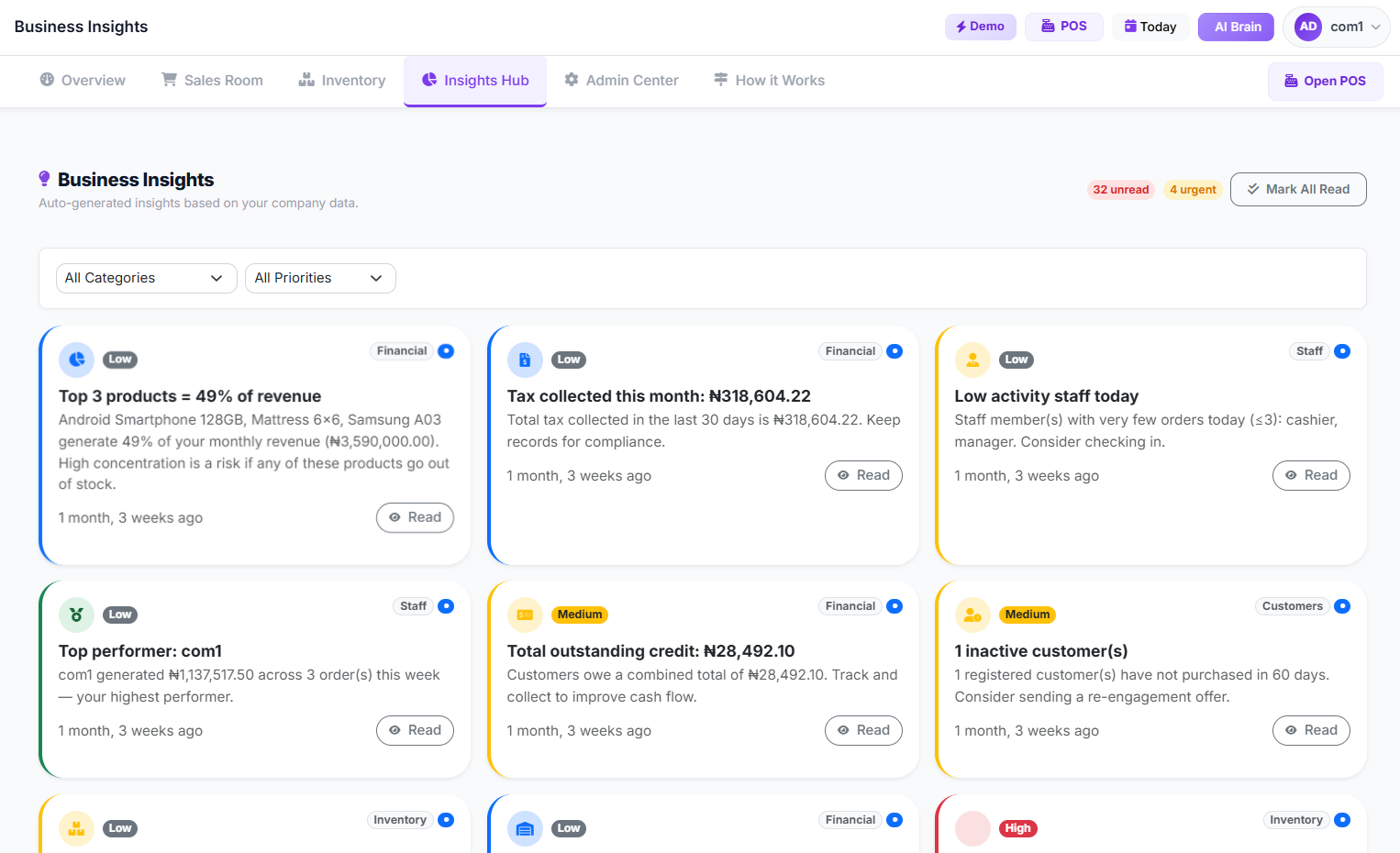 Business Insights Page
- Cross-Reference with Inventory: Your sales numbers should align with changes in your inventory. If your system says you sold 20 cartons of milk, but your stock count only shows a reduction of 15, you have a problem. This is where truly integrated retail accounting comes into play. Systems like SwiftPOS connect sales directly to inventory, so you can track product movement and identify discrepancies. If you're not doing this, you're missing a huge piece of the puzzle. You can read more about this in Nigerian Retailers: Stop Manual Stock Takes & Boost Sales with POS Software.
- Track Staff Performance: With clear daily reconciliation, you can see which cashiers are consistently accurate and which ones need more training. This isn't about punishment; it's about improvement. A system that tracks and provides
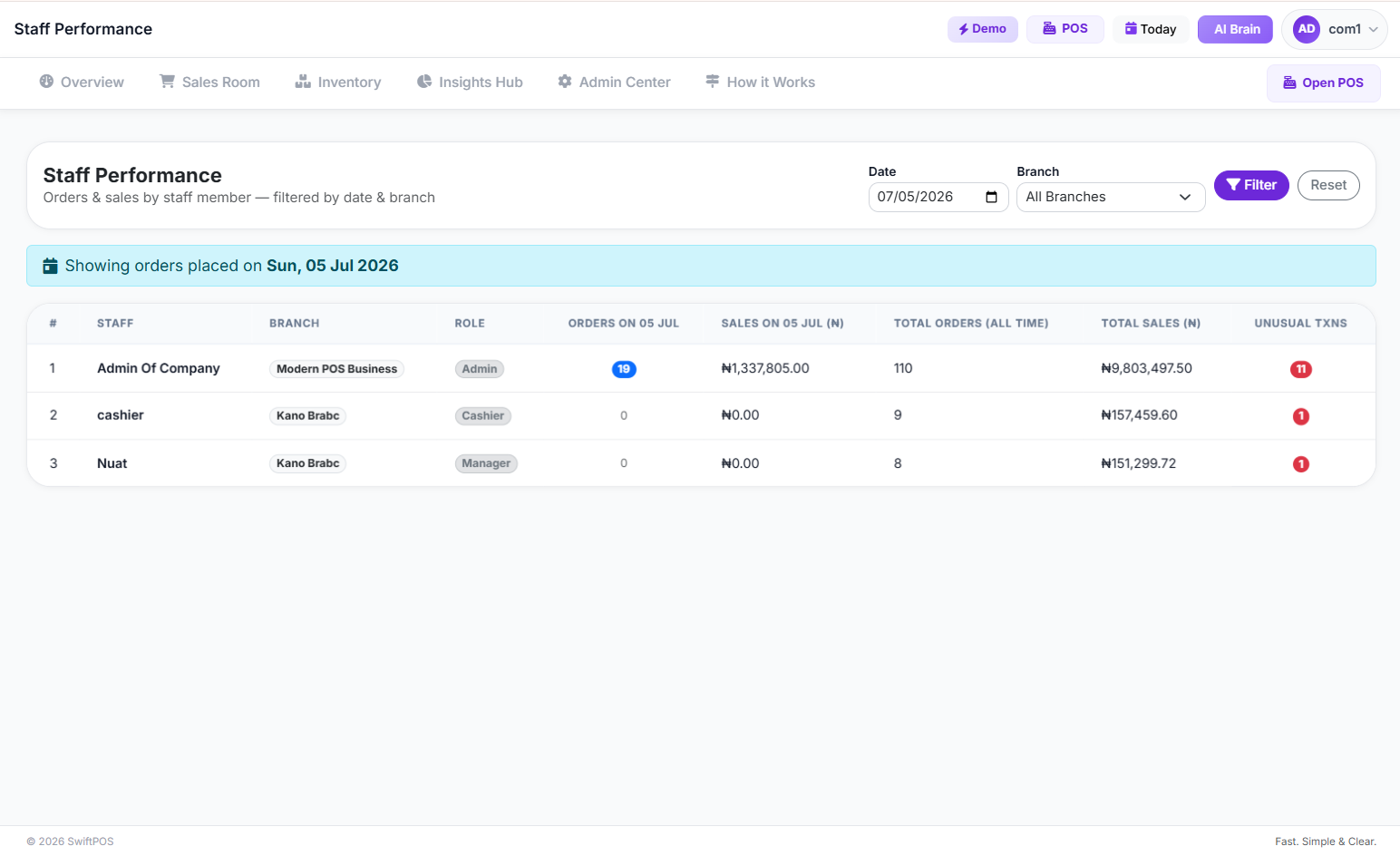 Staff Performance Pagegives you objective data to work with.Staff Activity Records
- Identify Revenue Leaks: Beyond just cash discrepancies, look for other "leaks." Are discounts being given excessively? Are returns high? Are credit sales being properly followed up? These are all things that impact your actual profit. Many businesses lose thousands this way. Check out 7 Revenue Leaks: Mistakes Costing Nigerian Retailers Thousands (and How to Fix Them) for more insights.
- Re-evaluate Your Processes: After 90 days, review your entire reconciliation process. Is it working smoothly? Are there bottlenecks? Can anything be improved? This continuous improvement mindset is what separates thriving businesses from those just getting by.
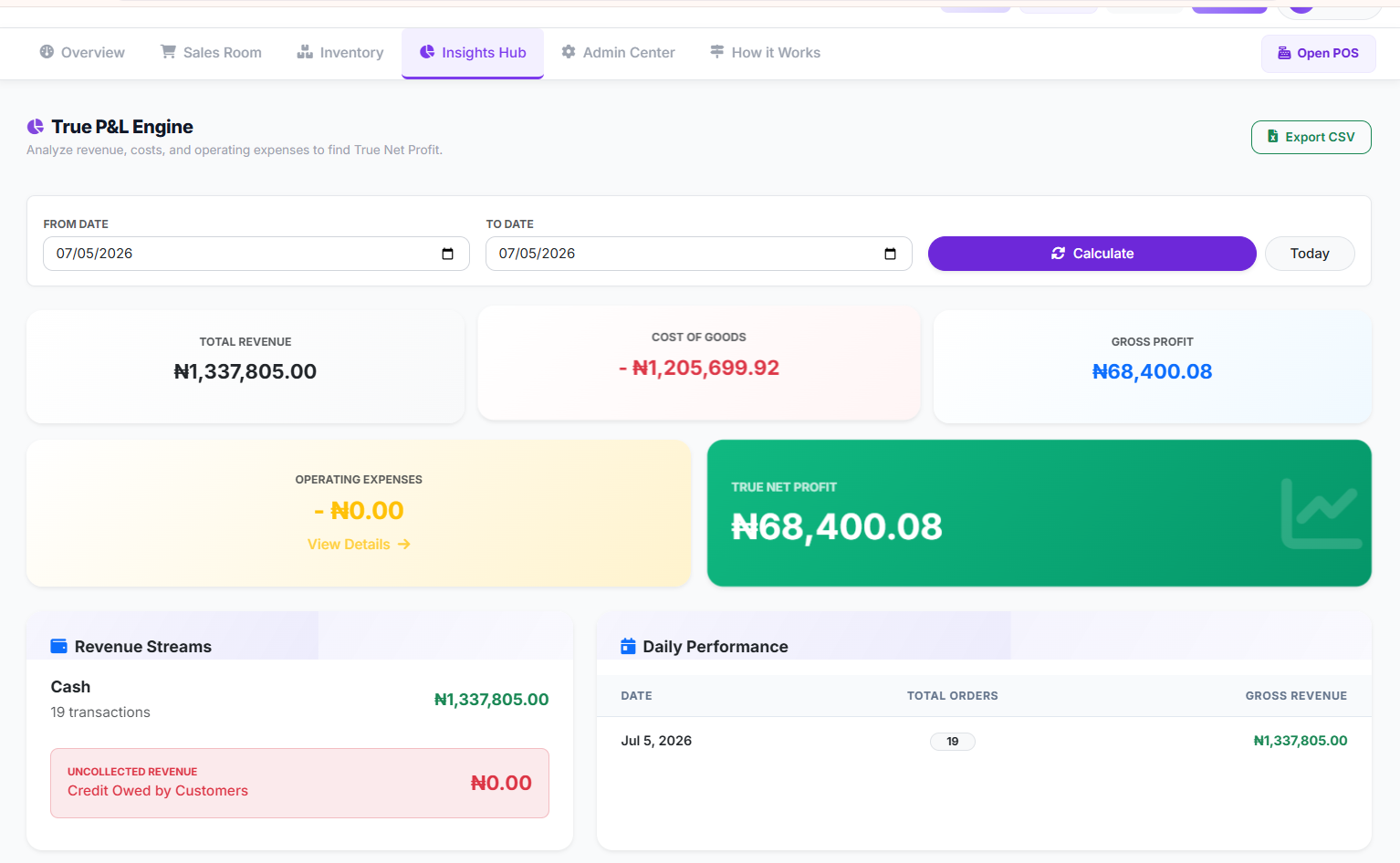 profit and loss
FAQ: Answers to What You're Actually Googling
Q1: What is the fastest way to reconcile cash and sales at the end of the day?
Honestly, the fastest way is to use a modern POS system that automates most of the data collection. It calculates your sales by payment type instantly. All you then need to do is physically count your cash, check your bank alerts, and compare them to the system's report. If you're still doing it manually, there's no "fast" way without risking errors. You might want to consider Best Cloud POS Software for Retail Business Nigeria — Complete 2026 Guide.
Q2: How do I handle discrepancies in my daily reconciliation?
First, don't panic. Re-count the cash and double-check all non-cash payment records. Look for data entry errors in your sales system. If it's a small difference (say, less than ₦200 for a daily sale of ₦100,000), you might log it as a cash over/short and move on, but always investigate if it becomes a pattern. For larger discrepancies, you need to dig deeper – review transaction logs, check CCTV, and speak with the cashier on duty. Always document everything.
Q3: Is it better to use a manual sales book or a computer for end-of-day reconciliation?
A computer, specifically a POS system, is almost always better. It reduces human error, speeds up the process, and provides detailed reports that a manual book simply cannot. While a sales record book costs about ₦800 – ₦2,500 monthly, the hidden costs of manual errors and lost time far outweigh the investment in a good system. Think about it: a manual book can't tell you your
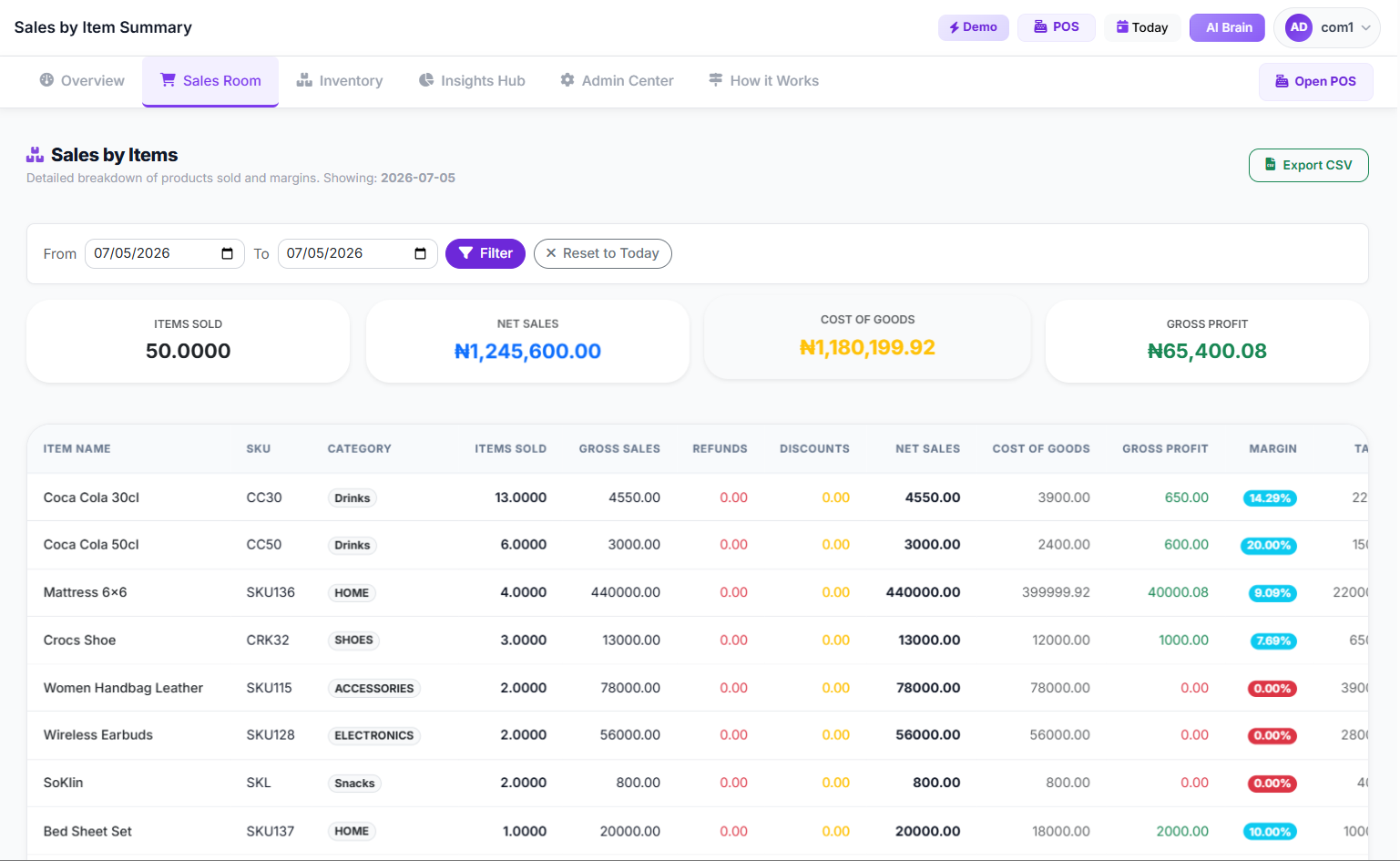 sales by item
Q4: My cashier always has shortages. What should I do?
This is a serious issue that needs addressing immediately. Start by observing their process without interference. Provide more training on handling cash and making change. Implement a clear cashier balancing procedure and ensure they understand the importance of accuracy. If the shortages continue, despite training and support, you might need to consider disciplinary action or reassigning them, as consistent shortages can indicate negligence or worse. Remember, a good POS system can help you track individual cashier performance.
Q5: How often should I reconcile my cash and sales?
You should reconcile your cash and sales every single day without fail. This practice, known as end-of-day reconciliation, is fundamental to good financial management. It helps catch errors quickly, deter theft, and gives you an accurate picture of your daily performance. Leaving it for days or weeks just invites bigger problems and makes it nearly impossible to trace discrepancies.
Ready? Here's Where to Start
Look, running a business in Nigeria is tough. You're juggling so much, and the last thing you need is to lose money because your daily reconciliation is a mess. You've seen how much a proper system can save you, not just in naira, but in stress and wasted time.
If you're tired of the endless counting, the missing kobo, and the headache of manual record-keeping, it's time for a change. SwiftPOS is designed specifically for Nigerian businesses like yours, helping you manage your retail shop with useful insights and even AI. It connects all your sales, inventory, and financial data in one easy-to-use system.
Why not see for yourself? You can start with a 14-day free trial and experience the difference a truly integrated system makes. No more guessing, no more stress. Just clear, accurate numbers that help you grow. Or, if you want to understand more about what SwiftPOS offers, check out our features and benefits pages.
Written by SwiftPOS Team
Practical guides from the retail specialists at Nura Mustapha Technologies Limited, for modern Nigerian merchants.