10 Best Businesses to Start in Nigeria With ₦2 Million (High Profit)
SwiftPOS Team
Published November 02, 2026

A staggering 63% of small businesses in Nigeria fail within their first five years, often not due to lack of effort, but because they jump in without a clear understanding of the market and the true costs involved. You’ve probably heard people say you need millions to start a profitable business in Nigeria. While some ventures do, I'm here to tell you that with a strategic approach and smart choices, it’s entirely possible to find 10 Best Businesses to Start in Nigeria With ₦2 Million (High Profit) potential even in 2026. This isn't about guesswork; it's about understanding where your naira goes and how to make it work for you.
A young nigerian entrepreneur smiling confidently in herWhy Most People Get This Wrong from Day One
The biggest mistake I see, time and time again, is people underestimating startup capital. They hear "₦2 million business" and think it's all for stock. No, my dear. That ₦2 million needs to cover much more than just the products you sell. It’s about rent, registration, equipment, staff, and even a buffer for those inevitable slow months. If you don't factor in these hidden costs, your dreams can crumble faster than a poorly baked puff-puff.
Consider this: shop rent in a decent area, say, a busy street in Ibadan, can easily run you ₦400,000 to ₦1,200,000 annually. In a prime spot on Lagos Island or Abuja, you're looking at ₦1,500,000 to ₦2,500,000 per year. If you've only budgeted ₦1 million for everything, you're already in trouble before you even buy your first carton of goods. This is why many promising ventures never even get off the ground, or they start, struggle, and quickly close shop. You need a realistic breakdown of what it truly takes to launch a 2 million business in today's Nigerian economy.
Another common pitfall? Ignoring proper business registration. Many operate as unregistered entities, thinking they're saving money. But what happens when you need a bank loan, or a supplier requires proper documentation? Or when you want to expand and formalize? Business registration with the Corporate Affairs Commission (CAC) can cost anywhere from ₦25,000 for a sole proprietorship to ₦70,000 for a limited company, especially when you factor in legal fees. It’s a small investment that unlocks bigger opportunities and protects your business. Don't skip it.
Before You Do Anything: The Foundation Work
Before you even think about which business ideas Nigeria offers that fit your budget, you need to lay a solid foundation. This isn't glamorous, but it's where successful businesses are built.
- Market Research & Business Plan (Time: 2-4 weeks, Cost: ₦0 - ₦50,000)
- Business Registration & Permits (Time: 2-6 weeks, Cost: ₦35,000 - ₦120,000)
- Secure Your Location (Time: 1-3 months, Cost: ₦80,000 - ₦2,500,000 annually)
- Initial Capital Assessment (Your ₦2 Million Breakdown)
- Shop Rent (Annual): ₦80,000 - ₦2,500,000 (Let's aim for a mid-range for a decent small shop: ₦500,000)
- Business Registration (CAC & Permits): ₦25,000 - ₦120,000 (Budget: ₦75,000)
- Initial Stock/Inventory: ₦300,000 - ₦1,500,000 (This is where most of your remaining capital goes. Let's say: ₦800,000)
- Equipment/Tools: ₦150,000 - ₦800,000 (Shelving, display units, a small freezer for a provision store, basic office supplies. Budget: ₦250,000)
- Generator (Small): ₦120,000 - ₦350,000 (A non-negotiable in Nigeria. Budget: ₦180,000)
- Marketing/Advertising (Initial 3 months): ₦50,000 - ₦200,000 (Local flyers, social media boosts. Budget: ₦80,000)
- Working Capital (3 months buffer): ₦150,000 - ₦600,000 (Covers salaries, fuel, minor repairs before consistent revenue. Budget: ₦300,000)
The Step-by-Step Path (What Actually Works)
Alright, let's talk about the actual businesses you can start and how to make them work. We're focusing on retail-centric models because that's where you can really make your ₦2 million work hard for you.
Step 1: Provision Store / Mini-Mart
What to do: Stock everyday essentials like groceries, toiletries, snacks, drinks, and household items. Think quick grab-and-go for a local community.
Why it matters: High demand, repeat customers, and essential goods are less affected by economic fluctuations. You can start small, perhaps even from a converted garage or a compact shop space.
Common shortcut that backfires: Overstocking on fancy, slow-moving items. People want what they need every day.
Action item: Visit local markets like Balogun or Onitsha Main Market to scout suppliers for competitive pricing. Focus on high-turnover items.
- Initial Stock: ₦400,000 - ₦1,000,000 (Focus on fast-moving consumer goods like detergents, cooking oil, rice, pasta, beverages, toiletries).
- Equipment: ₦200,000 - ₦450,000 (Shelving, a good display fridge for drinks, counter, small generator).
- Target Monthly Revenue: ₦300,000 - ₦800,000.
- Gross Profit Margin: 20% - 35%.
Step 2: Pharmacy/Drug Store (Small Scale)
What to do: Sell over-the-counter medications, health supplements, first aid supplies, and personal care products. If you're a licensed pharmacist, you can expand to prescription drugs.
Why it matters: Health is wealth, and demand for health products is constant. A well-located drug store, especially in a residential area, can be incredibly profitable.
Common shortcut that backfires: Trying to stock everything. Focus on common ailments and high-demand products first.
Action item: Secure necessary licenses from PCN (Pharmaceutical Council of Nigeria) if applicable, and connect with reputable pharmaceutical distributors.
- Initial Stock: ₦600,000 - ₦1,500,000 (Pharmaceuticals, health products, personal care items).
- Equipment: ₦300,000 - ₦700,000 (Proper shelving, air conditioning, secure storage, small generator).
- Target Monthly Revenue: ₦500,000 - ₦1,200,000.
- Gross Profit Margin: 25% - 45%.
Step 3: Boutique/Clothing Shop (Targeted Niche)
What to do: Instead of trying to sell everything, pick a niche. Are you focusing on affordable Ankara wear, trendy ready-to-wear for young professionals, or quality children's clothing?
Why it matters: Fashion is always in demand, but a niche helps you stand out and target your marketing effectively.
Common shortcut that backfires: Buying generic clothes from mass markets that everyone else sells. Your unique selling proposition disappears.
Action item: Source directly from Aba shoe market or Kano textile market, or find local tailors/designers to create unique pieces. Leverage social media heavily.
- Initial Stock: ₦500,000 - ₦1,200,000 (Quality, niche-specific clothing items).
- Equipment: ₦150,000 - ₦400,000 (Mannequins, display racks, fitting room, good lighting).
- Target Monthly Revenue: ₦400,000 - ₦1,000,000.
- Gross Profit Margin: 30% - 60%.
Step 4: Electronics & Phone Accessory Store
What to do: Sell phone accessories, chargers, headphones, power banks, small gadgets, and perhaps offer basic phone repairs.
Why it matters: In 2026, almost everyone has a phone, and accessories are always needed. The margins can be quite good on quality accessories.
Common shortcut that backfires: Selling fake or low-quality products. Customers will quickly lose trust.
Action item: Source directly from Computer Village in Ikeja for competitive prices, ensuring genuine products. Build relationships with trusted suppliers.
- Initial Stock: ₦700,000 - ₦1,500,000 (Original accessories, small electronics).
- Equipment: ₦200,000 - ₦500,000 (Display cases, repair tools if offering services, secure storage).
- Target Monthly Revenue: ₦600,000 - ₦1,500,000.
- Gross Profit Margin: 25% - 50%.
Step 5: Food & Beverage Vendor (Packaged Goods/Small Eatery)
What to do: This isn't about starting a full-blown restaurant. Think a small, clean spot selling packaged snacks, fresh juices, local finger foods (akara, puff-puff), or a limited menu of popular dishes like Jollof rice and chicken.
Why it matters: Food is recession-proof. If it's tasty, affordable, and hygienic, people will buy.
Common shortcut that backfires: Poor hygiene, inconsistent quality, or trying to offer too many dishes.
Action item: Focus on a few signature items. Get proper food hygiene certifications. Consider a food cart or a small, easily accessible space in a busy area.
- Initial Stock: ₦300,000 - ₦800,000 (Ingredients, packaging, drinks).
- Equipment: ₦250,000 - ₦600,000 (Cooking equipment, display warmer/cooler, generator, utensils).
- Target Monthly Revenue: ₦400,000 - ₦1,000,000.
- Gross Profit Margin: 35% - 60%.
Step 6: Wholesale/Distribution Business (Specific Product)
What to do: Identify a high-demand product (e.g., bottled water, soft drinks, provisions, building materials like cement) and become a distributor for a specific area. You buy in bulk and sell to smaller retailers or directly to consumers in larger quantities.
Why it matters: Higher volume sales, even with smaller margins per item, can lead to significant overall profit.
Common shortcut that backfires: Not having enough capital to buy large enough quantities to get true wholesale pricing.
Action item: Research manufacturers or primary distributors. You might need a small warehouse space (even a large garage) and a delivery vehicle (or partner with one).
- Initial Stock: ₦800,000 - ₦1,500,000 (Bulk purchase of a specific product).
- Equipment: ₦100,000 - ₦300,000 (Storage racks, perhaps a small forklift if dealing with heavy goods, generator).
- Target Monthly Revenue: ₦700,000 - ₦1,500,000.
- Gross Profit Margin: 15% - 30% (Lower margin, higher volume).
Step 7: Agricultural Produce Retail
What to do: Focus on fresh, high-quality agricultural produce. Think a dedicated store for organic vegetables, fruits, or even processed local foods like garri, yam flour, or palm oil, sourced directly from farms.
Why it matters: Nigerians consume these daily. By cutting out some middlemen, you can offer better prices or higher quality.
Common shortcut that backfires: Poor storage leading to spoilage. Perishables need careful management.
Action item: Establish direct relationships with farmers in rural areas. Invest in good storage (e.g., a cold room for vegetables) and efficient logistics.
- Initial Stock: ₦300,000 - ₦700,000 (Fresh produce, dried goods).
- Equipment: ₦200,000 - ₦500,000 (Refrigeration, display units, weighing scale, generator).
- Target Monthly Revenue: ₦350,000 - ₦900,000.
- Gross Profit Margin: 25% - 50%.
Step 8: Stationery & Office Supply Store
What to do: Sell school supplies, office stationery, printing services, photocopying, and perhaps even basic computer accessories.
Why it matters: Schools, offices, and students constantly need these items. Locating near schools or a business district is key.
Common shortcut that backfires: Not diversifying services. Just selling pens won't cut it; offer printing, lamination, binding.
Action item: Source from major distributors in Lagos or Onitsha. Invest in a good printer/photocopier.
- Initial Stock: ₦400,000 - ₦900,000 (Pens, notebooks, paper, printing cartridges).
- Equipment: ₦250,000 - ₦600,000 (Printer/photocopier, laminator, binding machine, shelving).
- Target Monthly Revenue: ₦300,000 - ₦700,000.
- Gross Profit Margin: 30% - 55%.
Step 9: Cosmetics & Beauty Supply Store
What to do: Focus on skincare, haircare, makeup, and personal grooming products. You could specialize in local organic brands or popular international ones.
Why it matters: The beauty industry in Nigeria is booming. People invest in how they look and feel, regardless of the economy.
Common shortcut that backfires: Selling counterfeit products. This quickly destroys your reputation.
Action item: Source genuine products from reputable importers or local manufacturers. Offer consultations or tips to build customer loyalty.
- Initial Stock: ₦500,000 - ₦1,200,000 (Authentic beauty products).
- Equipment: ₦200,000 - ₦500,000 (Attractive display cases, good lighting, mirrors).
- Target Monthly Revenue: ₦450,000 - ₦1,100,000.
- Gross Profit Margin: 30% - 50%.
Step 10: Pet Store / Pet Supply
What to do: Sell pet food, toys, accessories (collars, leashes), and grooming products. You could even offer basic grooming services.
Why it matters: Pet ownership is growing in urban Nigeria, and pet owners spend significantly on their furry friends. It's a niche market with less competition.
Common shortcut that backfires: Not understanding pet needs or stocking low-quality, unsafe products.
Action item: Partner with local vets or pet breeders. Research popular pet food brands and accessories. Start with a small, curated selection.
- Initial Stock: ₦400,000 - ₦900,000 (Pet food, toys, accessories).
- Equipment: ₦150,000 - ₦350,000 (Display shelves, grooming tools if offering services).
- Target Monthly Revenue: ₦300,000 - ₦750,000.
- Gross Profit Margin: 25% - 45%.
Now, no matter which of these profitable business ideas you choose, managing it effectively is the real secret to turning that ₦2 million into much more. This is where a robust system comes in. For any of these retail businesses, you absolutely need a way to manage sales, track inventory, handle customers, and monitor your profit. Trying to do all of this with pen and paper or basic Excel in 2026 is like trying to drive a car with a flat tire – you'll get somewhere, but it'll be slow, inefficient, and costly. This is where a tool like SwiftPOS NG can genuinely change your business trajectory. It's a business management and Point-of-Sale (POS) platform designed for Nigerian retailers, connecting everything from sales to inventory, customer debt, and expenses in one system. It's not just a cash register; it's a complete control center for your shop.
 A cashier at a busy mini mart uses
The Numbers That Will Make or Break You
Understanding your capital isn't enough; you need to grasp your ongoing operational costs and realistic revenue projections. This is the part most people don't expect, but it's crucial for any ₦2 million business to thrive.
Monthly Running Costs (Beyond initial setup):
- Staff Salary (1-2 people): ₦90,000 - ₦180,000 (₦45,000 - ₦90,000 per person, depending on skill and location).
- Fuel for Generator: ₦30,000 - ₦150,000 (This is highly variable. A small generator running 4-6 hours daily could be ₦50,000-₦80,000 monthly).
- Utilities (Electricity, Water, Waste): ₦10,000 - ₦50,000.
- Internet/Data: ₦5,000 - ₦15,000.
- Replenishing Stock: This is your biggest ongoing cost and directly ties to your sales. If you sell ₦500,000 worth of goods with a 30% gross profit, you need about ₦350,000 to restock.
- Marketing (Ongoing): ₦10,000 - ₦50,000 (Social media boosts, local promotions).
- Miscellaneous (Repairs, supplies): ₦5,000 - ₦20,000.
- Salary: ₦60,000
- Fuel: ₦70,000
- Utilities: ₦20,000
- Internet: ₦10,000
- Marketing: ₦20,000
- Misc: ₦10,000
- Total Fixed Monthly Operating Costs: ₦190,000
Gross Profit (₦135,000) - Fixed Monthly Operating Costs (₦190,000) = -₦55,000.
See the problem? You're losing money! This is why your gross profit margin and sales volume are critical. You need to either increase your sales, increase your margins, or reduce your operating costs. This is the stark reality for many small businesses.
<blockquote style="background-color: #f8f8f8; border-left: 5px solid #ffcc00; padding: 15px; margin: 15px 0;">
"Many businesses focus on sales volume, but true profitability comes from understanding your gross profit and diligently managing operating expenses. Without this, you're running on a treadmill."
</blockquote>
This financial transparency is not just nice to have; it's essential. A system that helps you track your monthly profit margins, like SwiftPOS NG, can be the difference between guessing and truly knowing if your business is making money. It even helps you track expenses and calculate your true net profit after all those crucial operating costs.
Growth After Launch: The Next 90 Days
The first 90 days after launching your 2 million business are critical. This isn't the time to relax; it's time to hustle, learn, and adapt.
- Monitor Sales & Inventory Closely: What's selling? What isn't? Which products have the best margins? Don't let popular items run out of stock. At the same time, identify dead stock and move it quickly, even at a discount. This is where the real-time insights from a system like SwiftPOS NG become invaluable. It can help you predict when products will run out of stock in Nigeria and avoid those frustrating "out of stock" moments.
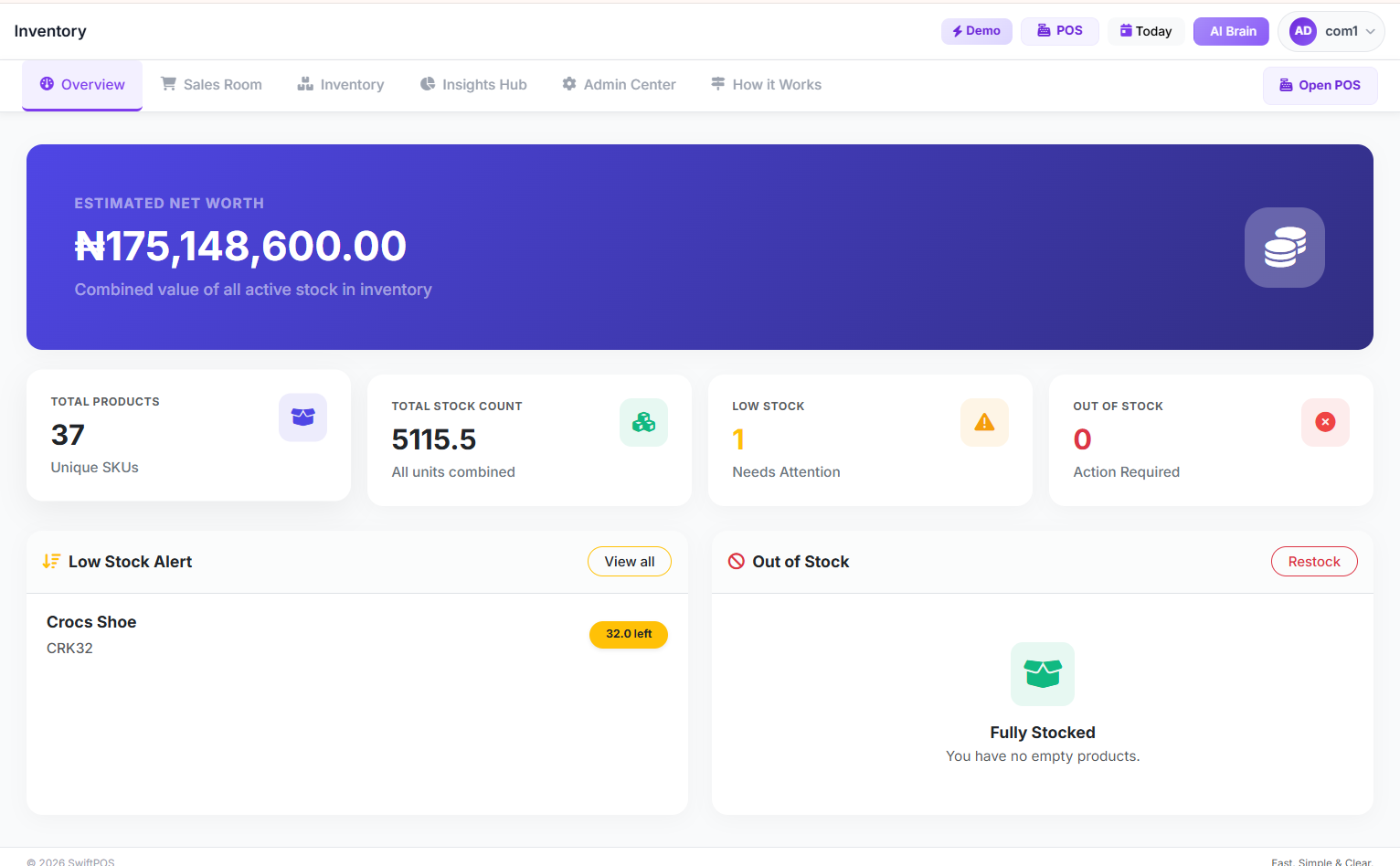 Inventory Dashboard
- Gather Customer Feedback: Ask your customers what they need, what they like, and what they don't. Are your prices fair? Is your service good? This feedback is gold and will help you refine your product offerings and service delivery.
- Optimize Your Marketing: Initial marketing gets you noticed; ongoing marketing keeps you relevant. Use social media, local flyers, and word-of-mouth. Offer small incentives for referrals. Consider WhatsApp Automation: Customer Notifications for Nigerian Retail Businesses for direct engagement.
- Manage Cash Flow Aggressively: Keep a close eye on your money. When are payments due? When do you expect revenue? Avoid tying up too much capital in slow-moving inventory. For more on this, check out 7 Revenue Leaks: Mistakes Costing Nigerian Retailers Thousands (and How to Fix Them).
- Review Staff Performance (If Applicable): If you've hired staff, ensure they're productive and customer-focused. Train them well and set clear expectations. You can use tools to set staff access permissions in retail software in Nigeria to control what different employees can do.
- Embrace Technology from Day One: Seriously, don't wait until you're overwhelmed. Starting with a manual system only to switch later is more painful and costly. Adopt a system that streamlines your operations from the get-go. This includes for everything from your sales to retail inventory management: step-by-step guide to efficient stock adjustments.
FAQ: Answers to What You're Actually Googling
Q1: Is ₦2 million enough to start a profitable business in Nigeria in 2026?
A: Yes, absolutely, but it requires careful planning and realistic expectations. As we've broken down, ₦2 million is a decent starting point for many small to medium retail businesses, but it will be stretched. You need to prioritize essential costs like rent, initial stock, and a generator, and be prepared to manage your working capital tightly. It's about smart allocation, not just the raw figure.
Q2: What are the most important factors for a 2 million business to succeed?
A: Beyond the capital, the key factors are market research (understanding demand), location (accessibility and customer traffic), efficient inventory management (avoiding dead stock and stockouts), excellent customer service, and robust financial tracking. You need to know what's coming in, what's going out, and where your profits truly lie.
Q3: How quickly can I expect to see profit from a new business in Nigeria?
A: This varies widely by industry and how well you execute your plan. Generally, for a small retail business, you might start breaking even within 3-6 months. Generating significant profit could take 6-12 months, or even longer. It’s a marathon, not a sprint. Your initial working capital should ideally cover at least 3 months of operating expenses before you expect consistent positive cash flow. For a deeper dive, read POS System ROI: Calculating True Value for Nigerian Retailers.
Q4: Should I get a loan for my startup capital?
A: If you have personal savings, starting with that is always preferable. If a loan is necessary, ensure it’s from a reputable source, and you have a clear repayment plan. Calculate your projected cash flow meticulously to ensure you can meet loan obligations even during slow periods. Many businesses fall into debt cycles because they don't properly account for loan repayments.
Q5: What role does technology play for a business starting with ₦2 million?
A: Technology is no longer a luxury; it's a necessity, even for small businesses. A good POS and inventory management system can help you track sales, manage stock, understand your profit margins, and even identify suspicious staff activity. This prevents losses and gives you data-driven insights to make better decisions. Think of it as your business's brain. You can find more information about Best Cloud POS Software for Retail Business Nigeria — Complete 2026 Guide.
Ready? Here's Where to Start
Starting a business with ₦2 million in Nigeria in 2026 is a real possibility, not a pipe dream. But it demands diligence, smart choices, and a willingness to embrace modern tools. Don't just jump in. Plan meticulously, understand your costs, and be ready to adapt.
If you're serious about making your venture a success, especially in retail, you need a system that supports your growth from day one. Take the next step and explore how SwiftPOS NG can be the backbone of your new business. It's designed to help you manage everything from sales and inventory to staff and profit, giving you the clarity and control you need to thrive.
Ready to transform your business idea into a profitable reality? Learn more about the benefits of a smart POS system and how to set up your SwiftPOS account today.