
How to Calculate Gross Profit Per Sale (Step-by-Step Guide)

The cashier in the mini-mart on Adeniji Adele Road wiped sweat from his brow, tallying the day's sales on a worn ledger. Each line item, a sachet of Milo, a bottle of groundnut oil, a pack of biscuits, was dutifully recorded. He knew the total revenue, sure, but as he looked at the pile of cash, a familiar knot formed in his stomach. How much of this was actual profit? This struggle to truly understand how to calculate gross profit per sale (step-by-step guide) is a daily reality for countless Nigerian business owners.
Nigerian shop owner reviewing ledgerWhy Most People Get This Wrong from Day One
Look, I've been there. Twelve years managing shops in Lagos taught me one thing: we are obsessed with sales figures. "Ah, today I sold ₦350,000!" you'll hear someone boast. And that's great, on the surface. But that number, that revenue, it's a siren song if you don't know what it truly means. Most people, especially those running provision stores in Surulere or electronics shops in Computer Village, make a fundamental mistake: they confuse revenue with profit. They see cash in hand and assume it's all theirs.
Here's the thing though — does that actually work? Not really. You see, the cost price selling price relationship is often underestimated. You buy a carton of soft drinks for ₦4,000 and sell each bottle for ₦300. You sell 20 bottles, that's ₦6,000. Looks good, right? But did you factor in the Keke Napep fare to pick up the carton? The ice to keep it cold? The small nylon bag you put it in? These little things eat into your retail margin, and if you're not tracking them, you're just guessing.
The biggest obstacle is often the sheer volume of transactions and the reliance on manual methods. Imagine a busy market stall in Balogun, selling fabric. You make hundreds of sales a day. Trying to manually calculate the exact profit on each ₦1,500 scarf when you bought the fabric in bulk for ₦187,500 and paid ₦2,500 for a delivery moto is a headache. This leads to what I call "aggregate guessing" – you know you made some money, but you can't point to how much on each item. This lack of precise gross profit calculation leaves you vulnerable, unable to identify your most profitable products or truly understand where your money is going. Many Nigerian retailers are still stuck using basic spreadsheets, or worse, paper, which can lead to significant revenue leaks. You can read more about how these manual methods cost businesses money in this article: Why Manual Retail Management Is Costing Nigerian Shops Money.
Before You Do Anything: The Foundation Work
Before you can even begin to accurately calculate your gross profit per sale, you need to lay some groundwork. This isn't optional; it's the bedrock of a profitable business. You wouldn't build a house on sand, would you?
- Know Your True Cost of Goods Sold (COGS) for Every Item: This is non-negotiable. It's not just the price you paid the supplier. Did you pay transportation to get it to your shop? Storage fees? Import duties? Add all of that to the initial purchase price. For example, if you bought 100 sachets of detergent for ₦50,000 from a wholesaler in Onitsha Main Market, and paid ₦2,500 for transport, your actual cost per sachet isn't ₦500; it's ₦525. That ₦25 difference, multiplied across thousands of sales, is huge.
- Separate Your Business Finances: This sounds basic, but many small business owners in Nigeria use their shop's cash for personal expenses. Stop it. Right now. Your business needs its own bank account, its own ledger, its own identity. How can you know what the business is truly making if you're constantly dipping into the till for personal needs?
- Track All Expenses, Big and Small: From your annual shop rent (which can be anywhere from ₦150,000 in a small town to ₦3,500,000+ in a prime Lagos location) to the daily fuel for your generator, every kobo spent must be recorded. These aren't directly part of your COGS, but they impact your overall profitability. You can't understand gross profit without also having an eye on the bigger picture of net profit.
- Get Your Pricing Strategy Right: You need to know your target retail margin. Are you aiming for a 20% margin? 35%? This guides your selling price. Don't just copy the shop next door. Understand your own costs. For instance, a mobile phone accessory might cost you ₦7,500 and you sell it for ₦12,000. That's a decent margin, but if your competitors are selling the exact same item for ₦10,000, you need to re-evaluate.
- Embrace Digital Tools (Seriously): If you're still on paper or basic Excel, you're wasting time and losing money. The hidden costs of manual retail operations are significant. You can find out more about that here: Hidden Costs of Manual Retail Operations in Nigeria: What You're Missing Beyond POS. A good system will handle most of this foundation work for you, automatically.
The Step-by-Step Path (What Actually Works)
Alright, let's get into the nitty-gritty of how to calculate gross profit per sale. This isn't just theory; it's what I've seen work time and again for businesses, from a bustling pharmacy on Ago-Palace Way to a quiet boutique in Port Harcourt.
Step 1: Pinpoint Your Exact Selling Price (SP)
This one seems obvious, right? But it's not always as simple as the price tag.
What to do: For every single item you sell, write down its final selling price. If you offer discounts, make sure you're using the actual price it sold for after the discount.
Why it matters: This is the top line. This is the money that comes into your business from that specific sale. Without it, you have nothing to compare your costs against.
Common shortcut that backfires: Using the listed price even when you consistently give customers small discounts or haggle. Those small deductions add up and distort your actual revenue.
Specific action item: Go through your last 20 sales. What was the exact amount of money you received for each item sold?
Step 2: Determine Your True Cost of Goods Sold (COGS)
This is where many businesses trip up. Your cost price selling price equation starts here.
What to do: For each item, sum up all direct costs associated with bringing that product to a sellable state in your shop. This includes:
- Purchase Price: What you paid the supplier. (e.g., ₦500 for a sachet of detergent, ₦15,000 for a phone accessory).
- Transportation Cost: If you paid for delivery to your shop, divide that cost among the items. For example, if you paid ₦1,500 to transport 100 items, that's ₦15 per item.
- Customs/Duties (if applicable): For imported goods, factor these in.
- Packaging (for bulk purchases): If you buy in bulk and repackage, the cost of the smaller packaging material per unit. (e.g., ₦20 for a small nylon bag).
Common shortcut that backfires: Ignoring transport costs or packaging. You think a product costs you ₦700, but with transport (₦150) and a custom bag (₦50), it's actually ₦900. That's a ₦200 difference you've just erased from your potential profit.
Specific action item: Pick 5 popular items. Call your supplier, check your waybills, and calculate the precise COGS for each unit, including transportation.
Step 3: Identify Other Direct Costs Associated with That Specific Sale
This is the part most people don't expect. Gross profit isn't just sales minus COGS; it's sales minus all direct costs of that sale.
What to do: Consider costs that occur only when a sale happens. These aren't your fixed monthly expenses like rent.
- Sales Commission: If you pay your staff a commission per sale (e.g., ₦50-₦500 per item sold).
- Delivery to Customer: If you offer delivery and charge for it, the actual cost of that delivery (e.g., ₦200-₦2,500 within city limits).
- Payment Gateway Fees: If the customer pays with a POS machine or online, the transaction fee (e.g., ₦50-₦250).
- Specific Promotional Costs: If this sale happened because of a direct ad campaign where you can tie the cost back to the sale (e.g., ₦100-₦1,000 for a specific social media boost that led to this one sale).
- Packaging (for outbound delivery): If you use special packaging for delivery, this cost. (e.g., ₦50-₦200 per item).
Common shortcut that backfires: Lump all these into "general expenses." You're then inflating your gross profit, giving you a false sense of how healthy each sale actually is.
Specific action item: For your next 10 sales, record any direct commissions, delivery fees, or payment gateway charges. You'll be surprised how quickly they add up.
Step 4: Calculate Your Gross Profit Per Sale
Now, the moment of truth.
What to do: Use this simple formula:
Gross Profit Per Sale = Selling Price (SP) - (COGS + Other Direct Costs Per Sale)
Let's take an example:
You sell a mobile phone accessory:
- Selling Price (SP): ₦12,000
- COGS: ₦7,500 (purchase price) + ₦200 (transport share) = ₦7,700
- Other Direct Costs:
- Sales Commission: ₦300
- Payment Gateway Fee: ₦150
- Packaging for customer: ₦100
- Total Other Direct Costs = ₦300 + ₦150 + ₦100 = ₦550
Gross Profit Per Sale = ₦12,000 - ₦8,250
Gross Profit Per Sale = ₦3,750
This ₦3,750 is your actual gross profit for that one sale. It's the money left over to cover your general operating expenses (rent, salaries, electricity) and, ultimately, your net profit.
Why it matters: This figure gives you a clear picture of the profitability of each product and each transaction. It helps you decide which products to push, which promotions are truly worth it, and whether your pricing is sustainable.
Common shortcut that backfires: Only subtracting COGS. If you ignored the ₦550 in other direct costs in our example, you'd think your gross profit was ₦4,300. That's a ₦550 error on just one sale! Imagine that across hundreds of sales.
Specific action item: Apply the full formula to the 5 items you calculated COGS for in Step 2.
Step 5: Calculate Your Gross Profit Margin (Percentage)
While the absolute gross profit is important, the percentage margin tells you how efficient your sales are.
What to do: Use this formula:
Gross Profit Margin (%) = (Gross Profit Per Sale / Selling Price) x 100
Using our example:
Gross Profit Margin (%) = (₦3,750 / ₦12,000) x 100
Gross Profit Margin (%) = 0.3125 x 100
Gross Profit Margin (%) = 31.25%
This means for every ₦100 of sales for that product, you keep ₦31.25 to cover overheads and net profit.
Why it matters: This percentage allows you to compare the profitability of different products, even if they have vastly different selling prices. It helps you identify your high-margin and low-margin items.
Common shortcut that backfires: Only looking at the naira amount. A ₦10,000 gross profit on a ₦100,000 sale (10% margin) is very different from a ₦10,000 gross profit on a ₦25,000 sale (40% margin).
Specific action item: Calculate the gross profit margin for all your sample items. Which ones are truly pulling their weight?
This is where a tool like SwiftPOS NG becomes invaluable. Instead of doing all these calculations manually, which is prone to errors and takes up precious time, a good POS system tracks all these figures for you in real-time. It automatically calculates your cost price selling price, your retail margin, and your gross profit calculation instantly for every transaction. It's designed for businesses in Nigeria that need to manage sales, stock, staff, customers, branches, expenses, profits, suppliers, and day-to-day operations in one system. You can even track these key retail metrics for profit growth. Check out this guide: 7 Key Retail Metrics Nigerian Businesses Must Track for Profit Growth.
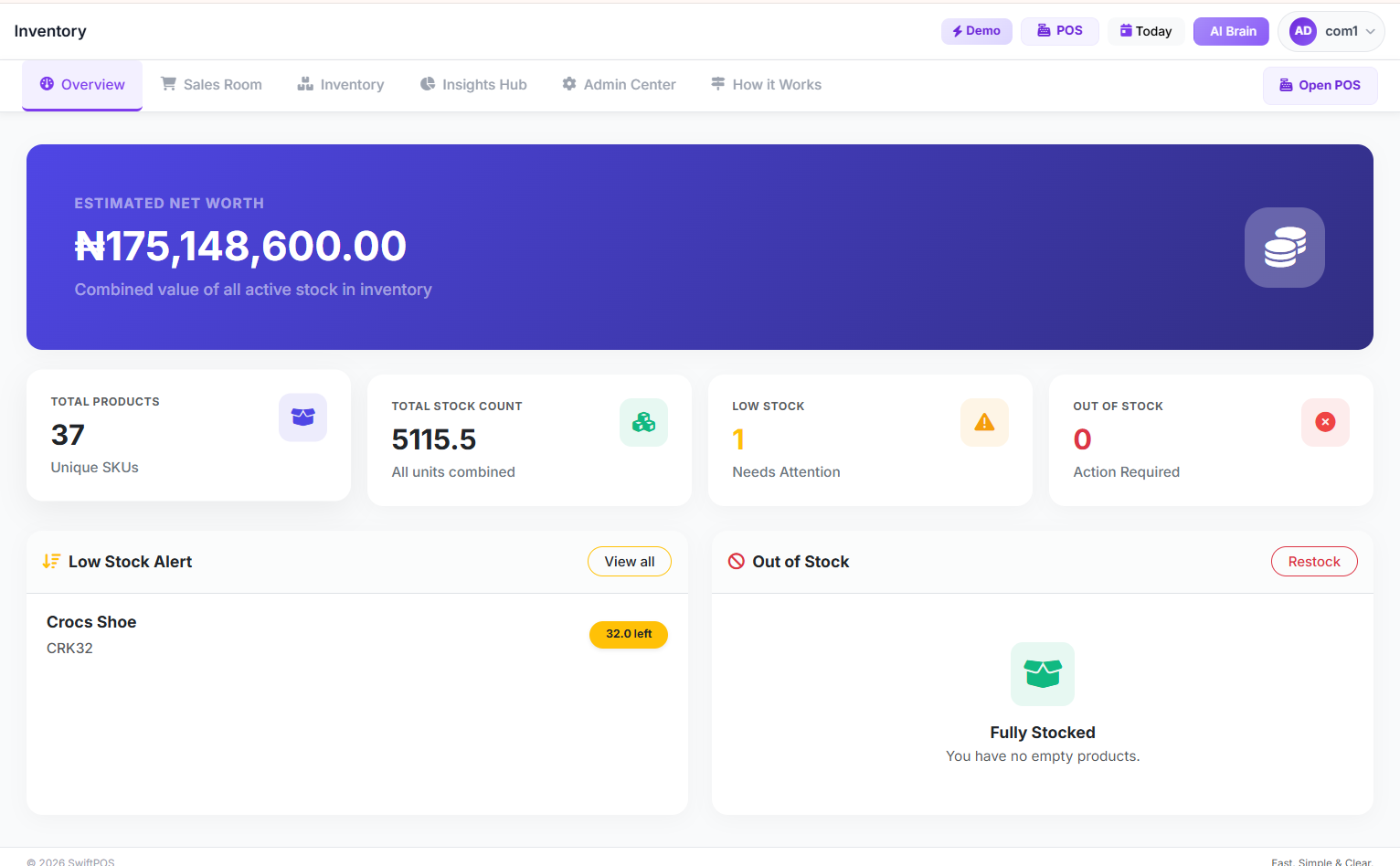 SwiftPOS Inventory Dashboard
The Numbers That Will Make or Break You
Understanding gross profit isn't just an academic exercise; it's about survival and growth in the Nigerian market. Let's talk real numbers.
Imagine you run a small provision store in Ibadan.
- Startup Costs: To open a decent mini-mart in 2026, you're looking at anywhere from ₦2,500,000 to ₦15,000,000, depending on location and stock level. This includes annual rent, initial inventory, shelving, and permits. Want a detailed breakdown? Check out: How Much Money Do You Need to Open a Mini Supermarket in Nigeria? (2026 Full Cost Breakdown).
- Monthly Running Costs (Overhead):
- Staff salaries: ₦50,000 - ₦150,000 per staff member (for 2-3 staff, that's ₦100,000 - ₦450,000).
- Electricity/Generator fuel: ₦30,000 - ₦100,000 (especially with current fuel prices).
- Miscellaneous (cleaning, security, airtime): ₦20,000 - ₦50,000.
- Let's say your total fixed monthly overheads average ₦250,000.
- Expected Revenue Timelines: A new store might take 3-6 months to break even on operational costs, let alone recoup initial investment. You need to be making consistent sales with healthy gross profit margins to cover that ₦250,000.
This is why understanding your gross profit on each individual sale is so critical. It helps you adjust your pricing, negotiate better with suppliers, or even decide to stop selling certain low-margin products that aren't worth the effort. Knowing your gross profit percentage is also essential for calculating the true value of a POS system for your business. Learn more about it here: POS System ROI: Calculating True Value for Nigerian Retailers.
Growth After Launch: The Next 90 Days
Once you've got a handle on your gross profit per sale, the real work of growth begins. The first 90 days after you start tracking this data properly are crucial.
- Identify Your Profit Drivers: Look at your sales reports. Which products consistently give you the highest gross profit margin? Focus your marketing efforts on these. Maybe it's those unique fashion accessories in your boutique, or specific imported provisions in your mini-mart. Push them!
- Rethink Low-Margin Items: If an item has a consistently low gross profit margin and isn't a "loss leader" (something you sell cheap to attract customers for other purchases), consider if it's worth the shelf space. Can you negotiate a better price from your supplier? Can you increase the selling price without losing too many customers? Or should you phase it out?
- Optimize Your Costs: Knowing your COGS and other direct costs per sale allows you to actively look for ways to reduce them. Can you buy in larger bulk to get a better purchase price? Find a cheaper, reliable transport option? Negotiate lower payment gateway fees?
- Staff Training: Educate your staff on the importance of these numbers. If they understand how their sales commission impacts gross profit, they might be more strategic in their selling.
- Leverage Technology for Insights: A system like SwiftPOS NG provides powerful insights into your sales, inventory, and profit. It can track your sales by item, showing you which products are moving and what their associated gross profit is.
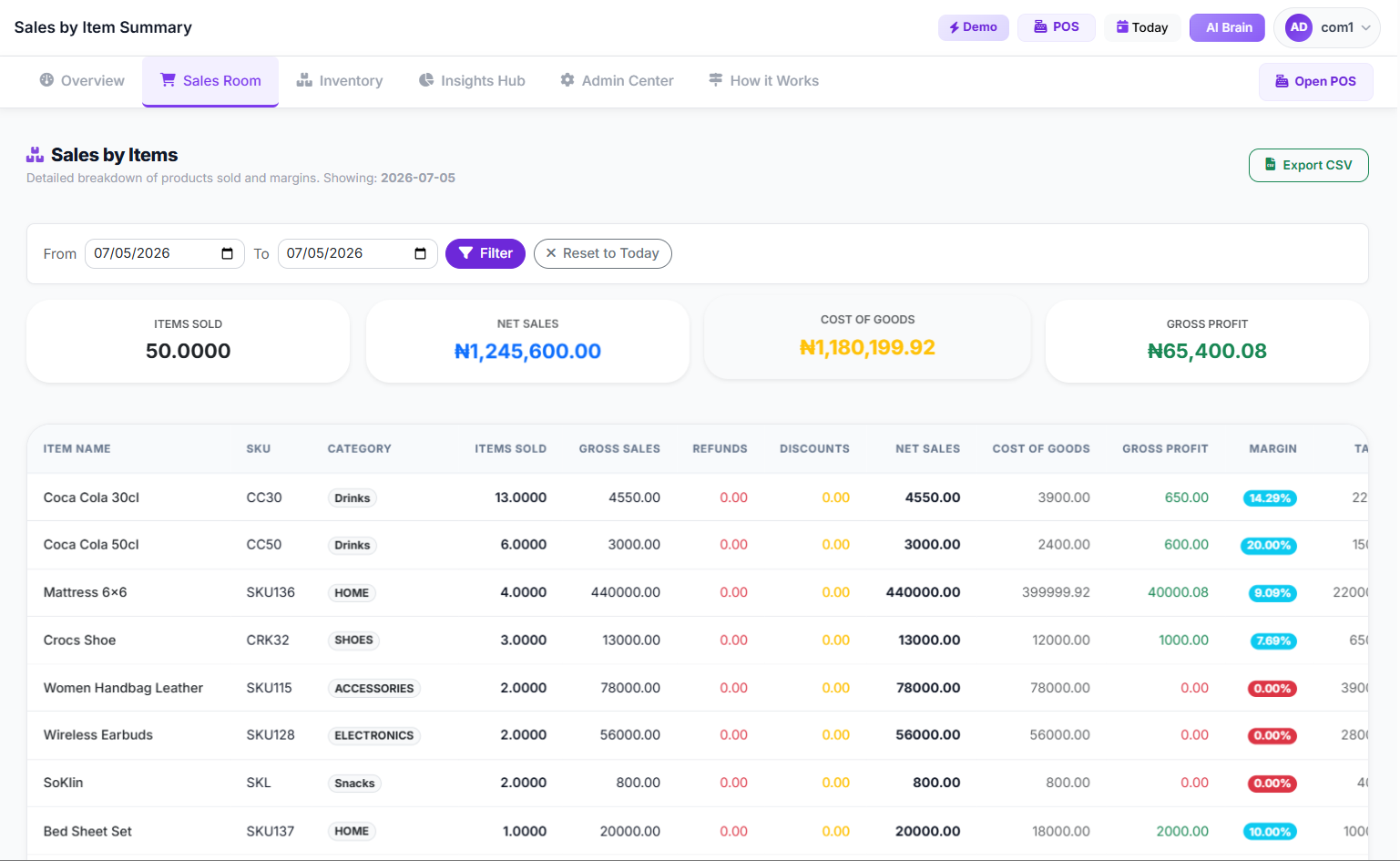 SwiftPOS Sales By Item Page
It even has a "Smart Store Forecast" feature that can predict when products will run out based on sales velocity, helping you avoid stockouts on your most profitable items. You can dive deeper into this with: How to Predict When Products Will Run Out of Stock in Nigeria: A Practical Guide for Shop Owners. This kind of data is gold for making informed decisions, not just guessing.
> "Many business owners mistake activity for productivity. Making many sales doesn't mean you're making much profit if you don't understand the true costs behind each transaction."
FAQ: Answers to What You're Actually Googling
Q1: What's the difference between gross profit and net profit?
A: Gross profit is your revenue minus the direct costs of making or selling a product (Cost of Goods Sold and other direct costs per sale). It's what's left to cover your overheads. Net profit is what's left after you've deducted all your operating expenses (rent, salaries, electricity, marketing, etc.) from your gross profit. It's the true bottom line – the money you actually get to keep. Knowing your gross profit calculation is the first step to understanding your overall shop profit.
Q2: How often should I calculate gross profit per sale?
A: Ideally, for every single sale. If you're doing it manually, that's impossible. But with a good POS system, it's done automatically in real-time. If you're using basic methods, try to do it weekly for your top 10-20 products to get a good snapshot. This helps you monitor your retail margin closely.
Q3: My gross profit margin is too low. What should I do?
A: Two main approaches:
- Increase Selling Price: Can you raise prices slightly without impacting demand too much? Test it.
- Reduce Costs: Negotiate harder with suppliers, find cheaper transport, reduce packaging costs, or streamline your direct labor. Sometimes, a combination of both is needed. You might also want to explore ways to increase sales in your retail shop. Here are 10 Strategies That Actually Work in 2026.
Q4: Is it okay to have some products with a very low gross profit margin?
A: Yes, sometimes. These are often called "loss leaders." You might sell bread at a very low margin in your supermarket just to get customers through the door, hoping they'll buy high-margin items like expensive imported biscuits or fresh produce. The key is to know why you're selling them at a low margin and that they contribute to overall shop profit. If they're just sitting there and not attracting other sales, then they're just losing you money.
Ready? Here's Where to Start
You've learned how to calculate gross profit per sale, a critical step for any retail business in Nigeria looking to thrive in 2026. The information is powerful, but only if you use it. Stop guessing with your money. Start making informed decisions based on real data.
If you're tired of manual calculations, lost receipts, and wondering where your money actually goes, it's time to consider a system that does the heavy lifting for you. SwiftPOS NG is built specifically for Nigerian businesses like yours, helping you manage everything from sales and inventory to staff and profit. You can learn more about all its features and how it can benefit your business. Take the first step towards true financial clarity. Visit https://app.swiftpos.ng/ to start your free 14-day trial today.
Written by SwiftPOS Team
Practical guides from the retail specialists at Nura Mustapha Technologies Limited, for modern Nigerian merchants.