How to Calculate Your Retail Shop's True Profit (A Step-by-Step Guide)
SwiftPOS Team
Published September 16, 2026

Many Nigerian retail shop owners track their sales diligently, but a common challenge is truly understanding how much profit they actually make after all costs are accounted for. You might see a healthy sales figure, but without a clear picture of your expenses, that "profit" could be an illusion. In 2026, with rising operational costs and a competitive market, knowing your true profit is not just good practice—it's essential for survival and growth.
Busy nigerian market stall with various goodsThe Evolving Landscape of Retail Profitability in Nigeria (2026)
The Nigerian retail sector in 2026 is dynamic, but also fraught with complexities that directly impact shop profit calculation. From fluctuating foreign exchange rates affecting import costs to the ever-present challenge of power supply, businesses face numerous variables. Traditional methods of simply subtracting initial stock cost from sales revenue are no longer sufficient. The market demands a more granular approach to understanding where every naira goes and comes from.
For instance, the cost of goods sold (COGS) for many retailers can range from 60% to 85% of sales, leaving a smaller margin than many initially assume. Add to this the annual shop rent, which can be anywhere from ₦80,000 for a small stall in a rural market to a staggering ₦2,500,000 for a prime location on Lagos Island. These significant overheads, coupled with monthly electricity bills (₦5,000 - ₦40,000) and generator fuel costs (₦15,000 - ₦70,000), quickly eat into gross profits. Understanding these nuances is critical, as highlighted in our guide on the hidden costs of manual retail operations in Nigeria.
What You Need Before You Start
Before diving into the calculations, ensure you have these fundamental elements in place:
- Organized Sales Records: A clear record of all products sold and their selling prices.
- Detailed Purchase Records: Information on every item bought for resale, including its cost price and quantity.
- Expense Log: A comprehensive list of all operational expenses, categorized (e.g., rent, salaries, utilities, transport, marketing).
- Inventory Tracking System: A method, even if manual, to know your starting and ending inventory values for a specific period.
- A Calculator or Spreadsheet Software: For performing the necessary arithmetic.
- Dedicated Time: This isn't a quick glance; it requires focused attention to detail.
Step-by-Step: Calculate Your Retail Shop's True Profit
Calculating your true shop profit requires moving beyond just sales figures. It involves a systematic review of all financial inflows and outflows over a specific period, typically a month, quarter, or year. This process helps you understand your gross profit vs net profit, revealing the actual financial health of your business.
Step 1: Define Your Accounting Period
First, decide on the timeframe you want to analyze. This could be monthly, quarterly, or annually. Consistency is key for meaningful comparisons. For most small to medium retail businesses, analyzing monthly is a good start to identify trends and make timely adjustments.
Step 2: Calculate Your Total Sales Revenue
This is the total amount of money your shop generated from selling goods or services within your defined accounting period. It's crucial to include all sales, regardless of payment method (cash, POS, bank transfer, or even customer credit sales that haven't been fully paid yet).
Formula: Total Sales Revenue = (Quantity of Product A Sold x Selling Price of A) + (Quantity of Product B Sold x Selling Price of B) + ...
For example, if you sold 10 bags of rice at ₦35,000 each and 20 cartons of noodles at ₦8,000 each in a month:
Total Sales Revenue = (10 ₦35,000) + (20 ₦8,000) = ₦350,000 + ₦160,000 = ₦510,000.
Many retailers using manual systems struggle to accurately aggregate this data. A point-of-sale (POS) system can automate this by logging every transaction, providing real-time sales reports.
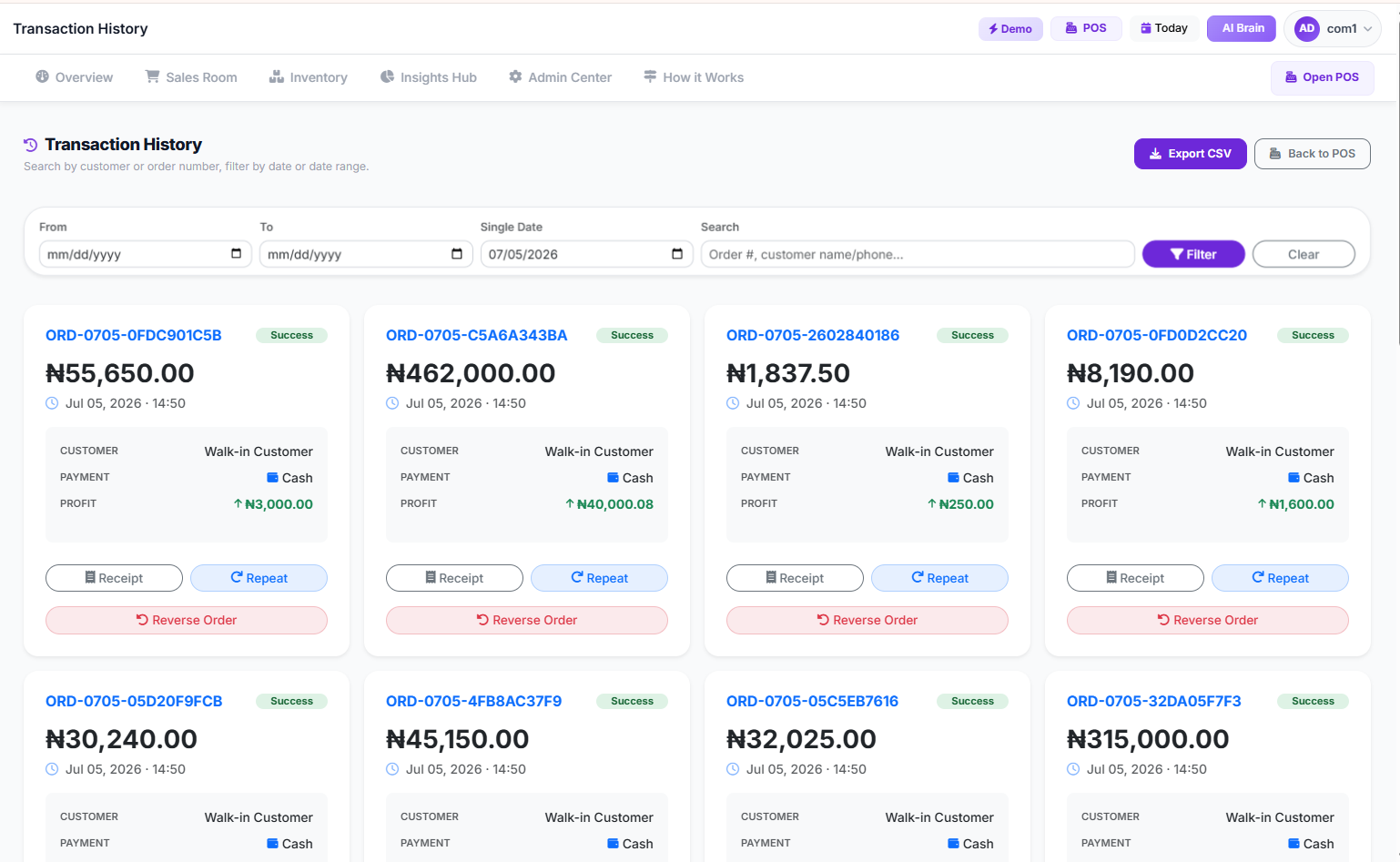 ALL Transaction History Page
Step 3: Determine Your Cost of Goods Sold (COGS)
COGS represents the direct costs attributable to the production of the goods sold by your shop. For retailers, this primarily means the purchase price of the items you sold. This is often where shop profit calculation gets tricky, especially with fluctuating stock levels.
Formula: COGS = Beginning Inventory + Purchases During Period - Ending Inventory
- Beginning Inventory: The value of all goods available for sale at the start of your accounting period.
- Purchases During Period: The total cost of all new inventory purchased during the accounting period, including shipping and handling fees.
- Ending Inventory: The value of all goods remaining unsold at the end of your accounting period.
COGS = ₦200,000 + ₦300,000 - ₦150,000 = ₦350,000.
Accurate inventory management is paramount here. Tools that allow for
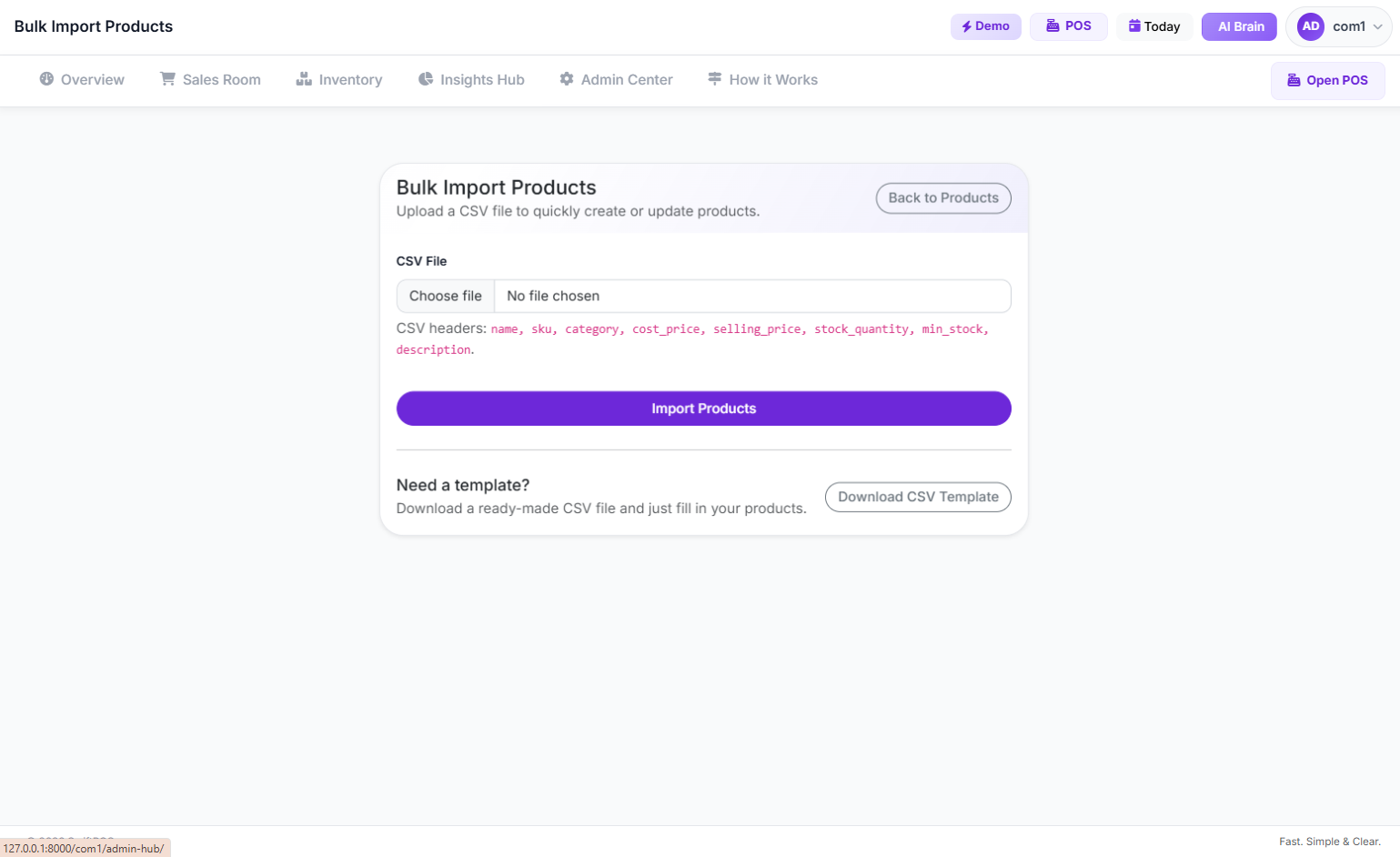 bulk product import
Step 4: Calculate Your Gross Profit
Gross profit is the profit your business makes after deducting the direct costs associated with selling your products. It shows how efficiently your business converts sales into profit before considering overheads.
Formula: Gross Profit = Total Sales Revenue - Cost of Goods Sold
Using our previous examples:
Gross Profit = ₦510,000 (Sales Revenue) - ₦350,000 (COGS) = ₦160,000.
This figure is a good indicator of your product pricing strategy and purchasing efficiency. However, it's not the "true profit" yet.
Step 5: Identify and Sum Your Operating Expenses
Operating expenses are the costs incurred to run your business, not directly related to the production of goods. These are critical for understanding your retail accounting and often overlooked in quick profit estimates.
Common operating expenses for Nigerian retailers include:
- Rent: Annual rent divided by 12 for monthly calculation. (e.g., ₦80,000 - ₦2,500,000 annually).
- Salaries: Staff wages (e.g., ₦45,000 - ₦90,000 per employee monthly).
- Utilities: Electricity (₦5,000 - ₦40,000 monthly), water, waste disposal.
- Generator Fuel/Maintenance: (e.g., ₦15,000 - ₦70,000 monthly).
- Transportation: For stock, deliveries, or business-related errands (₦10,000 - ₦50,000 monthly).
- Marketing & Advertising: Flyers, social media promotions (₦5,000 - ₦100,000 monthly).
- Miscellaneous: Cleaning supplies, minor repairs, internet subscription (₦3,000 - ₦20,000 monthly).
- Payment Processing Fees: Charges from POS terminals or bank transfers (typically 0.5% - 1.5% of transaction value).
- Business Registration/Licenses: Annual renewals, if applicable.
- Monthly Rent: ₦80,000 (from ₦960,000 annual rent)
- Staff Salary (1 person): ₦60,000
- Electricity: ₦15,000
- Generator Fuel: ₦25,000
- Transportation: ₦15,000
- Marketing: ₦10,000
- Miscellaneous: ₦7,000
- Payment Processing Fees (estimate 1% of ₦510,000 sales): ₦5,100
Keeping track of these expenses is vital. A system that allows you to
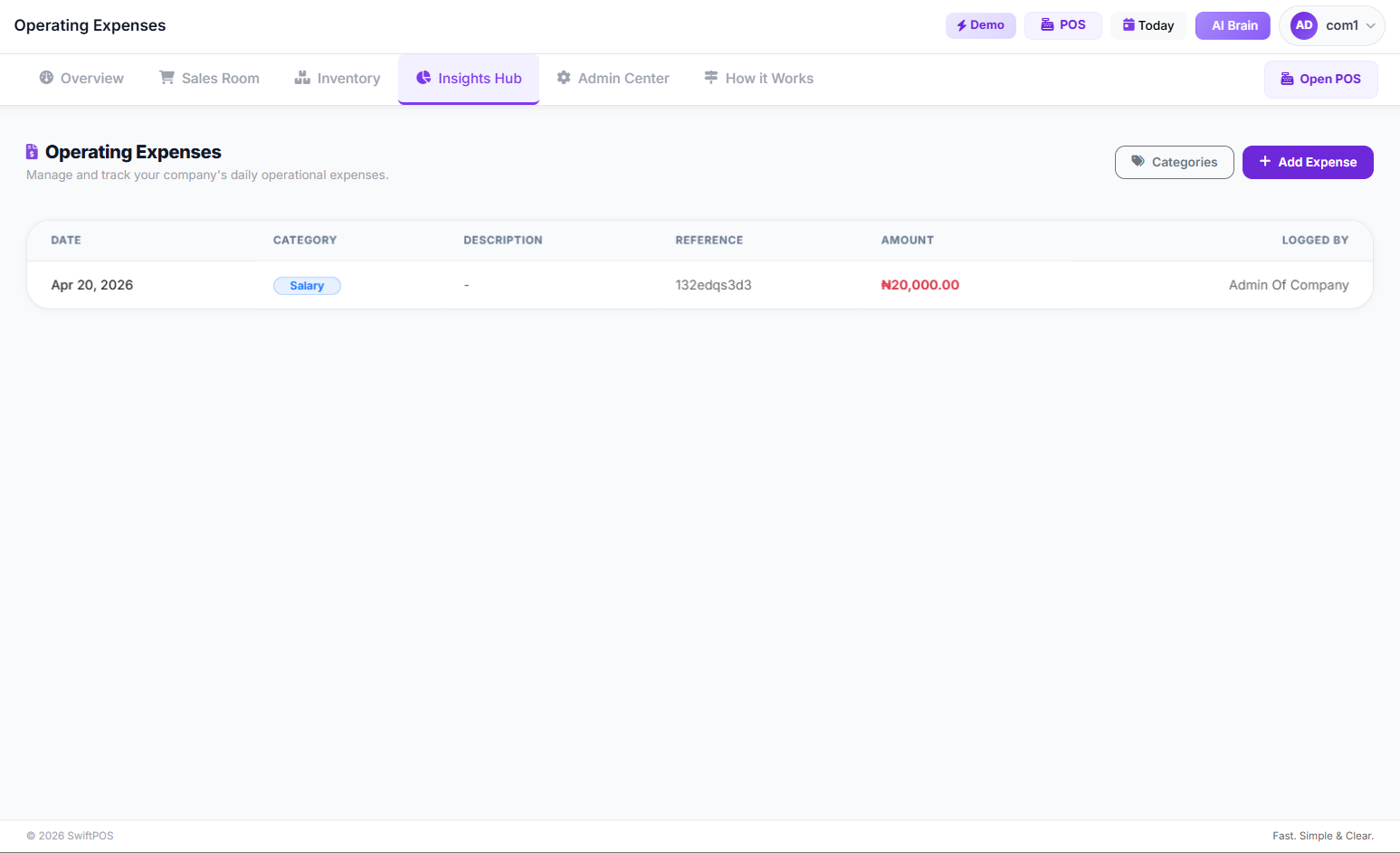 manage expenses
Step 6: Calculate Your Net Profit (True Profit)
This is the ultimate figure – your true profit. Net profit is what remains after all expenses, both direct (COGS) and indirect (operating expenses), have been deducted from your total sales revenue. This is the money you actually get to keep.
Formula: Net Profit = Gross Profit - Total Operating Expenses
Using our calculations:
Net Profit = ₦160,000 (Gross Profit) - ₦217,100 (Total Operating Expenses) = -₦57,100.
In this example, the business actually ran at a loss of ₦57,100 for the month. This demonstrates why calculating true net profit is so crucial. A positive gross profit doesn't guarantee a positive net profit. This scenario is all too common for businesses that only track sales and COGS.
> "Many businesses fail not because they don't sell enough, but because they don't truly understand their costs. Profit is not what you make, it's what you keep."
Step 7: Account for Other Income and Non-Operating Expenses (If Applicable)
Some businesses might have other sources of income (e.g., rental income from a part of their shop, affiliate commissions) or non-operating expenses (e.g., interest paid on business loans, one-time legal fees). These should be added or subtracted to arrive at your final profit figure.
- Other Income: Add to Net Profit.
- Non-Operating Expenses: Subtract from Net Profit.
Final Net Profit = -₦57,100 + ₦10,000 - ₦5,000 = -₦52,100.
This comprehensive approach ensures you have a complete picture of your financial performance. For a broader understanding of your financial health, you can also consider factors like return on investment (ROI) for your POS system.
Common Mistakes to Avoid
Understanding your shop's true profitability can be transformative, but many retailers fall into common traps. Avoid these pitfalls to ensure your calculations are accurate and actionable:
- Ignoring Operating Expenses: This is perhaps the biggest mistake. Focusing solely on sales and stock costs gives a false sense of profitability. Rent, utilities, staff salaries, and even small daily expenses add up significantly.
- Inaccurate Inventory Valuation: Guessing your beginning or ending inventory values will lead to incorrect COGS and, consequently, inaccurate gross and net profits. Regular stock takes and proper inventory management are non-negotiable. This is a common pitfall addressed in our article on inventory management mistakes crushing profits.
- Mixing Personal and Business Finances: This makes it impossible to distinguish genuine business expenses from personal spending, skewing your profit figures. Always maintain separate accounts.
- Not Categorizing Expenses: Lumping all expenses together as "miscellaneous" makes it difficult to identify areas where you can cut costs or improve efficiency. Categorize everything.
- Infrequent Calculation: Doing a profit calculation only once a year means you're reacting too late to problems. Regular, ideally monthly, analysis allows for timely adjustments.
- Underestimating Payment Processing Fees: These small percentages can significantly impact your bottom line, especially with high sales volumes. Factor them into your operating costs.
How to Track and Grow After Launch
Calculating your profit is just the beginning. The real value comes from consistently tracking these figures and using the insights to grow your business.
- Monitor Key Metrics: Beyond just profit, keep an eye on your sales trends, average transaction value, and inventory turnover. These 7 key retail metrics Nigerian businesses must track provide a holistic view.
- Regular Review: Schedule dedicated time each week or month to review your profit and loss statement. Look for patterns, unexpected spikes in expenses, or dips in sales.
- Identify Revenue Leaks: Your profit calculation might reveal areas where money is slipping away. Could you negotiate better deals with suppliers? Are certain products not selling well? Our blog on 7 revenue leaks costing Nigerian retailers thousands offers practical solutions.
- Implement Technology: For accurate, real-time profit tracking, manual methods quickly become cumbersome and error-prone. A robust POS and business management system like SwiftPOS can automate sales recording, inventory management, expense tracking, and generate detailed profit and loss reports. This means you spend less time on calculations and more time on strategic decision-making, helping you understand your true net profit.
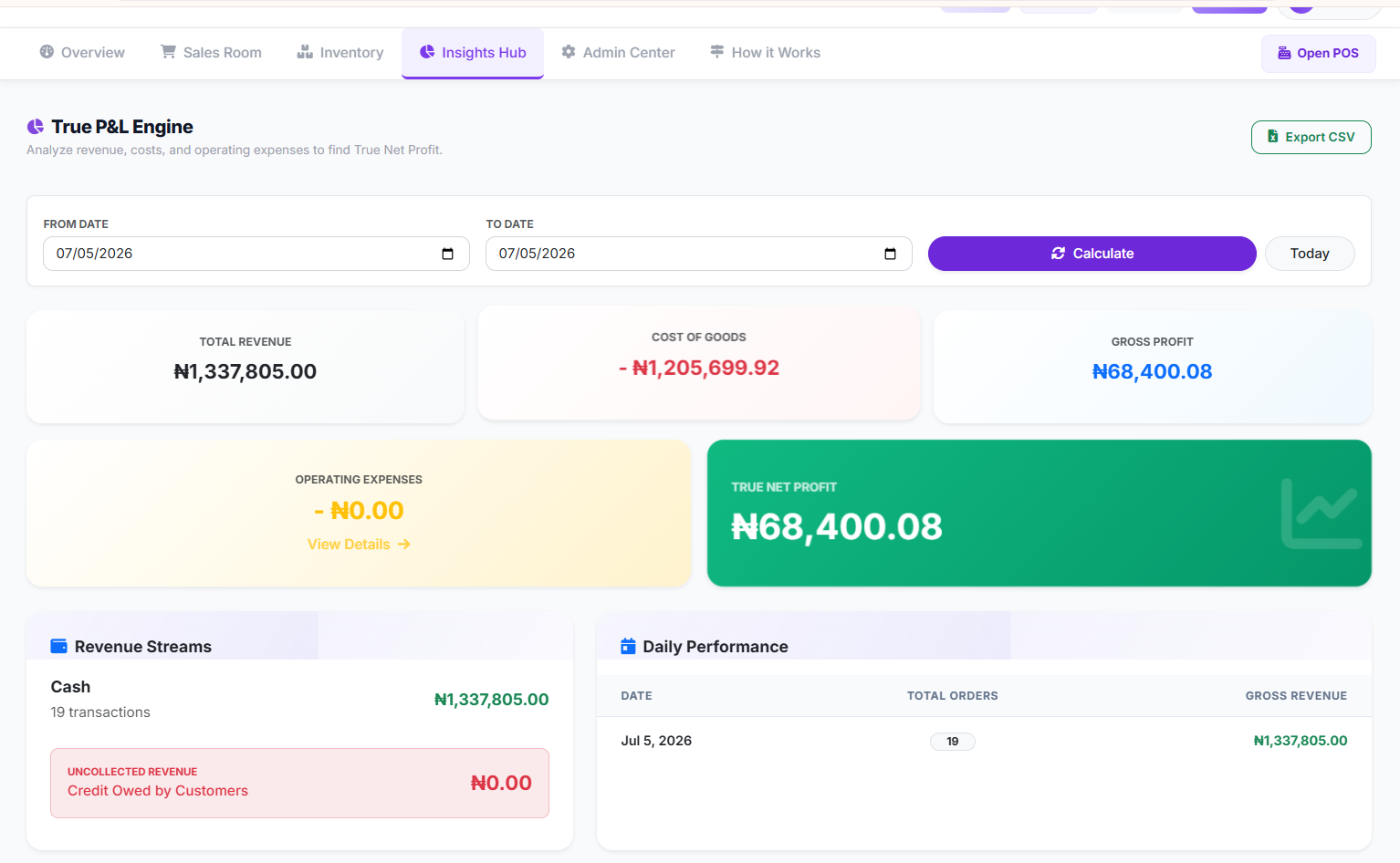 Profit and Loss Page
With features like the
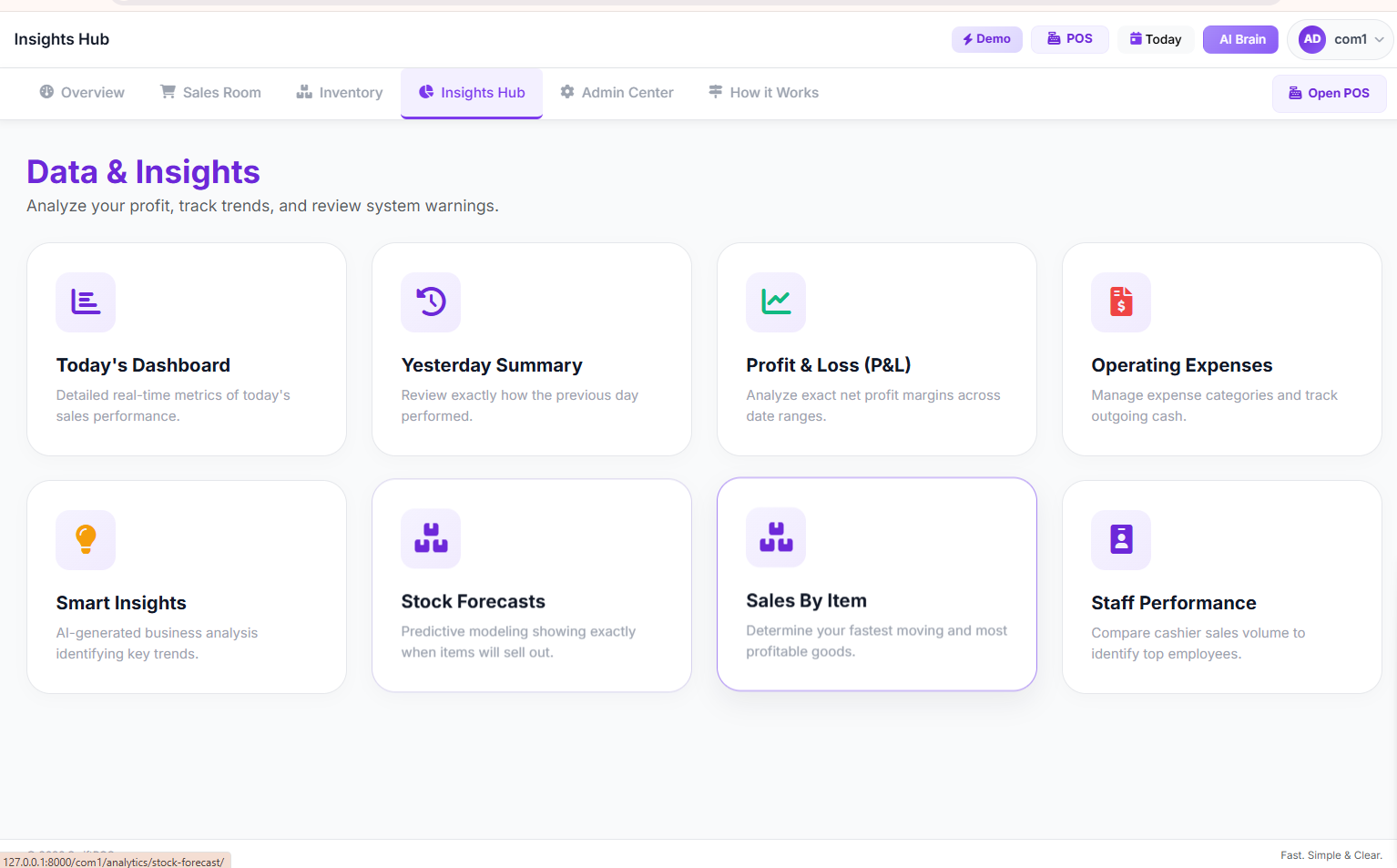 Insights Hub
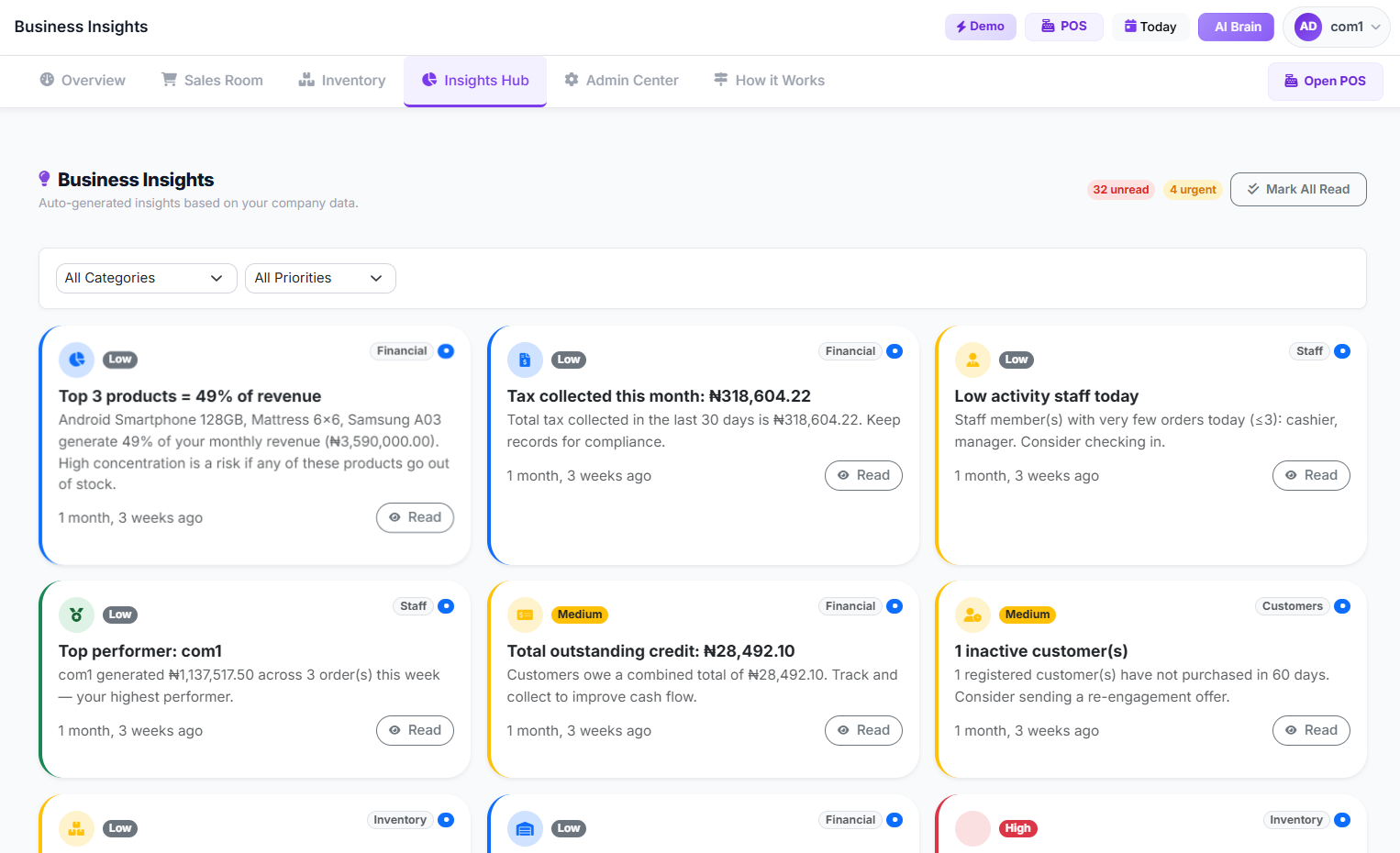 Business Insights Page
- Forecast and Plan: Use your historical profit data to forecast future performance and set realistic goals. This helps in making informed decisions about expansion, new product lines, or staffing.
Frequently Asked Questions
Q1: What is the difference between gross profit and net profit?
Gross profit is your total sales revenue minus the cost of goods sold (COGS). It shows how much profit you make directly from selling your products. Net profit (or true profit) is what's left after you subtract ALL operating expenses (like rent, salaries, utilities, marketing) from your gross profit. Gross profit doesn't account for your daily operational costs, while net profit gives you the real bottom line.
Q2: How often should I calculate my shop's profit?
Ideally, you should calculate your profit monthly. This allows you to identify problems or opportunities quickly and make timely adjustments to your operations, pricing, or expense management. Waiting longer, such as quarterly or annually, means you might miss critical trends.
Q3: Why is accurate inventory tracking so important for profit calculation?
Accurate inventory tracking directly impacts your Cost of Goods Sold (COGS). If your beginning or ending inventory figures are wrong, your COGS will be incorrect, leading to a miscalculation of your gross and net profits. Proper inventory management ensures you know the true cost of what you've sold, which is fundamental to understanding profitability.
Q4: My gross profit is good, but my net profit is very low or negative. What does this mean?
This indicates that your operating expenses are too high relative to your sales volume and gross profit margin. You might be selling products profitably, but the cost of running your business (rent, salaries, utilities, generator fuel, etc.) is eating up all your gains. You need to review your operating expenses to identify areas for cost reduction or strategies to increase sales volume significantly to cover these overheads.
Q5: Can I calculate profit manually, or do I need software?
While you can calculate profit manually, especially for very small operations, it becomes increasingly prone to errors and time-consuming as your business grows. Manual calculations make it difficult to track all details, categorize expenses, and generate quick reports. Software solutions designed for retail, like a POS system, automate these processes, providing accurate, real-time insights into your shop's profitability and making it easier to understand your true net profit. This is especially true for businesses looking to stop using spreadsheets and boost their business with POS software.
Ready to Take Control of Your Shop's Profitability?
Understanding your true profit is the bedrock of a successful retail business in Nigeria. Stop guessing and start making informed decisions. Explore how a comprehensive business management platform can simplify your financial tracking, automate calculations, and provide the insights you need to grow. Get started today by visiting the SwiftPOS NG website and discover a smarter way to manage your retail operations.

How to Calculate Supermarket Profitability in Nigeria:…
Sep 15, 2026
How to Open a Supermarket in Nigeria with ₦5 Million (…
Sep 14, 2026
How to Start a Mini Supermarket in Nigeria With ₦1 Mil…
Sep 11, 2026