How to Start a Supermarket Business in Nigeria: A Step-by-Step Guide
SwiftPOS Team
Published September 03, 2026

In Nigeria, starting a supermarket business can feel like navigating a complex maze, with countless entrepreneurs facing unexpected hurdles that drain their capital and enthusiasm. Many begin with grand visions, only to discover that inadequate planning, poor inventory control, and a lack of clear financial oversight can quickly turn a promising venture into a struggle for survival. This comprehensive guide breaks down every essential step, helping you build a profitable and sustainable supermarket from the ground up.
A bustling nigerian supermarket interior with customers shoppingThe Lucrative, Yet Challenging, Supermarket Landscape in Nigeria
The retail sector in Nigeria is a powerhouse, contributing significantly to the nation's GDP. In 2026, despite economic shifts, the demand for convenient shopping experiences continues to grow, making the supermarket business plan an attractive prospect for many. However, the market is competitive, and success hinges on more than just stocking shelves. Businesses grapple with fluctuating exchange rates, infrastructure challenges like inconsistent power supply, and the need for efficient logistics. Small and medium-sized supermarkets are particularly vulnerable if they fail to embrace modern management practices.
According to a recent report, over 60% of new retail businesses in Nigeria struggle to survive past their first five years, often due to poor inventory management and a lack of real-time financial insights. This highlights the critical need for robust operational strategies and technological adoption. The traditional method of using ledgers or basic spreadsheets for inventory and sales tracking is simply no longer sufficient to compete effectively in 2026. Understanding the true costs and potential pitfalls is the first step toward building a resilient business. For a deeper dive into the profitability of a mini-supermarket, explore our article on Is Supermarket Business Profitable in Nigeria? The Real Cost-to-Profit Breakdown for a Mini Supermarket (2026).
What You Need Before You Start
Before you embark on your supermarket startup journey, ensure you have these fundamental elements in place:
- Capital: A realistic budget covering all initial setup costs and at least 6 months of operating expenses. Remember, cash flow is king.
- Business Plan: A detailed supermarket business plan outlining your vision, market analysis, operational strategy, marketing approach, and financial projections.
- Market Research: A thorough understanding of your target customers, local competition, and product demand in your chosen location.
- Legal & Regulatory Knowledge: Familiarity with business registration processes, permits, and health regulations in Nigeria.
- Supplier Network: Initial contacts with reliable wholesalers and distributors for your product categories.
- Basic Business Acumen: An understanding of sales, inventory, and customer service principles.
Step-by-Step: How to Start a Supermarket Business in Nigeria
Starting a supermarket in Nigeria requires careful planning and execution. Follow these steps to lay a strong foundation for your venture.
Step 1: Develop a Comprehensive Business Plan
Your supermarket business plan is your roadmap to success. It should detail everything from your business model to your financial projections. Begin by defining your niche – will you be a general provision store, a specialty supermarket, or focus on a specific product range? Conduct thorough market research to understand local demographics, purchasing power, and competitor offerings. This will help you identify gaps in the market and position your supermarket effectively.
Crucially, include a detailed financial plan. This should cover startup costs, operational expenses, projected revenue, and break-even analysis. Don't forget to factor in potential challenges like power fluctuations and supplier delays. A well-researched plan will not only guide your decisions but also be essential if you seek funding from banks or investors. For more insights on financial planning, consider our guide on How Much Money Do You Need to Open a Mini Supermarket in Nigeria in 2026? (Full Cost Breakdown).
Step 2: Secure Your Business Registration and Legal Permits
No business can thrive without proper legal backing. Registering your business with the Corporate Affairs Commission (CAC) is mandatory. The cost for business registration can range from ₦25,000 to ₦70,000, depending on whether you're registering a small business name or a limited liability company. After registration, you'll need to obtain various permits and licenses from local and state authorities, including a business premises permit, health permit, and potentially a signage permit.
Ensure you understand all the regulatory requirements for operating a retail business in your specific location to avoid future legal issues or fines. This might involve consulting with a legal professional familiar with Nigerian business law.
Step 3: Find the Right Location and Setup Your Shop
Location is paramount for a supermarket business in Nigeria. Look for areas with high foot traffic, good visibility, easy access for customers (including parking), and proximity to residential areas or busy commercial hubs. Consider the demographics of the area – does it match your target customer profile? Once you've identified a suitable space, negotiate the lease. Shop rent in Nigeria is typically paid annually, with costs ranging from ₦150,000 in smaller towns to ₦5,000,000+ in prime Lagos or Abuja commercial areas. You'll also likely need to pay a security deposit, often 1-2 years' rent upfront, which can be ₦150,000 to ₦10,000,000.
After securing the location, plan your shop layout. This includes shelving, display units (₦200,000 - ₦1,500,000), checkout counters, and storage areas. Renovation and fit-out costs can vary significantly, from a basic setup at ₦300,000 to a modern, air-conditioned space costing up to ₦3,000,000. Don't forget essential equipment like refrigerators and freezers, which can cost between ₦400,000 and ₦3,000,000 depending on size and whether they are new or used commercial units.
Step 4: Source Your Initial Inventory and Establish Supplier Relationships
The quality and variety of your stock will define your supermarket. Identify reliable suppliers and wholesalers for your product categories. Negotiate favorable terms, including credit options and delivery schedules. Your initial stock purchase will be a significant investment, typically ranging from ₦1,000,000 for a small neighborhood store to ₦15,000,000 for a medium-sized supermarket.
Building strong relationships with multiple suppliers is crucial to ensure consistent stock levels and mitigate risks from a single source. Always verify the authenticity and quality of products, especially for consumables. You can manage your suppliers and purchase orders efficiently using a system that tracks these records, ensuring you know what you owe and what's incoming.
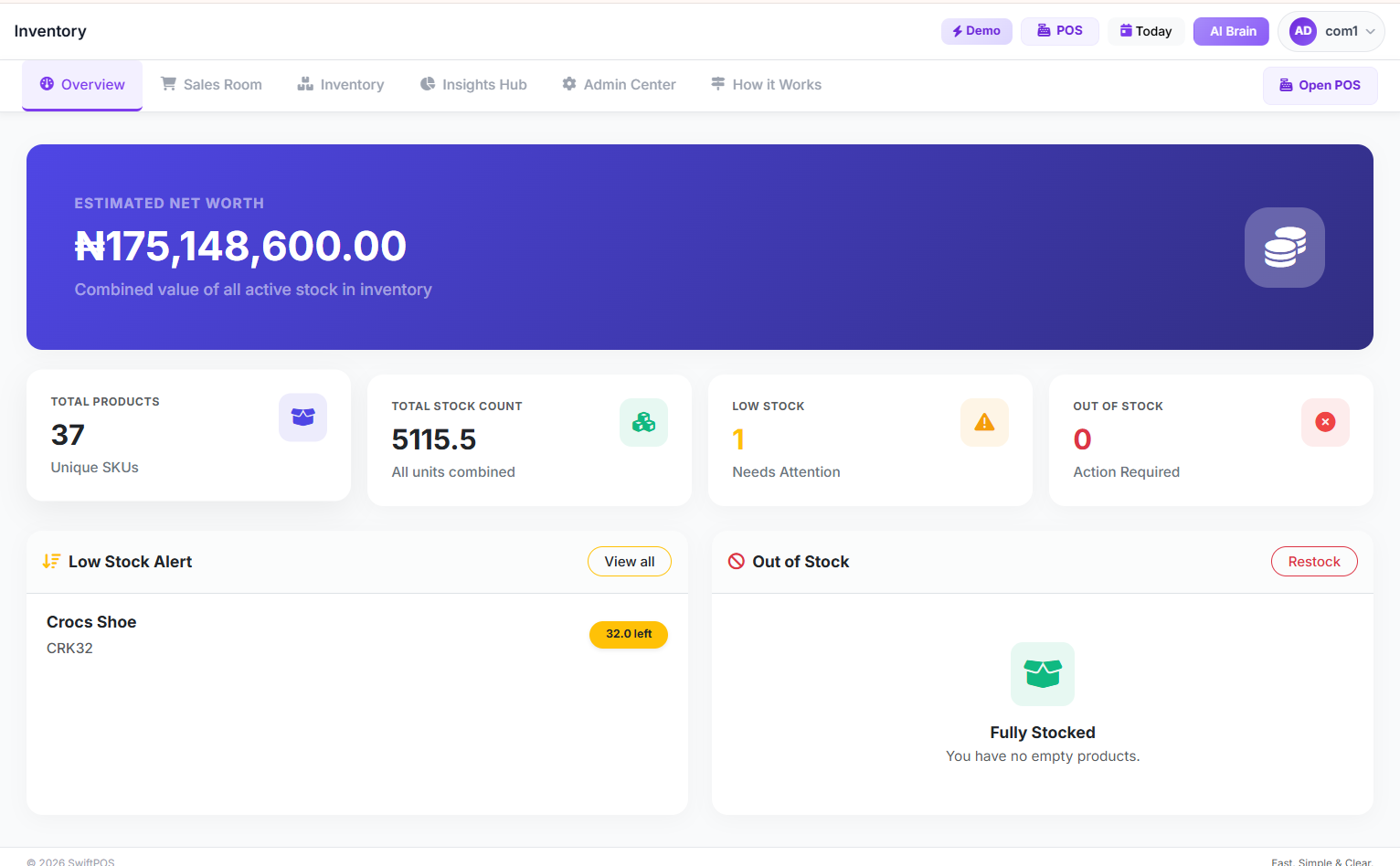 Inventory Hub showing product list and stock levels
Step 5: Implement a Modern Point-of-Sale (POS) System
Moving beyond manual ledgers is non-negotiable for a successful supermarket in 2026. A robust POS system is the central nervous system of your retail business. It handles sales, tracks inventory, manages customer data, and provides critical business insights. The cost for a good POS system (hardware and software) in Nigeria can range from ₦150,000 for a basic standalone unit to ₦700,000 for an integrated multi-terminal system.
A comprehensive system like SwiftPOS NG offers more than just transaction processing. It allows you to:
- Manage Inventory: Track stock in real-time, set reorder points, and identify fast-moving or slow-moving items. This is crucial for avoiding stockouts and reducing waste. You can even track products with expiration dates, a vital feature for supermarkets.
- Process Sales Efficiently: Speed up checkout with barcode scanning, handle various payment methods (cash, card, transfer, mobile money), and print professional receipts.
- Manage Customers: Keep a directory of your regular customers, track their purchases, and even manage customer credit accounts if you offer them.
- Monitor Staff Performance: Assign different roles and permissions to your staff, track their sales, and identify any suspicious activities.
- Gain Insights: Access detailed sales reports, profit and loss statements, and identify business trends.
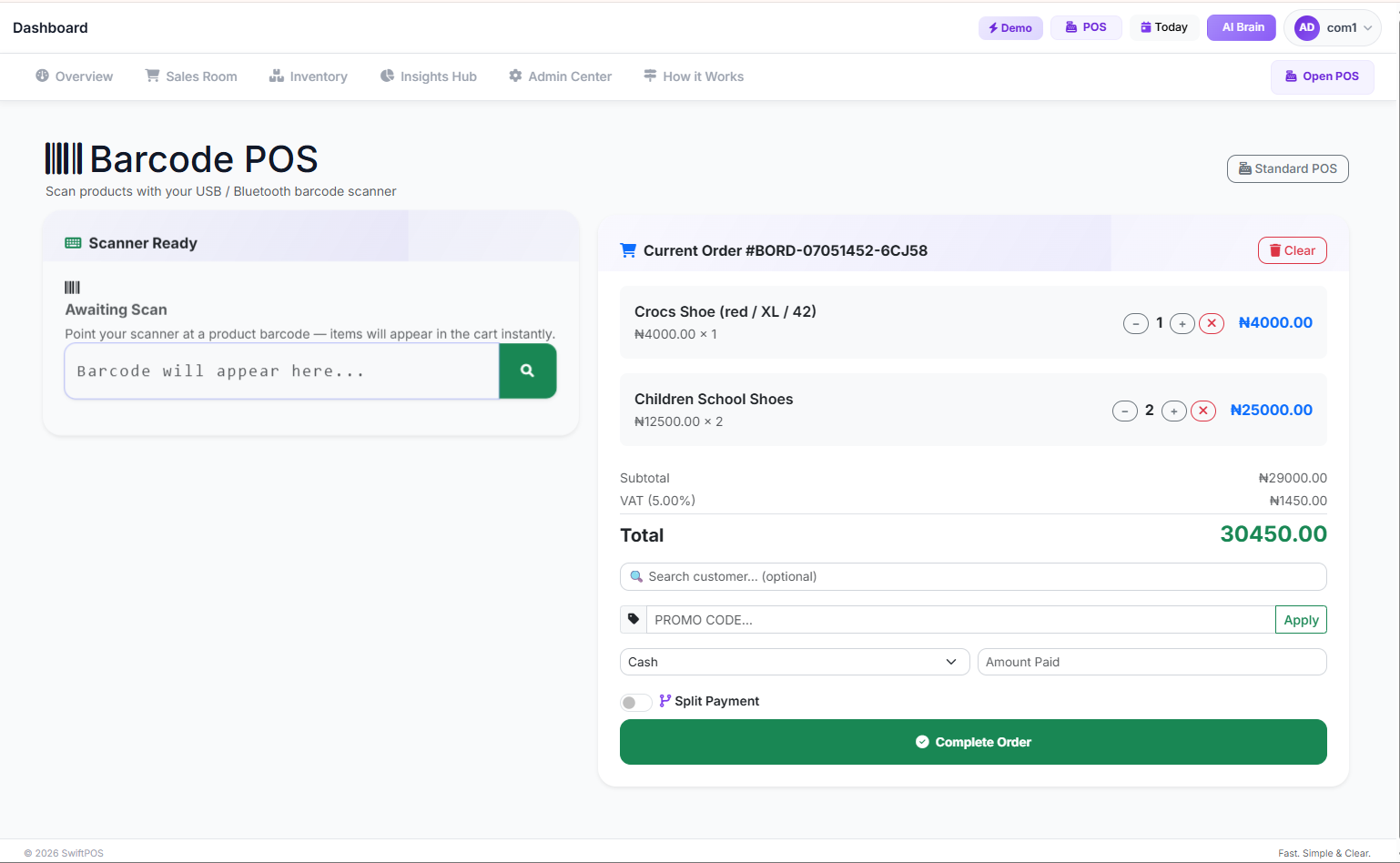 Barcode POS Interface with product scanning
Step 6: Hire and Train Your Staff
Your staff are the face of your business. Recruit individuals who are honest, customer-focused, and eager to learn. For a supermarket, you'll typically need cashiers, sales assistants, and possibly a store manager. Staff salaries per month can range from ₦45,000 for a sales assistant in a rural area to ₦90,000 for a cashier in a city.
Provide thorough training not just on product knowledge and customer service, but also on how to use your POS system effectively. Proper training ensures smooth operations and minimizes errors. Empower your staff with the right tools and knowledge, and they will become valuable assets. You can also use a system to set staff access permissions in retail software to control what different employees can do.
Step 7: Plan Your Marketing and Grand Opening
Even the best supermarket needs to attract customers. Develop a marketing strategy that includes both pre-opening buzz and ongoing promotional efforts. Your grand opening budget could range from ₦50,000 for local flyers and banners to ₦500,000 for social media ads, a small event, and local radio spots.
Consider local advertising, social media campaigns, loyalty programs, and special opening discounts. Word-of-mouth is powerful in Nigeria, so focus on excellent customer service from day one. Engage with your community and build relationships to foster customer loyalty. For strategies to boost sales, check out our article on How to Increase Sales in Your Retail Shop in Nigeria: 10 Strategies That Actually Work in 2026.
Common Mistakes to Avoid
- Underestimating Startup Costs: Many entrepreneurs fail because they don't budget adequately for rent, renovation, initial stock, and a buffer for unexpected expenses. Always add a contingency of at least 20%.
- Poor Inventory Management: This is a profit killer. Overstocking leads to spoilage and tied-up capital, while understocking means lost sales. Manual systems are prone to errors.
- Ignoring Customer Feedback: Your customers are your best source of information. Listen to their needs, preferences, and complaints to improve your offerings and service.
- Neglecting Financial Tracking: Without clear records of sales, expenses, and profits, you won't know if your business is truly viable. Many Nigerian retailers are losing money due to hidden costs of manual operations.
- Inadequate Power Solutions: With inconsistent power supply, a reliable generator is essential. A small to medium generator can cost ₦300,000 to ₦1,500,000, and monthly electricity (PHCN + fuel) can range from ₦80,000 to ₦500,000. Failing to account for this will disrupt operations.
- Lack of Staff Training and Oversight: Untrained staff can lead to poor customer service, errors, and even theft. Implement clear roles, training, and monitoring.
How to Track and Grow After Launch
Once your supermarket is operational, the real work of monitoring and growth begins. Regularly review your sales data to identify peak hours, best-selling products, and customer purchasing patterns. Pay close attention to your inventory turnover rate.
Key Performance Indicators (KPIs) to track include:
- Daily Sales Revenue: How much are you making each day?
- Average Transaction Value: How much does each customer spend on average?
- Gross Profit Margin: What percentage of your sales revenue is profit before expenses?
- Stockout Rate: How often are you running out of popular items?
- Customer Retention Rate: How many customers return to your store?
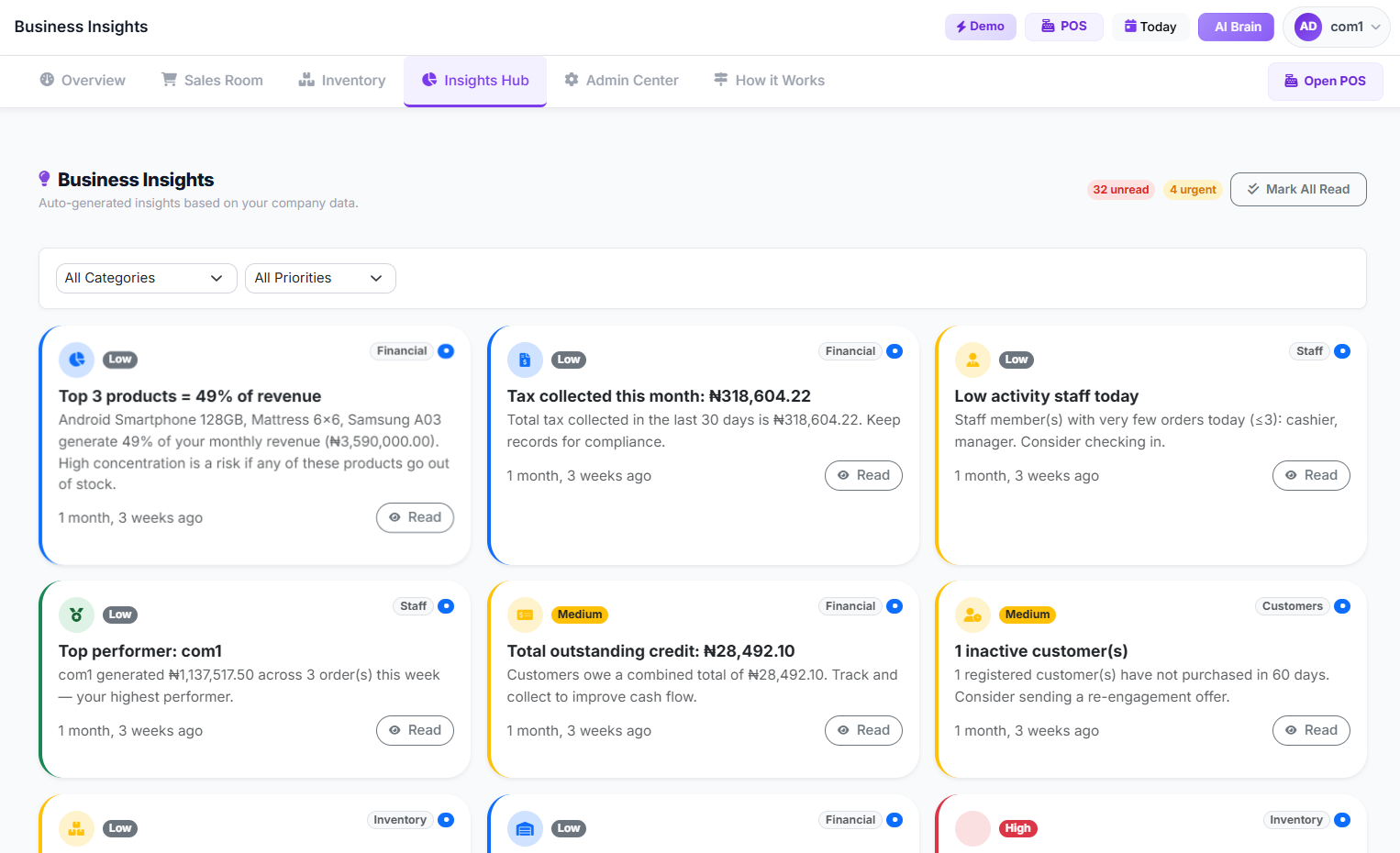 business insights
Consider expanding your services, such as offering home delivery or introducing a loyalty program. Based on your data, you might decide to diversify your product range or open additional branches. For businesses considering multiple locations, a comprehensive guide on Multi-Branch Retail: Seamless Operations & Profitability can be very helpful.
Business Insights page with various charts and dataFrequently Asked Questions
Q1: How much capital do I really need to start a supermarket in Nigeria?
A1: The capital required varies widely based on location and scale. For a mini-supermarket in a smaller town, you might start with ₦2,000,000 - ₦5,000,000 covering rent, basic fit-out, initial stock, and some operational buffer. For a medium-sized supermarket in a prime city location like Lagos, you could be looking at ₦15,000,000 - ₦30,000,000+ to cover higher rent, extensive renovations, larger initial stock, and more sophisticated equipment. Always budget for at least 6 months of operating expenses.
Q2: Is a supermarket business still profitable in Nigeria in 2026?
A2: Yes, a supermarket business can be very profitable in Nigeria in 2026, especially with strategic planning, efficient management, and the adoption of modern technology. The key is to manage inventory effectively, control costs, provide excellent customer service, and leverage data to make informed decisions. Profitability is significantly impacted by location, product pricing, and operational efficiency.
Q3: What are the biggest challenges for a supermarket startup in Nigeria?
A3: Key challenges include inconsistent power supply (leading to high generator fuel costs), fluctuating product prices due to inflation and exchange rates, intense competition, managing perishable goods, and securing reliable supply chains. Theft and poor inventory control are also major profit drains if not properly addressed.
Q4: How important is technology for a small supermarket in Nigeria?
A4: Technology, particularly a robust POS and inventory management system, is critical. It helps automate sales, track stock accurately, manage customer data, and provide vital business insights. This prevents losses from errors, theft, and expired goods, allowing even small businesses to compete more effectively and scale. Ignoring it is one of the inventory management mistakes crushing profits.
Q5: Can I start a supermarket without a physical shop?
A5: While the traditional supermarket relies on a physical shop, you could explore a hybrid model combining a smaller physical footprint with online ordering and delivery services. However, for a full-fledged supermarket experience, a physical location is usually essential for customer browsing and impulse purchases.
Q6: What's the best way to manage staff in a Nigerian supermarket?
A6: Effective staff management involves clear job descriptions, comprehensive training (including POS system usage), fair compensation, and performance incentives. Implementing a system that allows you to set different user permissions and track staff activities helps ensure accountability and reduces the risk of internal fraud.
Ready to Transform Your Supermarket Business?
Starting and running a successful supermarket in Nigeria in 2026 demands more than just capital; it requires smart management, efficient operations, and a clear understanding of your business's pulse. By implementing the right strategies and leveraging modern tools, you can build a resilient and profitable venture. Discover how SwiftPOS NG can simplify your operations, track your inventory, manage your sales, and provide the insights you need to grow your supermarket. Visit our features page to learn more about how we can help your business thrive.

How Much Does It Cost to Start a Clothing Business in …
Oct 17, 2026
How Much Does It Cost to Open a Cosmetics Shop in Nige…
Oct 17, 2026
How to Start a Cosmetics Business in Nigeria: A Step-b…
Oct 17, 2026