
How to Calculate Product Selling Price: A Step-by-Step Guide

Are you losing money every month, even though your shop seems busy? Does it feel like you’re just guessing when it comes to setting prices, hoping customers will buy, and still ending up with slim profit margins? You're not alone. Many Nigerian retailers, from the bustling stalls in Balogun Market to the mini-marts in Surulere, grapple with how to calculate product selling price: a step-by-step guide that actually works for our unique market. In fact, a recent informal survey of small businesses in Lagos found that over 60% admit they don't have a clear, consistent strategy for retail pricing, leading to significant revenue leaks. This isn't just about making sales; it's about making profitable sales.
A small nigerian shop owner looking thoughtfully atWhy Most People Get This Wrong from Day One
Let's be honest, many of us start a retail business with passion, a good product, and perhaps a rough idea of what competitors are charging. We buy at ₦1,500 and think, "Okay, if I sell for ₦2,500, that's a cool ₦1,000 profit." Simple, right? Wrong. That's the biggest lie we tell ourselves, and it's why so many shops struggle to stay afloat, especially in Nigeria's dynamic economic climate. You see, the cost you pay your supplier is just one piece of a much larger, more complex puzzle.
Most business owners here overlook what I call the "hidden costs of doing business." They don't factor in transportation from Alaba International Market to their shop, which could be anywhere from ₦500 for an Okada to ₦10,000 for a small van if you're buying in bulk. Then there's the rent for your space; whether it's a small kiosk for ₦7,000 a month in a local market or a prime spot in Lekki going for ₦180,000 monthly, that cost needs to be spread across every single item you sell. And don't even get me started on electricity, generator fuel (a constant headache!), staff salaries, and those little "miscellaneous" expenses that add up faster than you can say "NEPA bill."
When you ignore these real, tangible expenses, your supposed profit margin vanishes into thin air. You end up selling products below their true cost, working hard for little to no actual gain. This isn't sustainable. It's a fast track to burnout and eventually, closing shop. Understanding your true costs is the bedrock of effective retail pricing.
Before You Do Anything: The Foundation Work
Before we even touch a calculator, you need to lay some groundwork. This isn't glamorous, but it's absolutely essential for accurate selling price calculation.
- Know Your True Product Cost (Cost of Goods Sold - COGS): This is more than just what you pay the wholesaler.
- Wholesale Price: The actual price you paid for the item from your supplier. For example, a carton of soap might be ₦12,000, meaning each bar costs ₦1,000.
- Transportation/Logistics: How much did it cost to get that product from the supplier to your storage or shop? If you bought 20 items and paid ₦2,000 for transport, add ₦100 to the cost of each item.
- Packaging: Did you buy custom bags or boxes? Even a simple nylon bag costs ₦50. A branded box could be ₦500. Add this per unit.
- Import Duties/Levies (if applicable): For those importing goods, these fees can be substantial. Factor them in!
- Calculate Your Monthly Operating Expenses: These are the fixed and variable costs of running your business, regardless of how many products you sell.
- Rent: If you pay ₦1,000,000 annually for your shop in Aba, that's roughly ₦83,333 per month.
- Staff Salaries: A sales assistant might earn ₦40,000 – ₦85,000 monthly. If you have two, that's ₦80,000 – ₦170,000.
- Electricity/Generator Fuel: This can be a killer. Budget ₦3,000 for a small kiosk with minimal power to ₦30,000 for a larger shop running a generator for hours daily.
- Marketing/Advertising: Social media boosts, flyers, local radio spots – allocate ₦2,000 to ₦50,000 here.
- Miscellaneous/Contingency: Don't forget unexpected repairs, market levies, airtime, water. A small budget of ₦1,000 – ₦10,000 can save you headaches.
- Payment Processing Fees: If you use POS terminals or online payments, factor in 0.5% - 1.5% per transaction.
- Estimate Your Monthly Sales Volume: This is where it gets a bit tricky, especially for new businesses. You need to project how many units you expect to sell in a month. If you're selling fashion items, maybe 100-200 pieces. If it's a provision store, it could be thousands of individual items. Be realistic, not overly optimistic.
These foundational steps are like building the walls of your house before you can decide what color to paint them. Without them, any pricing strategy you attempt will be built on sand.
The Step-by-Step Path (What Actually Works)
Now that you have your foundational numbers, let's get into the actual process of how to calculate product selling price. We're going to use a method that ensures all your costs are covered and you're left with a healthy profit margin.
Step 1: Calculate the Total Cost Per Unit
This is where you combine your COGS with a portion of your operating expenses.
- Formula:
Total Cost Per Unit = COGS + (Total Monthly Operating Expenses / Estimated Monthly Sales Volume)
- COGS for that fashion item: ₦11,700
- Total Monthly Operating Expenses: ₦187,500
- Estimated Monthly Sales Volume (for that specific item, or average across items if similar): Let's say you expect to sell 150 of these fashion items a month.
So, the true cost of selling one of those fashion items, including all your overhead, is ₦12,950. This is the figure you absolutely must recover to break even. Most guides will tell you just to look at COGS. That's the wrong way to think about it in a market like ours, where operational costs are so high.
Step 2: Determine Your Desired Profit Margin
This is your desired percentage of profit on each sale. This figure varies wildly based on your industry, product type, and market position.
- Fast-moving consumer goods (FMCG) like provisions or soft drinks usually have lower margins, say 15% - 25%. You sell many, but make less per unit.
- Niche or luxury items like fashion, electronics, or specialized goods can command higher margins, sometimes 30% - 50% or even more. You sell fewer, but make more per unit.
Step 3: Calculate Your Selling Price
Now, we put it all together. There are two common ways to do this: Markup Pricing or Margin Pricing. For simplicity and clarity in our context, I recommend focusing on Margin Pricing because it directly calculates the price based on your desired profit percentage of the selling price.
- Formula (Margin Pricing):
Selling Price = Total Cost Per Unit / (1 - Desired Profit Margin as a Decimal)
- Total Cost Per Unit: ₦12,950
- Desired Profit Margin: 35% (or 0.35 as a decimal)
So, your calculated selling price is approximately ₦19,925.
See how far that is from the initial ₦8,000 cost plus a simple ₦1,000 markup? This is the power of proper product pricing.
Step 4: Analyze and Adjust for Market Realities
Here's the thing though – does ₦19,925 sound right for your market? This is where the numbers meet the streets.
- Competitor Pricing: What are similar shops in Computer Village or Onitsha Main Market selling for? If your calculated price is significantly higher, you need to understand why. Is your product superior? Is your brand stronger? Or do you need to adjust your margin or find a cheaper supplier?
- Price Elasticity: How sensitive are your customers to price changes? For essential goods, they might tolerate small increases. For discretionary items, they might walk away.
Step 5: Implement and Monitor with the Right Tools
Once you've set your prices, you need to consistently track sales, costs, and profits. Relying on paper or basic Excel spreadsheets for this is like trying to fetch water with a basket. It's inefficient, prone to errors, and you'll likely miss crucial insights.
This is exactly where a robust system like SwiftPOS comes in. It's more than just a cash register; it helps you manage your retail shop using AI and useful insights. You can input your product costs, set selling prices (including wholesale prices for bulk buyers), and SwiftPOS automatically tracks your inventory, sales, and even calculates your gross and net profit after factoring in your operating expenses. Imagine knowing your exact profit on that fashion item after every sale, without doing a single manual calculation. That's the power of having your numbers connected.
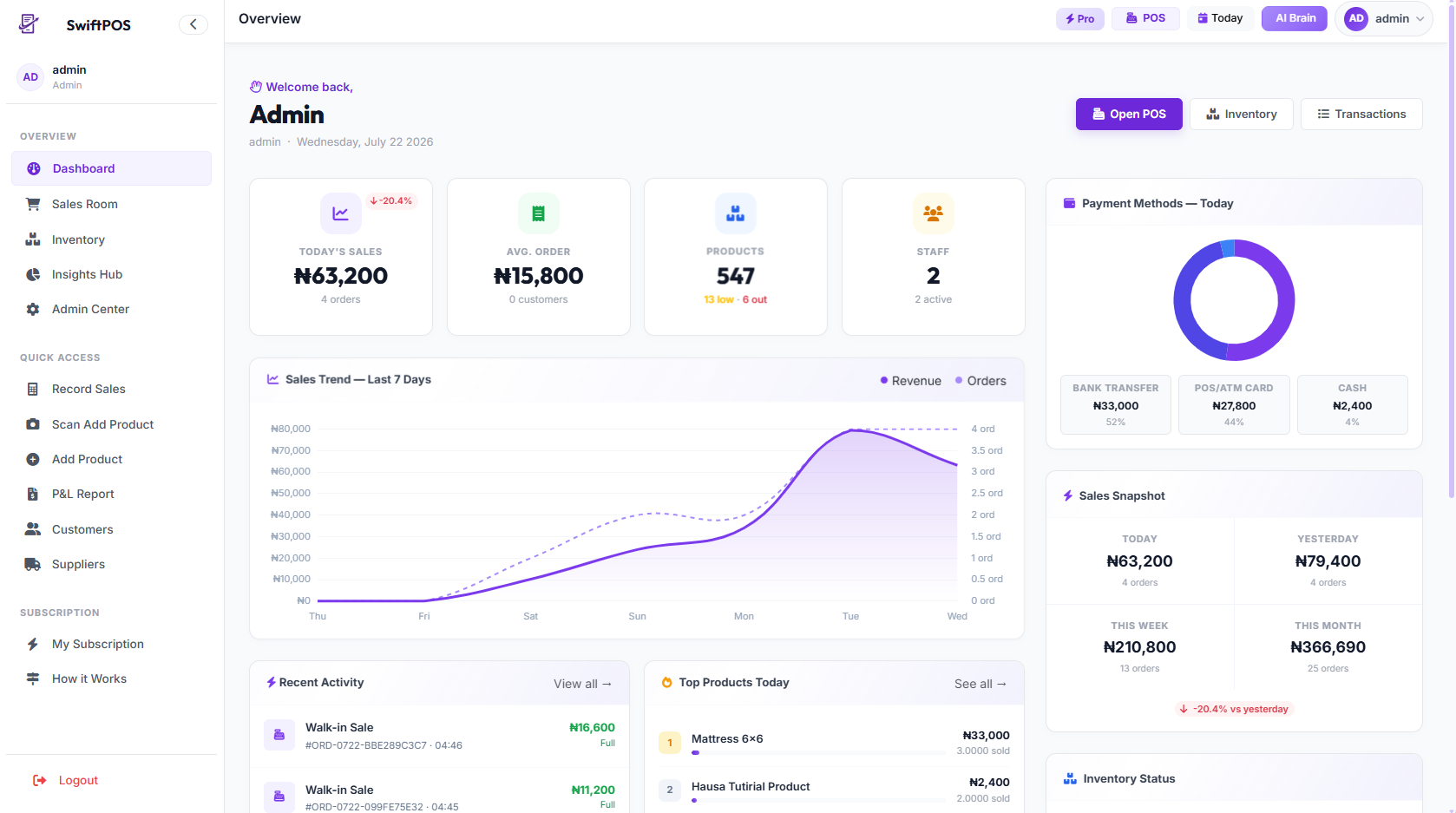 A SwiftPOS dashboard showing sales and inventory data with analytics.
When you're dealing with hundreds or thousands of products, especially in a busy supermarket or a chain of pharmacies, manual tracking of product pricing is simply impossible. SwiftPOS allows you to manage products and stock efficiently, ensuring your pricing strategy is consistently applied and monitored.
The Numbers That Will Make or Break You
Let's talk real money, the kind that determines if your business thrives or just barely survives. Understanding your total investment and ongoing costs is paramount for effective retail pricing.
Startup Costs (Initial Investment)
Before you even sell your first item, you'll incur costs. These aren't monthly, but they're significant.
- Initial Inventory Purchase: This is your biggest outlay. If you're starting a small provision store, you might stock up with ₦500,000 - ₦2,500,000 worth of goods from a wholesaler in Onitsha. For a boutique, it could be ₦800,000 - ₦4,000,000 for a curated collection.
- Shop Setup/Renovation: From painting to shelving, this could range from ₦50,000 for a simple kiosk to ₦1,500,000 for a well-fitted mini-mart.
- Equipment: POS system hardware (scanner, printer, cash drawer), a computer, AC, generator, CCTV. Budget ₦150,000 - ₦750,000. For a complete guide on hardware, check out Complete POS Hardware Setup for Supermarkets.
- Legal/Registration: Business name registration, local government permits. Expect ₦30,000 - ₦100,000.
- First Quarter Rent: Landlords often demand 1-2 years' rent upfront. If your annual rent is ₦900,000 (₦75,000/month), you might pay ₦1,800,000.
Monthly Running Costs (Operating Expenses Revisited)
We touched on this, but let's consolidate. These are the expenses you must cover every single month.
- Rent: ₦7,000 - ₦180,000 (as discussed, depending on location and size).
- Staff Salaries: ₦40,000 - ₦85,000 per staff. If you have 3 staff, that’s ₦120,000 - ₦255,000.
- Electricity/Fuel: ₦3,000 - ₦30,000.
- Restocking Inventory: This is variable, but you'll constantly be buying new stock. This isn't a cost per se, but cash outflow.
- Marketing: ₦2,000 - ₦50,000.
- Miscellaneous: ₦1,000 - ₦10,000.
- Software Subscriptions (like SwiftPOS): These are usually a fixed monthly cost, often a fraction of what you save in efficiency. Check out SwiftPOS pricing.
> "Many Nigerian businesses fail not because they don't make sales, but because they don't understand their true costs. You can't price right if you don't know what you're truly paying."
Expected Revenue Timelines
Don't expect to turn a massive profit in your first few months. The first 6-12 months are often about breaking even and building a customer base.
- Break-even Point: This is when your total revenue equals your total costs. For many small retailers, this can take 6-18 months.
- Profitability: Consistent, healthy profits usually start after the break-even point, once your brand is established and your operational kinks are ironed out.
Growth After Launch: The Next 90 Days
You've launched, you're selling, and you've got your initial prices set using a solid strategy. Now what? The first 90 days post-launch are crucial for refining your retail pricing and understanding market response.
- Monitor Sales Data Closely: Which products are flying off the shelves? Which are gathering dust? Are customers reacting well to your prices? Pay attention. Tools like SwiftPOS give you detailed reports, showing you exactly what's performing. This data is gold for making informed adjustments.
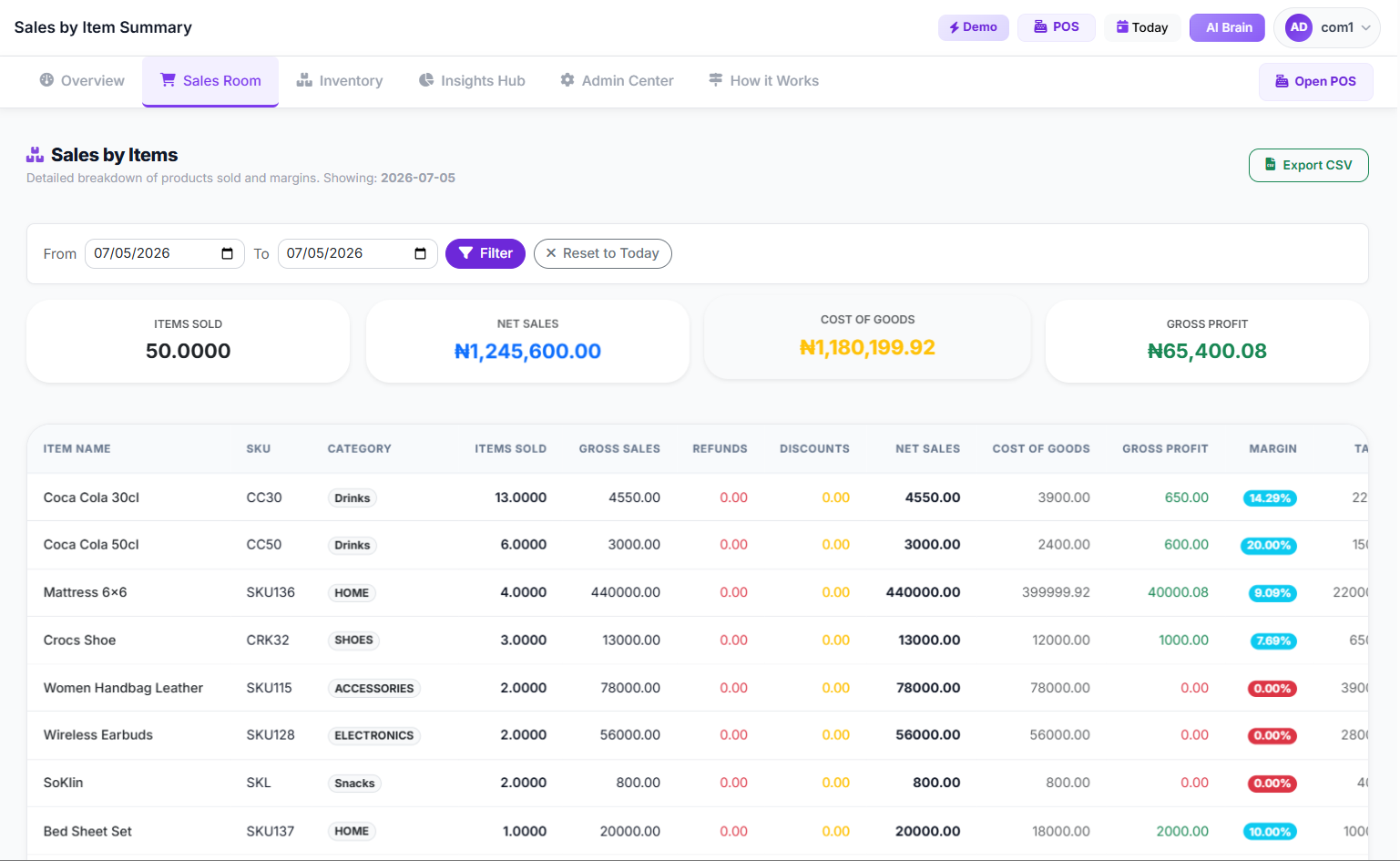 sales by item
- Gather Customer Feedback: Ask customers directly. Why did they buy? Was the price fair? What would they like to see? Don't be afraid to engage. A simple conversation at the counter can reveal a lot.
- Track Your Actual Profit Margins: Remember that desired profit margin? Now, with real sales data and recorded expenses, you can see your actual profit. SwiftPOS provides a clear , showing your gross and net profit after all expenses. If your actual margins are consistently lower than your desired ones, you either need to:
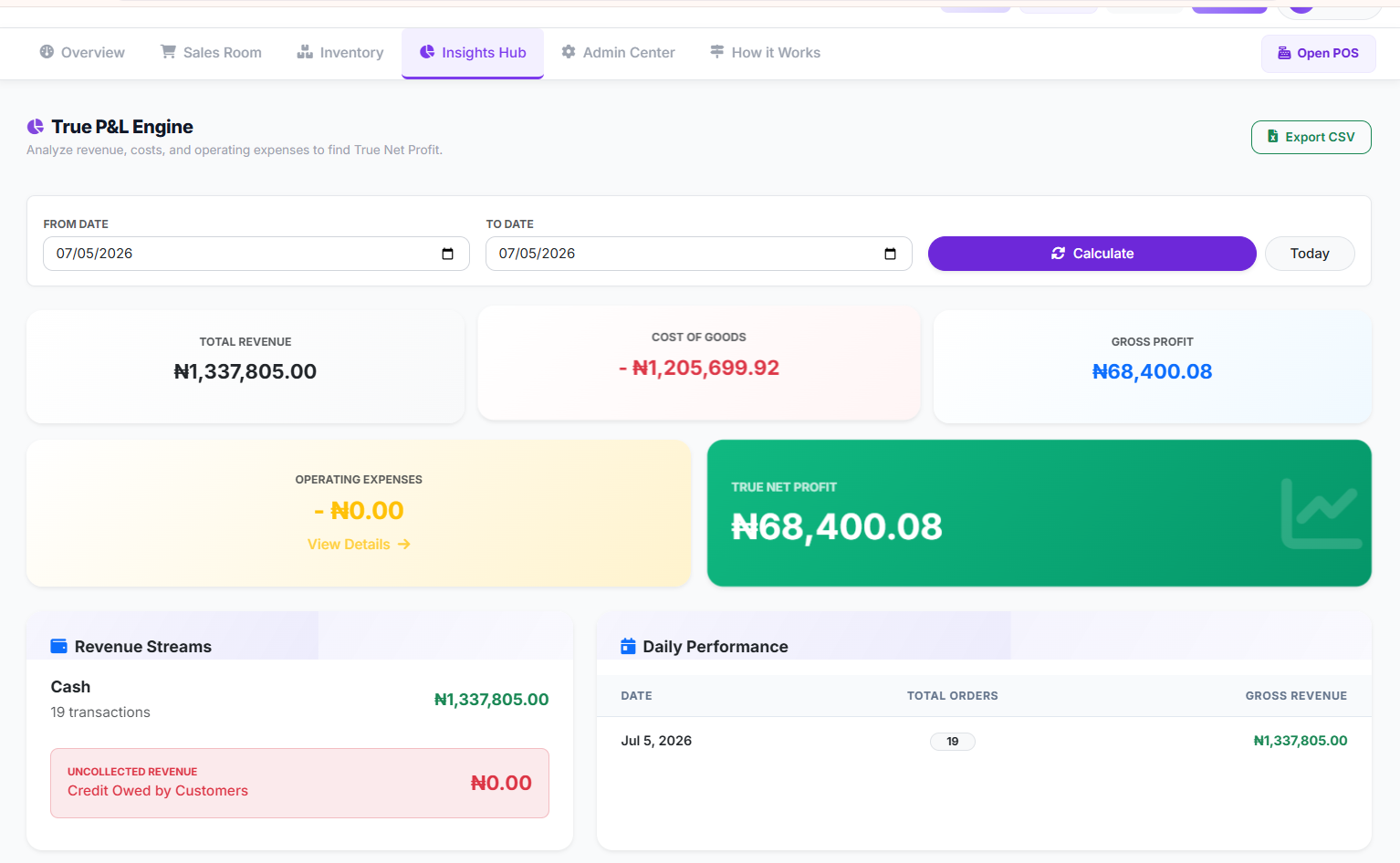 Profit and Loss Page
- Increase your prices (if the market can bear it).
- Reduce your costs (negotiate with suppliers, find cheaper transport).
- Increase your sales volume.
- Re-evaluate your product mix.
- Adjust Pricing Strategically: Don't be afraid to make small, data-driven adjustments. If a product with a 30% margin is selling incredibly fast, perhaps you can push it to 32% or 35% and see if sales dip. If a slow-mover has a high margin, consider a small discount to move it faster, or even a bundle deal. This continuous optimization is key to maximizing your overall profitability. For more on this, check out 7 Revenue Leaks: Mistakes Costing Nigerian Retailers Thousands (and How to Fix Them).
- Manage Inventory Levels: Pricing is intimately linked with inventory. Overstocking ties up capital and incurs storage costs. Understocking means lost sales. SwiftPOS has a that can estimate when stock might run out based on sales velocity. This helps you make smarter purchasing decisions, which in turn impacts your unit cost and ultimately, your selling price. For more on this, read How to Predict When Products Will Run Out of Stock in Nigeria.
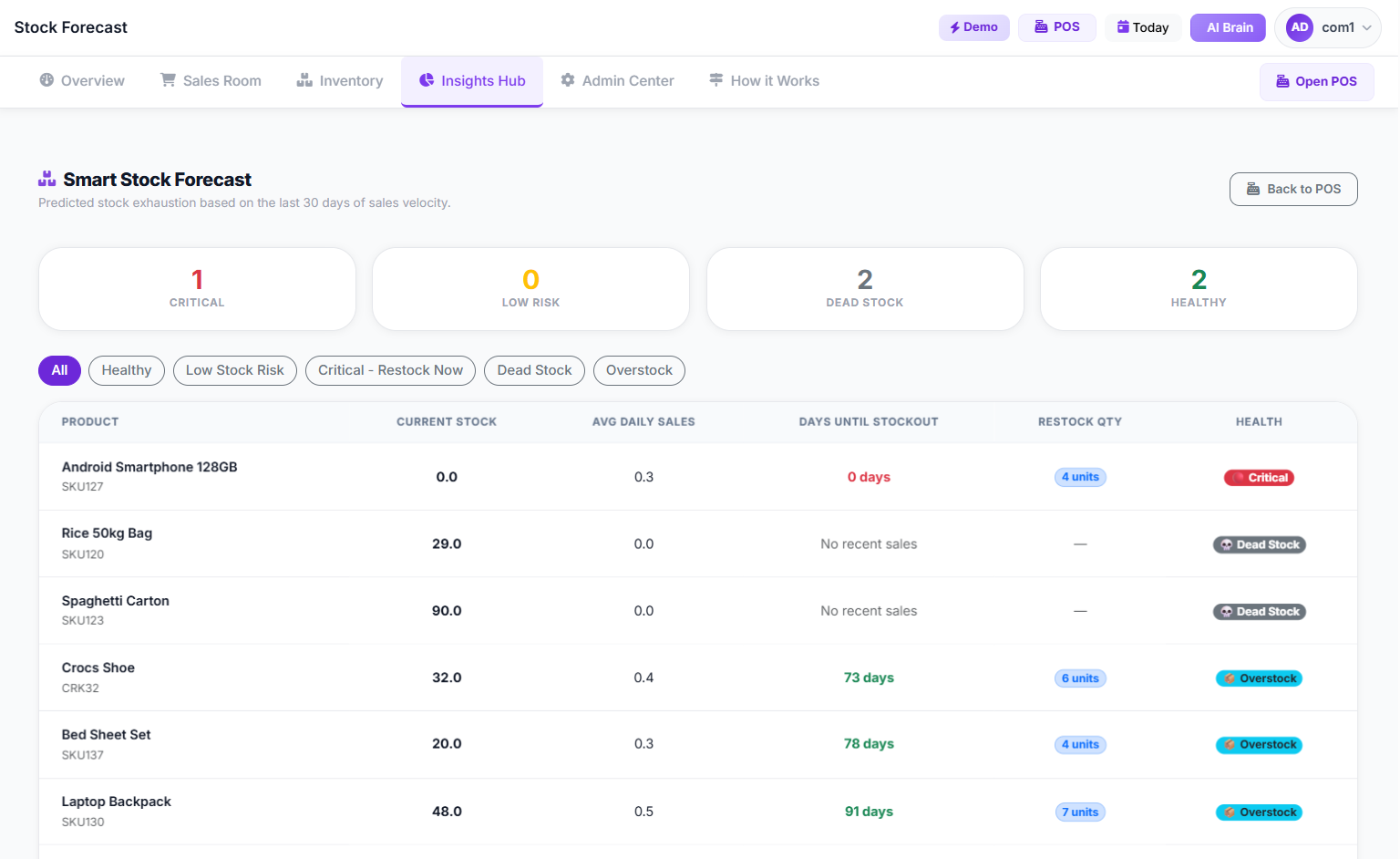 Smart Stock Forecast Page
 A busy cashier in a modern nigerian supermarket
FAQ: Answers to What You're Actually Googling
Q1: How do I handle pricing for wholesale vs. retail customers?
A: This is a common challenge, especially for businesses in markets like Aba. You need to have two distinct pricing structures. First, calculate your standard retail selling price using the steps above. Then, for wholesale, you'll offer a lower price, but typically require a minimum purchase quantity.
For example, if your retail price is ₦19,925, your wholesale price might be ₦16,500 for a minimum of 10 items. The key is to ensure both prices cover your costs and offer a profit, even if the wholesale margin is smaller due to volume. SwiftPOS allows you to set wholesale prices and minimum quantities directly in the product catalogue, so the system automatically applies the correct pricing during sales.
Q2: What if my calculated selling price is too high for the market?
A: This is a tough spot, but it happens. If your calculated price (which covers all your costs and desired profit) is significantly above what competitors charge or what customers are willing to pay, you have a few options:
- Re-evaluate your costs: Can you find a cheaper supplier? Reduce transportation costs? Negotiate lower rent? This is often the most impactful solution.
- Reduce your desired profit margin: If your costs are fixed, you might need to accept a slightly lower profit per unit to remain competitive. This means you'll need to sell more units to reach your overall profit goals.
- Differentiate your product/service: Can you add value? Better customer service, unique packaging, or a superior product can justify a higher price.
- Target a different market segment: Maybe your product is for a more premium customer who will pay the higher price.
Q3: How often should I review my product pricing?
A: In Nigeria's economy, with fluctuating exchange rates and fuel prices, you should review your pricing at least quarterly, or whenever there's a significant shift in your cost of goods or operating expenses. For fast-moving items, you might even do it monthly. The goal isn't to constantly change prices, but to be aware if your current prices are still profitable. Using a system that tracks your true net profit, like SwiftPOS, makes these reviews much easier and more accurate.
Q4: Does the "selling price calculation" change if I have multiple branches?
A: The core principles remain the same, but the calculation becomes more complex. Your operating expenses (rent, staff, electricity) will be specific to each branch, so the "Total Monthly Operating Expenses / Estimated Monthly Sales Volume" portion might vary per location. You might even have different pricing strategies for different branches if they cater to different demographics (e.g., a branch in Ikoyi versus one in Iyana-Ipaja).
A good multi-branch retail management system like SwiftPOS allows you to track stock, sales, and expenses separately for each branch, giving you the granular data needed to fine-tune pricing for every location.
Q5: What role does technology play in setting the right selling price?
A: A massive role! Manual calculations are tedious and prone to human error. Trying to factor in all your costs across hundreds or thousands of products manually is a nightmare. Technology, specifically a robust POS and inventory management system, automates much of this.
- It tracks your COGS accurately.
- It records all your operating expenses.
- It gives you real-time sales data to estimate volume.
- It calculates your true profit margins after every sale.
- It highlights slow-moving or highly profitable items.
Ready? Here's Where to Start
Calculating your product selling price isn't just an academic exercise; it's the heartbeat of your retail business's profitability. It requires diligence, honest accounting, and the right tools. Stop leaving money on the table or, worse, losing it without knowing.
Take the first step today. Start by gathering your actual cost data – every single naira spent, from wholesale purchases to the smallest miscellaneous fee. Then, consider how a system like SwiftPOS can streamline this entire process for you, giving you clarity and control over your pricing and profits. You can set up your free 14-day trial and explore its features to see how it can transform your business.
To get started with setting up your account, check out our step-by-step onboarding guide for Nigerian retailers. Your business deserves to be profitable, and it all starts with setting the right price.
Written by SwiftPOS Team
Practical guides from the retail specialists at Nura Mustapha Technologies Limited, for modern Nigerian merchants.