10 Best Retail POS Systems for 2026: Unbiased Reviews & Expert Picks
SwiftPOS Team
Published September 27, 2026
Are you tired of juggling ledgers, struggling with manual stock counts, and losing track of sales across your retail shop? Many Nigerian business owners find themselves stuck in a cycle of inefficiency, missing out on profits because their current systems can't keep up with the demands of 2026. This frustration is common, but it doesn't have to be your reality.
Vibrant nigerian market scene with a shop ownerThe Hidden Costs of Outdated Retail Operations
In Nigeria's dynamic retail landscape, sticking to manual or spreadsheet-based operations in 2026 isn't just inefficient—it's actively costing you money. Think about the hours spent on tedious inventory checks, the errors in handwritten sales records, and the sheer lack of real-time insight into your business performance. These aren't minor inconveniences; they are significant drains on your profitability and growth potential.
Consider the impact of inaccurate inventory. Without a clear picture of what's in stock, you risk overstocking slow-moving items, tying up valuable capital, or worse, running out of popular products, leading to lost sales and disappointed customers. A recent study indicated that Nigerian retailers using manual inventory methods lose an average of ₦50,000 to ₦200,000 monthly due to stock discrepancies and missed sales opportunities alone. For a deeper dive into these issues, explore the hidden costs of manual retail operations in Nigeria.
Beyond inventory, there's the challenge of managing staff and preventing revenue leaks. Manual systems make it difficult to track individual sales performance, identify suspicious activities like excessive voids or discounts, or even ensure cashiers are accounting for all transactions. These issues can chip away at your profits, sometimes unnoticed for months. Understanding these 7 Revenue Leaks is crucial for any business owner looking to protect their bottom line.
 Business owner looking frustrated at a stack of
Why Traditional Methods Fall Short in 2026
The market today demands speed, accuracy, and data-driven decisions. Traditional bookkeeping and simple cash registers, while familiar, simply cannot provide these.
Lack of Real-time Data
Manual systems offer delayed insights. You only know your sales performance or stock levels days or weeks after the fact. In a competitive market, this delay means missed opportunities to restock popular items, adjust pricing, or identify sales trends. Imagine a supermarket owner in Lagos finding out about a stockout of a fast-moving consumer good days after it happened, when customers have already gone to a competitor. This directly impacts sales and customer loyalty.
Prone to Errors and Fraud
Human error is inevitable with manual entries. A misplaced decimal, a forgotten transaction, or an intentionally hidden void can lead to significant financial losses. Furthermore, without digital records and audit trails, it's challenging to detect and prevent internal theft or fraud. This is a common concern for many Nigerian retailers, and understanding how to stop losing money with a POS system is vital.
Inefficient Customer Management
Building customer loyalty is key to sustained growth. Manual systems make it nearly impossible to track customer purchase history, offer personalized discounts, or manage customer credit effectively. This results in generic customer interactions and missed chances to foster repeat business.
Scalability Challenges
As your business grows, manual systems become a bottleneck. Expanding to multiple branches, managing a larger inventory, or hiring more staff exponentially increases the complexity and potential for errors. Trying to manage multi-branch retail operations with paper records is a recipe for chaos, as highlighted in our guide to seamless multi-branch operations.
The Smarter Approach: Integrated Retail Management
The solution lies in adopting an integrated retail management system, commonly known as a Point-of-Sale (POS) system. These aren't just cash registers; they are comprehensive platforms designed to streamline every aspect of your retail operations. A modern POS system goes beyond processing transactions; it integrates sales, inventory, customer management, staff performance, and financial reporting into one cohesive unit.
This integrated approach provides real-time data, reduces manual errors, enhances security, and empowers you to make informed decisions quickly. For instance, instead of manually checking shelves, you can see exactly how many units of a product you have across all branches, identify low-stock alerts, and even forecast future demand. This shift from reactive to proactive management is a game-changer for profitability. Our article on AI vs. Traditional Inventory further explains the benefits of this modern approach.
How SwiftPOS NG Transforms Your Retail Business
SwiftPOS is a comprehensive business management and Point-of-Sale (POS) platform built specifically for Nigerian retailers. It moves you beyond the limitations of manual systems by connecting every critical aspect of your business—sales, inventory, customers, staff, expenses, and profits—into one easy-to-use system. It's more than just a checkout tool; it's your central hub for managing your entire retail operation.
With SwiftPOS, you can:
- Process Sales Efficiently: Use intuitive interfaces like the Classic POS for fast product searching or the Barcode POS for high-volume scanning, ensuring quick customer checkout times. The system also supports various payment methods, including cash, card, bank transfers, and mobile money, with options for split payments.
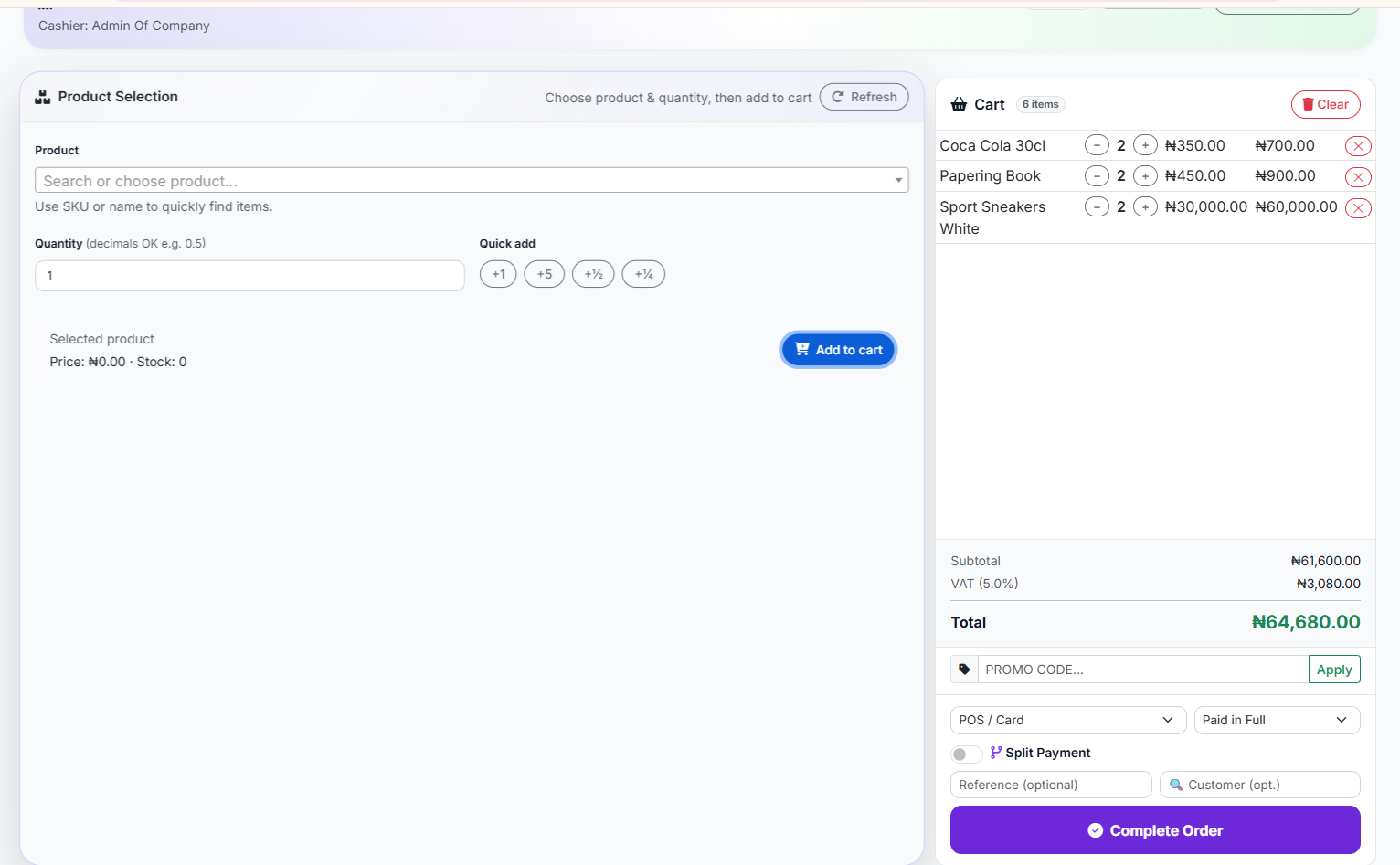 Classic POS Interface (List select)
- Master Your Inventory: SwiftPOS provides robust inventory management features. You can track products by name, category, cost, selling price, and even expiration dates. It handles fractional quantities, supports wholesale pricing, and allows you to create and print your own barcode labels. For businesses with multiple locations, it can track stock separately across branches and even manage a central warehouse with unit conversion capabilities. This eliminates the guesswork and helps you avoid costly stockouts or overstocking, a common pitfall for Nigerian retailers as discussed in Inventory Management Mistakes Crushing Your Profits.
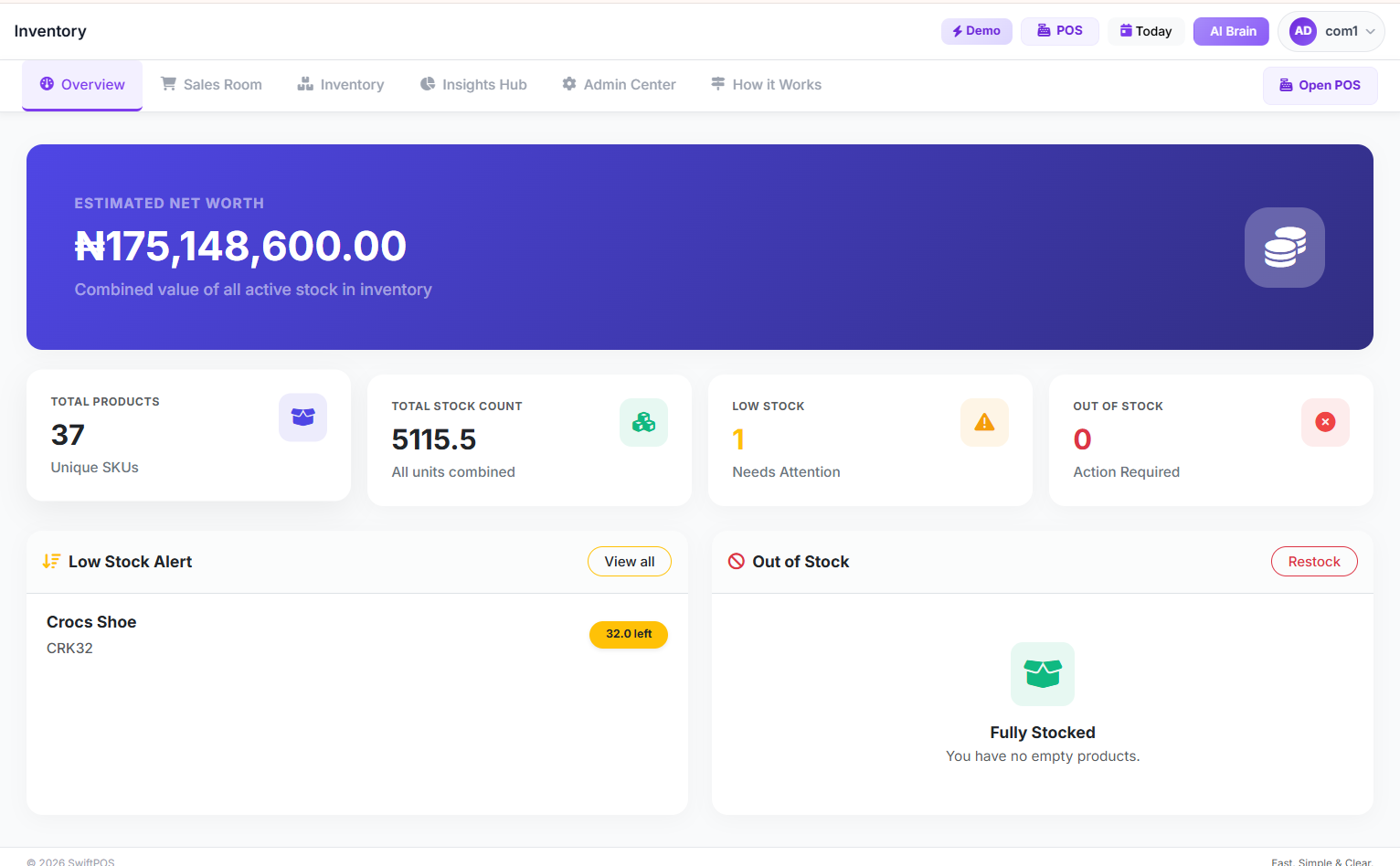 Inventory Dashboard
- Gain Deep Business Insights: Beyond sales, SwiftPOS helps you understand your true profitability. It tracks expenses, calculates gross and net profit, and provides business insights into sales trends, product performance, and staff activity. This data empowers you to make informed decisions that drive growth. For insights into key retail metrics, check out 7 Key Retail Metrics Nigerian Businesses Must Track for Profit Growth.
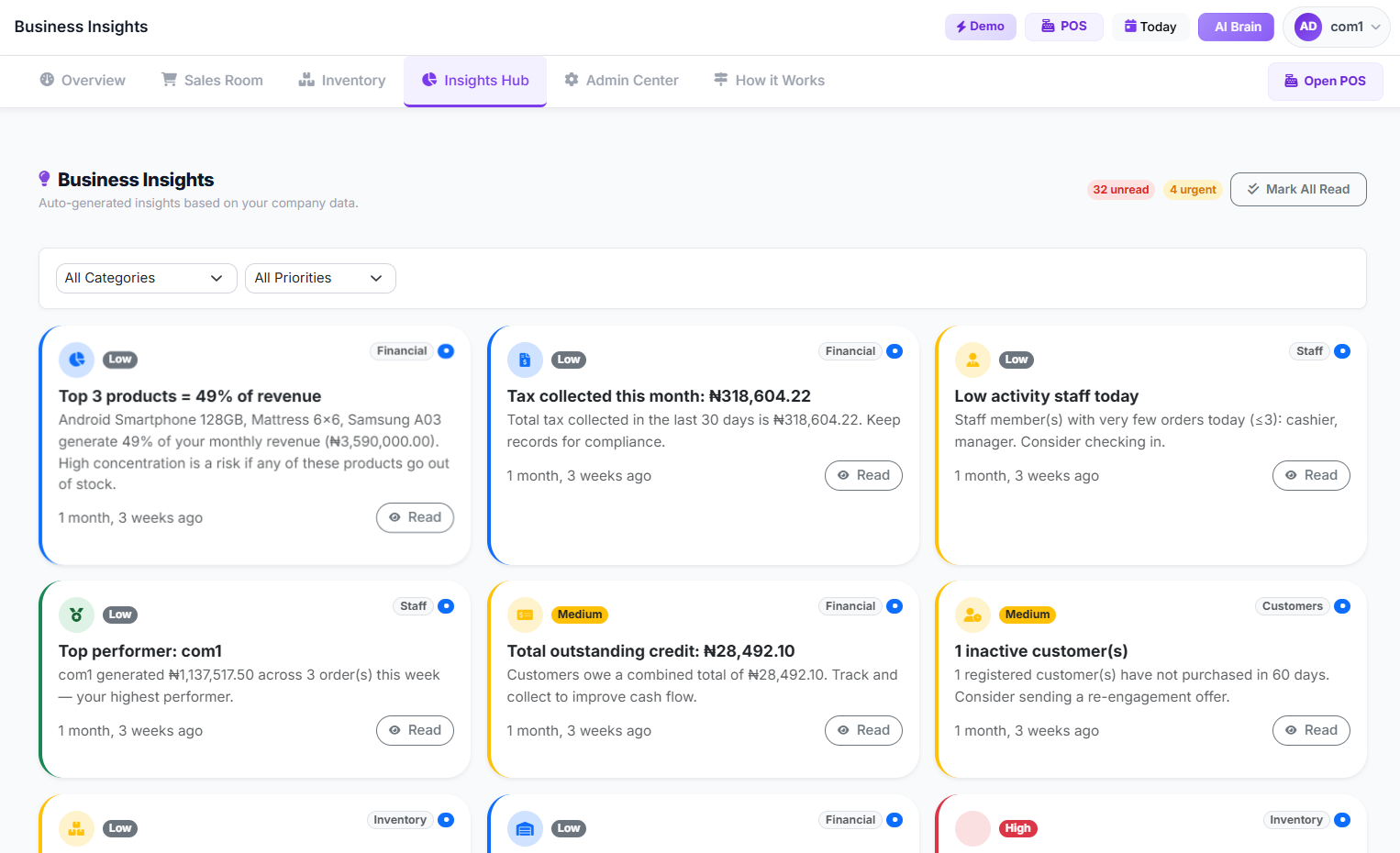 Business Insights Page
- Enhance Staff Control and Security: Manage staff roles and permissions, ensuring cashiers only have access to what they need. SwiftPOS records staff activity and can even flag suspicious patterns like unusual discounts or excessive voids, giving you peace of mind. Learn more about setting staff access permissions.
These capabilities make SwiftPOS one of the best retail POS systems available in Nigeria, offering a holistic solution to manage and grow your business efficiently.
Proof: Side-by-Side Comparison
Let's look at how an integrated POS system compares to traditional retail management methods.
| Feature / Aspect | Traditional Methods (Manual/Spreadsheets) | Modern Integrated POS System |
|---|---|---|
| Sales Processing | Slow, manual calculations, prone to errors, limited payment options. | Fast, accurate, supports multiple payment types (cash, card, transfer, mobile money), split payments. |
| Inventory Management | Manual stock counts, delayed updates, high risk of stockouts/overstocking, difficult across branches. | Real-time stock tracking, automated alerts, expiry date management, multi-branch inventory, central warehouse support. |
| Customer Data | Handwritten ledgers for credit, no purchase history, generic interactions. | Digital customer directory, credit management, purchase history for loyalty, personalized offers. |
| Reporting & Insights | Basic sales totals, difficult to calculate true profit, no performance trends. | Detailed sales reports, gross & net profit analysis, expense tracking, staff performance, business insights, stock forecasting. |
| Staff Management | Limited oversight, difficult to track individual performance or suspicious activity. | Role-based permissions, manager approvals for sensitive actions, activity logs, suspicious activity flagging. |
| Scalability | Extremely difficult to expand to multiple locations, increased error rate. | Easily scalable to multiple branches and warehouses, centralized management. |
| Cost Efficiency | Hidden costs from errors, fraud, lost sales, and excessive manual labor. | Reduces errors, prevents losses, optimizes inventory, saves labor costs, provides data for profit growth. |
| Offline Capability | N/A (requires physical records). | Important POS operations can continue offline and sync when internet is available. |
| Setup & Ease of Use | Relatively easy to start (paper/pen), but complex to maintain and scale. | Initial setup requires configuration, but daily use is intuitive and efficient. |
Frequently Asked Questions
What hardware do I need for a modern POS system in Nigeria?
To set up a modern POS system, you'll typically need a tablet or dedicated POS terminal, a thermal receipt printer, a barcode scanner, and a cash drawer. The cost can range significantly. A basic Android tablet and stand might cost ₦40,000 - ₦120,000, while a dedicated terminal could be ₦150,000 - ₦450,000. Thermal receipt printers are usually ₦25,000 - ₦70,000, and barcode scanners ₦15,000 - ₦60,000. Cash drawers are typically ₦10,000 - ₦30,000. For a complete breakdown, see our guide on POS hardware setup for supermarkets.
How much does a POS software subscription cost in Nigeria?
POS software subscriptions vary based on features and provider. For basic software suitable for a small shop, expect to pay between ₦5,000 - ₦15,000 per month. More advanced systems for mid-sized or multi-branch operations can range from ₦20,000 - ₦60,000 monthly. Some local developers offer one-time license fees from ₦80,000 - ₦250,000. Don't forget to factor in monthly internet data costs for cloud-based systems, which can be ₦5,000 - ₦15,000. You can review different pricing plans for specific details.
Can a POS system work without an internet connection?
Yes, many modern cloud-based POS systems, including SwiftPOS, are designed with offline capabilities. This means you can continue to process sales, manage inventory, and handle other critical operations even when your internet connection is down. Transactions are typically stored locally and then synchronized to the cloud once connectivity is restored. This ensures your business never stops, a crucial feature for businesses in Nigeria. Learn more about POS systems working without internet.
How difficult is it to set up and learn a new POS system?
Setting up a new POS system usually involves importing your product data, configuring settings like VAT rates and payment methods, and training your staff. While it might seem daunting, most modern POS providers offer clear onboarding processes and tutorials. For instance, our step-by-step onboarding guide helps Nigerian retailers get started quickly. Many systems are designed to be intuitive, reducing the learning curve for staff.
Is a POS system truly necessary for a small provision store or mini-mart?
Absolutely. Even small businesses benefit immensely from POS systems. They help prevent losses from errors, provide accurate stock control, save time on manual tasks, and offer insights that can help you grow. For a provision store, features like expiry date tracking and customer credit management are invaluable. It's about moving from basic cash registers to a tool that offers a complete overview of your business, as explained in our guide on how to start a profitable provision store.
Ready to transform your retail operations and unlock your business's full potential? Explore how a powerful, integrated POS system can streamline your sales, optimize your inventory, and provide the insights you need to thrive in 2026.
Start your free trial today and experience the difference SwiftPOS can make for your business!
7 Best Retail POS Systems for Small Businesses in 2026…
Sep 27, 2026
How to Start a Clothing Business in Nigeria: A Step-by…
Sep 26, 2026
How to Reduce Supermarket Checkout Lines (Without Hiri…
Sep 24, 2026